05.07.26
GMA Insights | Harnessing Green Demand to Drive Sustainable Chemicals Production
Our latest GMA Insights installment is a co-authored article by GMA’s Andrew Alcorta and RMI’s Brianne Cangelose.
Chemicals play a critical, though often overlooked, role in modern society. They provide many of the key building blocks for the construction industry, support agriculture by increasing crop yields, and offer novel materials for a range of products from automobiles to new energy technologies. In fact, chemicals are everywhere, present in 96% of manufactured goods, including 75% of the energy technologies that will be needed to navigate the energy transition.
While chemicals are deeply embedded in modern society, it is equally important to acknowledge the challenges they pose. Among these are the need to reduce reliance on fossil inputs, develop better end-of-life management for chemical products, and lower emissions even as production is projected to grow up to 43% by 2050. More effort is needed across all these fronts, but addressing the 2 billion metric tons — or roughly 5% of global greenhouse gas emissions — from chemical production annually requires particularly urgent action given the long timelines to commercialize new production methods.
Despite these challenges, technologies are emerging to enable low-emissions chemicals production. While many of these technologies show technical promise, few have moved beyond the pilot or early demonstration phase. Scale-up of these technologies is often not held back by technical feasibility so much as by commercial barriers, including uncertainty about demand for low-emissions products and risk-aversion among participants spread across long and complex chemicals value chains.
Clear demand signals from companies that use chemicals in their products and novel mechanisms to bridge chemicals value chains are critical to overcoming these roadblocks and unlocking investment. The Center for Green Market Activation (GMA) and RMI are actively working to establish demand signals by aggregating buyers of low-emissions chemicals and by developing a book and claim system to enable chemical producers to transact directly with downstream companies that have committed to lowering supply chain emissions and are willing to pay a premium to do so.
The Challenge of Decarbonizing Chemicals Production
Scaling low-emission technologies in the chemicals sector is uniquely challenging. Chemical production assets are highly capital-intensive, with investment horizons that span decades. Existing plants, many of which are fully depreciated and can produce at a low marginal cost, leverage processes that have been optimized over many years and produce at enormous scale. The result is constant cost pressure that reinforces the competitiveness of conventional production methods. As a result, even when low-emission alternatives exist, buyers and suppliers alike often default to the legacy status quo.
The diversity of chemical products — and the resulting complexity of value chains required to produce them — results in an additional challenge. Unlike other industries with relatively standardized products, the chemical sector encompasses thousands of molecules, intermediates, and derivatives. This often results in long value chains with multiple layers of intermediaries separating a primary chemicals producer, generally responsible for the majority of emissions, from the better-known companies at the end of the value chain that have made net-zero commitments and are closer to consumer demand. In the middle are specialized producers of intermediate chemicals or products that often operate with thin margins and limited visibility.
In this environment, intermediate producers operating with thin margins have few incentives to source lower-emissions, higher-cost inputs unless they have certainty that their customers are willing to pay an equivalent price premium. The result is an enormous coordination challenge. Multiple parties within a value chain must simultaneously close both procurement and offtake contracts at a material premium to market prices. And all of this needs to occur at a volume that gives the primary chemical producers certainty that customers will pay a premium for most of their output over an extended time horizon. While this may be possible in rare cases where large buyers directly purchase from primary chemical producers, it will be all but impossible in most chemical value chains.
Leveraging Novel Mechanisms to Catalyze Investment
Breaking the deadlock requires both credible demand for low-emissions chemical products and mechanisms to bridge companies across long, complex value chains. GMA and RMI believe that two critical interventions, pursued in tandem, have the potential to address these challenges and unlock investment in low-emissions chemical production: demand aggregation and book and claim.
Demand aggregation is the first necessary intervention. As in many industrial sectors, low-emissions production will come at a price premium, particularly given that novel technologies often operate at small scale and with less historical process optimization than their fossil-intensive counterparts. While new technologies have the potential to decrease costs as they scale, the ability to achieve initial traction in highly price-sensitive markets is often a challenge for these production methods. The presence of buyers willing to purchase at a premium is a critical proof point for projects seeking capital to invest in low-emissions production.
But why is it necessary for multiple buyers to act together in order to provide this proof point? Because chemical assets operate at such a significant scale and because their lifetimes are so long, the purchasing volume required to unlock investment in a new facility can be enormous. By pooling demand, multiple buyers can provide the necessary volume to support an investment decision, thereby decreasing the cost and risk that any individual company would otherwise have to take on.
In cases where physical offtake of low-emission chemicals is constrained, book and claim systems provide a mechanism to aggregate larger demand volumes through the use of Environmental Attribute Certificates (EACs). Under this chain of custody approach, chemical producers generate an EAC for each unit of low-emission product, such as a ton of ethylene, that reflects the reduced emissions intensity associated with production. This certificate is then sold separately from the physical product, which continues through the value chain as a traditional commodity with a baseline emissions intensity. This separation enables chemical producers to receive revenue from EAC sales to cover the premium associated with low-emission production, providing the financial certainty needed to finance capital-intensive projects. At the same time, buyers gain verifiable, traceable progress toward climate commitments through certificates that are independently verified and tracked through a registry system.
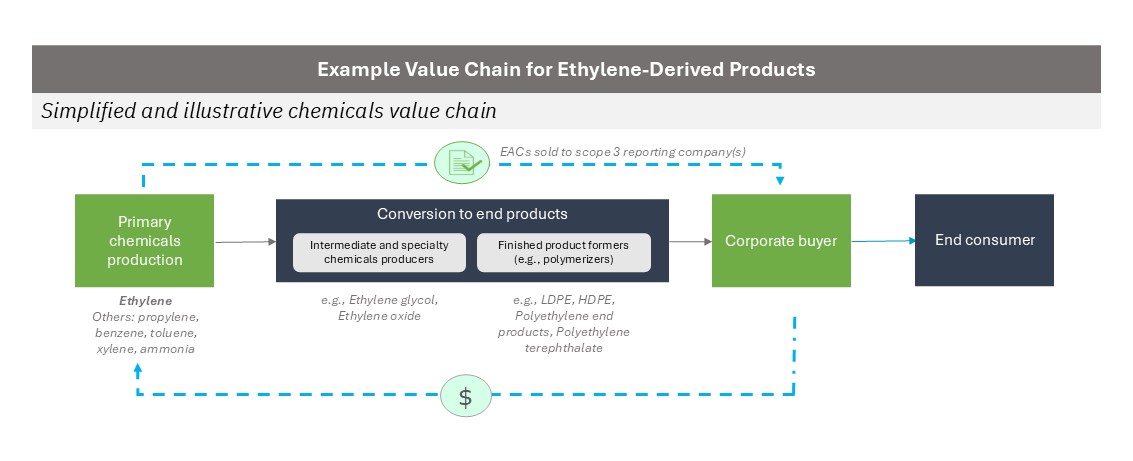
The result is three benefits that can dramatically alter the viability of low-emissions production:
- 1: Value Chain Bridging: Perhaps the most significant impact of book and claim systems is the ability for interested parties to transact efficiently. By enabling standardized transactions between downstream brands willing to pay for value chain decarbonization and upstream producers that most heavily influence emissions, the challenge of aligning multiple intermediaries around price and volume in complex value chains can be avoided.
- 2: Geographic Aggregation: Book and claim provides an additional benefit, particularly in the early innings of the net-zero transition when access to low-emissions products remain limited. Creating an EAC distinct from the physical product means that a producer is no longer constrained to finding customers willing to pay a premium for a low-emissions product near its production plant. Instead, they can sell the physical product locally at commodity prices and cover the green premium by selling an EAC to any downstream user of the product, regardless of geography.
- 3: Product Aggregation: By focusing a book and claim system on high value chemicals, a third benefit can be realized. A traditional demand aggregation approach would need to find buyers procuring identical products. However, book and claim enables demand aggregation across any product that contains a particular molecule. For example, demand for low-emissions ethylene can be aggregated across apparel companies using polyester for textiles, pharmaceutical companies sourcing polyethylene for syringes, and personal care companies using multiple types of plastic for everyday household goods. By focusing on a common and consistent upstream input, substantially more demand can be aggregated and transacted in a single procurement.
Given the immense challenges associated with decarbonizing chemical production, leveraging novel mechanisms to catalyze investment in low-emissions production will be essential. Combining demand aggregation with book and claim in the form of a buyers alliance for EACs offers a unique opportunity to reduce risk for both buyers and suppliers, while driving real investment decisions.
GMA and RMI’s Low-Emissions Chemicals Initiative
An emerging initiative from GMA and RMI to procure low-emissions high value chemicals leverages these approaches to tackle emissions in the chemicals sector. Multiple downstream brands that use chemicals in their products have come together to procure environmental attributes for low-emissions ethylene, with plans to expand this approach to other molecules in the future. In the process, they will provide demand certainty for low-emissions projects while simultaneously finding a pathway to address upstream Scope 3 emissions that had previously been out of reach due to complex, multi-tiered value chains.
Prior efforts from GMA and RMI to pool advanced commitments for low-emissions products in heavy industry sectors have demonstrated how aggregated demand can generate confidence for suppliers and investors. Sectoral buyers alliances such as the Sustainable Aviation Buyers Alliance (SABA), managed by Environmental Defense Fund, GMA, and RMI, have shown how standardized frameworks and collective purchasing can accelerate the deployment of next-generation technologies. Launched in 2021, this effort has evolved from one-year advanced commitments to purchase bio-based sustainable aviation fuel (SAF) to a scaled marketplace and targeted 5+ year offtakes at scale for next generation fuels.
Without credible demand signals and effective mechanisms to translate that demand into firm offtake agreements, the transition will stall. GMA and RMI are working to bring these pieces together—aggregating demand and developing mechanisms to more efficiently enable offtake—to ensure that novel pathways to produce low-emission chemicals are developed. Together with active engagement from buyers and support from the broader ecosystem, these actions can provide the demand certainty needed to unlock investment and enable the chemical sector to accelerate its transition to a net-zero future.
If you are interested in learning more about the GMA-RMI low-emissions chemical procurement that was spotlighted in this article please reach out to chemicals@gmacenter.org.
Related News & Resources