10.07.26
Webinar | GMA Trucking Education Workshop 1
In this first session of GMA Trucking’s carrier education series, recorded on October 6, 2026, the GMA team explains how book and claim works, how it fits into greenhouse gas accounting, and how pairing it with demand aggregation can help carriers get more zero-emission heavy-duty trucks on the road.
A full transcript of the webinar is available below. Presentation slides can be accessed here.
The following transcript has been edited for legibility and clarity.
ANDRE DE FONTAINE:
Okay. Good morning, good afternoon to everybody. Thank you for joining us today for a webinar that GMA Trucking is hosting to give a little bit of background on book and claim and share some plans for future work. Jakob, if you could go to the next slide. Thank you.
So why are we doing this? We have set up a series of workshops, one-hour webinars, over the course of the next couple of months. As I think many of you know, GMA Trucking has been working on book and claim for zero-emission trucks along with our partners. We ran an RFP last year and had a successful pilot project, but we’re looking to grow and scale that effort. As part of that, we want to make sure that the community of carriers and the business partners you work with understand the system, have knowledge about it, and are prepared to participate when we launch our next procurement, which will be in 2027 — so next year. We’re running these workshops with that goal in mind.
Today is really about the basics: a 101 on book and claim and some accounting. Then we’re going to get progressively more specific in future workshops, covering accounting, claiming, additionality, et cetera, in more depth.
For today, as you can see on the agenda on screen, I will spend a few minutes teeing up the issues. I’ll then pass it over to my colleague Jakob, who will cover some accounting and the basics of book and claim, both in general and as it applies to this sector. Clayton will discuss the business case and the benefits this model can bring, especially when it’s combined with demand aggregation, which is what we also do. We’ll have a short discussion about next steps, and then we will open it up to Q&A. If things go well, we should have about 15 minutes of Q&A to answer any questions you might have.
Please drop your questions in the chat — that’s probably the most efficient way of getting them. We’ll hold the questions until the end to make sure we can get through all the content. If we end up with more questions than we can answer today, we have these future webinars coming up over the next couple of months, and we’ll make sure to answer whatever we weren’t able to get to then.
So, the team with me today. First of all — I should have probably done this at the beginning — my name is Andre de Fontaine. I’m a managing director at GMA, where I have the privilege of working with the rest of the team on our trucking program. A lot of that is led by Clayton Gerber, our senior manager, supported by Jakob Sanchez and Stacy McCluskey.
While she is not on the call today, Illina from the Smart Freight Centre has been a great partner throughout all of this, and you’ll definitely be seeing more of her in future webinars. She’s on a well-deserved holiday. In general, we’re working very closely with SFC to understand a number of different things, but especially how book and claim can be integrated into physical demand aggregation through efforts they’ve stood up, like ZET SCALE, which I’m sure many of you are aware of.
Let me give a little bit of background on GMA. I’m going to move through this quickly, because I think we’re all eager to get into the guts of the presentation.
Briefly, GMA — the Center for Green Market Activation — has been around for a couple of years, so we’re a relatively new NGO. We are focused on market-based and demand-side measures to decarbonize the hard-to-abate sectors, and you can see the sectors we’re active in running along the top. These are your traditional hard-to-abate sectors.
We go about this work in a couple of different ways that are complementary to one another. We design and build book and claim systems, often working with partners, often building on existing work, and sometimes building things relatively from scratch. But we are always borrowing lessons learned from the other sectors we operate in, to make sure there’s a consistent structure to this work and for efficiency gains.
We usually do the demand aggregation after the system is built, once we have a functioning book and claim system. Through this, we work with a group of committed buyers — this is what we did with GMA Trucking last year. We form a buyers alliance, and we run a competitive procurement process on their behalf. The idea is to send a larger demand signal to the market to help scale these technologies faster than if we were to rely on individual bilateral negotiations.
An important differentiator for GMA is that we run this process all the way through to contracting. We want to make sure that binding contracts are signed for the attributes so that the investments really do occur.
You can go to the next slide, Jakob.
I’m fairly certain that everybody on the call recognizes the imperative behind the work we all do. It is really important to get more electric trucks on the road as quickly as possible if we are to stay on track for long-term decarbonization objectives. The IEA says we need a little more than a third of all heavy-duty truck sales to be zero-emission by 2035 — less than 10 years away — if we want to stay on track for the 2050 goal.
At the moment, we are not really on track. In the US in particular, which is a major market for heavy-duty trucks, only about three-tenths of 1% of new heavy-duty truck sales are zero-emission. There’s reason to be optimistic that the curve will accelerate, but the current situation is still pretty minimal.
At GMA, we are focused primarily on heavy-duty trucks. All of the road freight sector — really, all of the road transport sector — needs to electrify, but we launched this program specifically to tackle heavy-duty trucks for two reasons. First, they are the hardest to decarbonize, and I think they need the most help. Second, you get the biggest bang for the buck. Heavy-duty trucks are a little less than 10% of the total US truck fleet, but they are responsible for close to half of all the emissions. So you can get some really significant emission savings by replacing a relatively small portion of those trucks.
When you do so, the benefits are significant and cut across a number of different categories. The emissions benefits are clear from what we just talked about, but you also have lower energy costs and lower maintenance needs. This is what allows these trucks to eventually reach cost parity.
In addition to the greenhouse gas emission savings, you also get reductions in localized air pollution, which improves public health, especially in communities that are already exposed to a lot of air pollution. Then, of course, there are the energy security benefits of reducing reliance on fossil fuels. And something we hear time and time again is that drivers just like these vehicles better. They’re new, it’s a smoother ride, it’s quieter. There are a lot of reasons to like these trucks. So the benefits are very real.
If you go to the next slide — they are being realized today, but not in a way that’s well distributed. We’re seeing great variance in the penetration rates of zero-emission heavy-duty trucks. China is really zooming ahead with transitioning its fleets to electric. The same cannot currently be said of the European Union and the United States.
When you look at the US, there’s a lot of unevenness across states, and it should be no surprise that the states with the most significant public incentives currently have, by far, the largest share of deployments, with California far and away the biggest concentration of electric heavy-duty trucks. So we think this is an opportunity for all of us, working together, to deploy more trucks in more locations across the country.
So that’s a little bit of background on where we are and where we hope to go. At this point, I’m going to turn it over to Jakob to talk more about book and claim and accounting.
JAKOB SANCHEZ:
Thank you, Andre.
Before diving into some of the accounting details, I think it would be really useful to zoom back out and look at the levers we have as a market to reach our ultimate end goals.
Historically, policy and incentive structures have helped overcome a lot of the early adoption barriers that much of the sustainability world faces. For trucking in particular, this has come in the form of California’s HVIP program, the Western Seaboard’s Low Carbon Fuel Standards, and utility make-ready electrification programs. These can be very supportive, but policy support is not uniform across the country, and it is also subject to change over time.
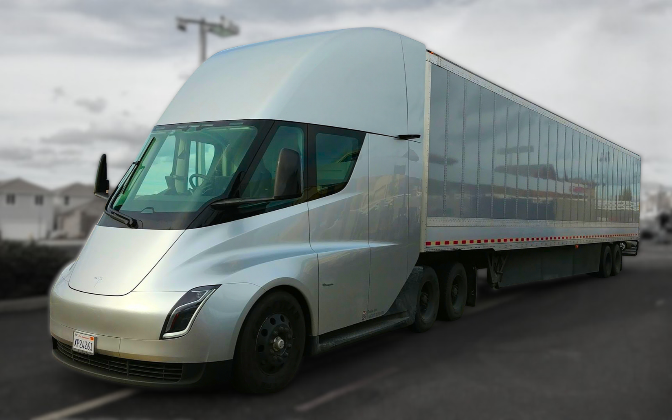
Looking ahead, we want to arrive at cost competitiveness. This is where the business case for low- and zero-emission vehicles really stands on its own merits. That could be supported through next-generation technology, such as the new Tesla Semi; reduced on-peak electricity prices; expanded access to reliable and accessible charging infrastructure; and better financing terms as leasing partners mature and start to realize the long-term value of these electric cabs.
Coming back to that middle column, corporate demand, we see this as really being the bridge between policy support, which can be quite supportive, and the ultimate end state, which is cost parity, where these trucks really speak for themselves. This is an arc that will be very familiar from so many sustainable technologies, just as it was for solar and wind. Those technologies were supported by policy until the market grew enough and advances in technology allowed them to stand on their own economics.
That middle column is really where GMA focuses its work, and it’s the lever we’re able to activate today. The intent is not for corporate demand to replace supportive public policy or fix every element of the business case, but rather to provide a source of support that companies can act on today.
Corporate buyers already purchase freight services and are quantifying portions of their transportation emissions. As a function of that, they are setting goals that increasingly include the broader parts of their value chain. If that existing demand can be translated into stronger commercial commitments, it can give carriers and the market more confidence around the revenue side of the electric truck investment.
Corporate sustainability commitments quite frequently come in the form of SBTi commitments — the Science Based Targets initiative, which I’ll touch on more later — but also other initiatives, such as the UN’s Race to Zero campaign, and the work we do here at GMA through demand aggregation.
This is especially important because a carrier is being asked to make a long-term investment in a truck and potentially charging infrastructure, while historically, freight contracts and individual shipper relationships can be much shorter-lived or less predictable. So we see corporate demand as the main vector through which we can channel investment toward these decarbonization goals.
To understand why corporates have these goals in the first place, it’s important to step back a layer and understand what corporate greenhouse gas accounting is and what it even means.
Perhaps the most widely cited and used global standard for greenhouse gas accounting is from the Greenhouse Gas Protocol. It introduced scoped accounting, whereby an organization can organize its emissions into buckets known as Scope 1, 2, and 3. This allows companies to baseline where their emissions are, identify hotspots, set goals, and track progress toward them.
In the context of trucking, emissions from freight and logistics are often a very significant and challenging source of emissions to address, because of how far removed they can be from a corporate’s actual control. If a company isn’t actually paying for the freight, or isn’t the one contracting for it directly, these can be really nebulous relationships to manage. This helps explain why corporates have a hard time addressing these emissions, and also the role we have to play.
If we look at the diagram on the right, this is pulled from the GHG Protocol. The GHG Protocol Corporate Accounting and Reporting Standard, as I said, is the most widely used and referenced corporate accounting standard globally. It serves as the foundation for how companies measure and report on these different scopes.
Scope 1 includes everything within your direct operational control: stationary combustion, such as natural gas or oil burned in boilers, furnaces, and generators; mobile combustion, meaning fuel used in a company-owned vehicle, aircraft, or vessel; and other emissions, such as process and fugitive emissions from chemical reactions or refrigerant or methane leaks. That all goes into your Scope 1. Importantly, your Scope 1 is also somebody else’s Scope 3, and Scope 3 makes up the entirety of the rest of a corporate’s value chain.
Scope 2 covers emissions from the generation of purchased electricity, steam, heating, or cooling that the company consumes. This is where the electricity purchased to run our battery electric trucks comes in.
And then Scope 3 is the giant monster that covers the rest of the accounting process.
When thinking about greenhouse gas accounting, it’s important to understand that these are ultimately tools. The purpose of accounting is to give us the ability to prioritize action, track against baselines, and communicate our results in ways that are reliable, defensible, and standardized.
As I mentioned, because Scope 3 encompasses so many components of a value chain — from the purchase of capital goods, business travel, and waste generated in operations, to the processing of your products, how those products are actually used, and their disposal and end-of-life treatment — it can be quite a lot for a corporate to address. And because corporates are setting these goals, we are seeing growing demand for solutions that can help them advance their sustainability objectives.
For freight in particular, emissions appear in three major places. For carriers, this is Scope 1 mobile combustion. Importantly, the GHG Protocol defines your Scope 1 as anything over which you have operational or financial control, so if a carrier leases trucks, those would also fall into its Scope 1 emissions.
For Scope 3, freight falls into either Category 4, upstream transportation and distribution — the transportation and distribution of goods that the company has itself purchased and paid for — or Category 9, downstream transportation and distribution, which is everything that happens after the point of sale that the reporting company does not pay for.
As you can imagine, Category 9 in particular can be very challenging for a corporate to address, because they don’t have direct financial insight into it. This is why it’s so important to begin these conversations throughout your value chain now: so we can start to provide greater visibility into data, improve its fidelity, and grease the wheels of those relationships so that companies can begin tracking those emissions reliably and set goals against them. And the point of setting goals and targets is so we can ultimately reach our planetary goals of near-term and net-zero targets.
As I mentioned earlier, SBTi, the Science Based Targets initiative, is the main target-setting and validation body. SBTi provides independent review and validates whether a company’s emissions reduction targets are ambitious enough to support global climate objectives. As a result, any SBTi-approved target is viewed as a credible signal that the company has a serious and measurable decarbonization plan.
SBTi targets have become an important benchmark for customers, investors, suppliers, and internal sustainability teams. Many large companies are now expected to have science-based targets and to have begun engaging their suppliers to measure emissions and demonstrate a meaningful pathway to reduce them.
So for companies with significant freight emissions, SBTi targets create pressure to find practical ways to reduce Scope 3 emissions. That’s one of the reasons there’s growing interest in zero-emission trucking, low-carbon freight programs, and book and claim more broadly.
From this graphic, we can see that a pretty large proportion of companies have validated targets under SBTi, and more than 70% of those include Scope 3 within their targets. To put the scale of the demand into perspective, as much as 75% of a corporate’s emissions can come from Scope 3. So it really is a huge component of corporate inventories, and companies are looking for meaningful ways to address it.
Historically, though, freight and trucking in particular has been a very fragmented ecosystem. A shipper who is motivated and willing to support zero-emission trucks might not be in a geography or on a route, or have carriers within its network, that can support battery electric deployment.
Of course, direct matching can work really well when it works, and we need more of it. But if there’s insufficient infrastructure, if electricity costs aren’t low enough, and if carriers can’t source enough volume to hit critical utilization thresholds, the economics start to become more challenging.
In this example, Shipper 1, who is interested but can’t find suitable carriers in its network, is forced to use a traditional diesel trucking service despite its intentions. Meanwhile, a carrier who has already made the initial investment and deployed a zero-emission vehicle might not have shippers in its network willing to help cover some of the additional costs arising from capital expenditures, infrastructure deployment, and so on. This is exactly the problem book and claim was invented to solve.
So if we revisit that example, here’s a brief overview of what book and claim is. It is the process by which the environmental attributes of a service — in this case, Carrier A’s battery electric truck service — are decoupled from the actual freight and sold to a shipper as an environmental attribute certificate, or EAC.
Shipper 1, who was motivated to support electric trucks but didn’t have any in its network, pays the green premium to the carrier, and in return receives the EAC. So even though its freight was physically moved by Carrier B using a traditional diesel truck, Shipper 1 can take that environmental attribute certificate, claim it against its Scope 3 inventory, and take the road transport emissions reductions. Meanwhile, Shipper 2, who was uninterested in or unmotivated to purchase the battery electric trucking service, simply receives a default diesel truck emission factor.
The process by which the environmental attribute is decoupled and then sold is book and claim. It’s the mechanism through which a lot of catalytic demand for Scope 3 decarbonization solutions is channeled from motivated shippers and buyers who have set ambitious climate goals.
So we’ve briefly covered the role of the carrier in deploying the electric vehicle and generating the EAC, and the role and motivations of shippers in purchasing those EACs to abate their Scope 3 emissions. I’m now going to focus a bit on the middle category: the CPOs, or charge point operators.
For our first procurement, we required that CPOs purchase renewable energy to match the electricity consumption of the electric vehicles one to one. We did this because we want to push the market toward being as sustainable and decarbonized as it can be, and we thought this would be a useful tool to help propel that objective forward.
It’s important to note that market-based accounting for electricity is still evolving, especially for freight and the allocation of electricity attributes. Additional guidance is needed on how different actors should account for and disclose within Scope 2. That will be forthcoming, and it’s something we can touch on in greater detail in the following webinars.
But in many cases, CPOs will play a really important role in providing charging data and electricity sourcing information. Again, we would encourage all involved parties to begin these conversations sooner rather than later so we can start forging those relationships.
This is the ecosystem as it stands, and around all of that activity is where we sit here at GMA. We help design the book and claim system, we identify willing carrier partners, we convene a buyers alliance of member shippers interested in procuring zero-emission trucking attributes, and we facilitate the bilateral contracting between the parties.
To walk through this in greater detail and really dive into the specifics of what GMA Trucking does, I’m going to hand it over to Clayton Gerber.
CLAYTON GERBER:
Awesome. Thanks, Jakob.
Continuing where Jakob left off, he mentioned a bit about the pillars and key activities of GMA Trucking. I’m going to take us into specifically what we do and how we see the interconnection between demand aggregation, book and claim, and the physical demand aggregation efforts we’ve been seeing in the market.
Quickly, on GMA Trucking: the program was launched roughly three years ago, bringing together a number of shippers to operationalize these different pillars — really helping to build and refine the book and claim systems, and then operationalizing them through these procurement processes. You can see some of the names of our members on the right-hand side. The membership spans tech, CPG, and several freight forwarders as well. The goal in our upcoming procurement process is to grow this number and bring in more shippers to activate more demand.
We’re also very grateful for our partnership with SFC, the Smart Freight Centre, and their expertise on a number of things, both accounting-related and fleet electrification.
I’ll note here that we don’t have many details on our first procurement in this presentation, but as was mentioned, we completed the procurement process at the end of last year. We selected the all-electric carrier Nevoya as the winner of that competitive process, finalized the contracts at the end of last year, and those trucks will be delivered this year. In the next webinars, we’ll touch more on the lessons learned and the procurement process in detail, so more to come on that.
If you go to the next slide — I want to go a layer deeper on how these two things come together. As mentioned, we bring together a number of shippers to help catalyze demand and bring it to fruition in a way that is bankable and scalable, and that also lowers cost. We see economies of scale: more trucks per charger, more utilization of those trucks. How can we grease the wheels of the system so that we can actually realize cost reductions through high utilization?
The book and claim system Jakob walked through is what provides the flexibility to bring these things together the way we do, because it enables long-term contracting. Whereas many freight logistics contracts are short-term — ranging from daily up to perhaps a year — book and claim contracts let us more flexibly sign multi-year contracts. That gives the carrier more assurance of a revenue stream and allows them to offer competitive rates and make the investment case. It’s really these two things coming together that allow us to do what we do in the way we do it.
If you go to the next slide — in this next procurement, a bit differently from the first round, we’re hoping to more intentionally bring book and claim together with physical demand. By physical demand, I mean that a shipper who is motivated to decarbonize, or to deploy electric trucks on its routes, actually has its goods on the trucks. With book and claim, it isn’t necessarily their goods on the trucks; they’re buying a certificate.
As many of you are probably aware, the ZET SCALE project was just announced a couple of weeks ago by SFC and Catalyst Mobility. ZET SCALE worked with several shippers in the market to aggregate their collective interest and demand, in order to secure lower truck pricing through a large-scale procurement of Class 8 trucks.
We are working with the SFC and Catalyst teams to bring these two things together, so that we can complement the work the ZET SCALE program has done — creating competitive leases and identifying the routes with the most favorable TCO — and then layer in book and claim. I’ll get into that in a minute, but I also want to give kudos to the team that led ZET SCALE.
Quickly, back to the book and claim side. I want to double-click on some of the benefits we see for both carriers and shippers in engaging in the book and claim market.
The first is de-risking the investments themselves. As I mentioned, multi-year contracts from creditworthy shippers provide revenue certainty to carriers making these investments, or signing contracts at a higher price — for example, if you’re leasing or using any sort of charging-as-a-service. You have assurance that there is revenue and demand in a contractual, bankable form, which helps you make the investment case to leadership as well as to finance partners.
The second is how that revenue gets used. The certificates have to be generated from moves. You can’t just buy certificates from the trucks themselves; they have to come from the truck actually being utilized, because that’s what avoids the diesel alternative. The revenue from the certificates can then help the carrier offer the most competitive rates to the market and ensure those vehicles are utilized. In particular, this can mean winning business from shippers who aren’t necessarily motivated by the greenness or electrification of the trucks — shippers who are simply price-sensitive. With this additional revenue stream, carriers can find those shippers, service their loads, utilize the trucks more, and in turn reach cost parity faster.
Third, this is a way to differentiate yourself as a carrier from the rest of the market. Book and claim can be a flexible tool to help you engage in this market and continue to scale, so that you become a front-runner in the zero-emission transition.
And lastly, this is a new kind of revenue stream and a new way of engaging with shippers. It looks a bit different, but it’s a way of being introduced to these companies.
If we go to the next slide — I want to touch on how we see these things coming together.
Physical demand is critical and important. It reflects the end state we want: companies that are motivated to have their goods physically moved on these trucks going out into the market. Having that physical demand solidified provides a form of guarantee to a carrier that there are shippers who want to prioritize the electric vehicle service. That utilization leads to lower TCO as carriers reach their investment decisions and what they expect to be parity over time.
Where we see the complication is when there isn’t sufficient utilization from the physical shipper network in a region to justify the full benefits of electrification. If a carrier is unsure whether it can reach the needed utilization with its existing shipper relationships, or from shippers motivated by electrification, there may be more empty loads and empty backhauls on those EVs. That means lower utilization than expected, which undermines the path to parity. That in turn may make the carrier less willing to deploy its next trucks, because if it hasn’t been able to utilize them to the extent expected, it isn’t reaching the payback it anticipated when it made the investment case. So without sufficient utilization, there’s a worry that in some instances carriers won’t be able to reach the revenue they need.
Obviously, this isn’t the case in all instances. We know of many cases where carriers get strong demand assurance from shippers, can match different shippers, or have a shipper with enough volume to fully utilize those electric trucks. But we also know there are other cases where the matching needed for full utilization isn’t yet known, or isn’t secure enough for a carrier to make the investment.
If we go to the next slide — what we see as the catalytic new element here is the injection of book and claim. If we follow this flywheel again, you have physical demand. That physical demand is an anchor that helps solidify a certain portion of a carrier’s expected utilization.
Then book and claim comes in and says, “We will help contribute an additional revenue stream.” That complementary revenue both bolsters the carrier’s economics and allows it to offer more competitive rates to the market, identifying additional shippers beyond those motivated strictly by the electric nature of the service. That leads to more utilization and, in turn, helps the carrier hit the targets it needed to make the investment case. With that, the carrier sees the market and the utilization of these trucks, has that flexibility, and makes the next investment in the next trucks.
That’s how we see this scalable flywheel and positive feedback loop, where we can actually reach the needed utilization, have flexibility from the book and claim certificate revenue, and lower overall premiums for everybody engaged in the market. This can be an interim solution on the way to where we want to be in the future: a world where everyone is deploying EVs on every route because it’s the most cost-effective thing to do. We know we’re not there today, and we need to do everything we can to get there. This is one of the solutions we see to create more flexibility in the market.
If we go to the next slide — in terms of next steps, within the next few days we are launching a Request For Information to gather information and perspectives from you all in the market to help inform the next procurement. We’re still refining the procurement model itself — the design, the reporting requirements, the commercial structure — to make sure it is tailored to where the market is.
We also want to identify opportunities: where are you looking to deploy zero-emission trucks, and how? And we want to know what questions and needs you have for this market, so we can be intentional and thoughtful and put you all in the best position to apply.
If we go to the next slide — Tactically, the RFI will come out in the next few days. We have the email addresses of everyone who registered, so we’ll send it directly to you, but it will also be broadly disseminated and posted on the GMA website. The email will include instructions on how to respond, and the due date will be the end of November. That will feed into our last webinar as well. We’ll gather as many questions and perspectives as we can, and ultimately those will be incorporated into the procurement process, which will launch in early 2027.
If you have any questions, first, put them in the chat now. We can also try to cover anything in the next webinars. And lastly, you can always reach out to any of us on the team, or at the trucking@gmacenter.org email. We’re trying to have as many avenues for questions and clarifications as possible.
Quickly, on the last slide: I know today’s meeting was relatively high-level, so for those of you already engaged in the book and claim market, it was probably largely a refresher. But we know many of you may be pretty new to this as well, so we wanted to start at a very high level: What is book and claim? What is greenhouse gas accounting? How are we using the tools at our disposal to help deploy these trucks and spur the market?
In the next two workshops, we’re going to go a couple of layers deeper. In the November workshop, we’ll talk more tactically about EAC generation: what data is needed, what the reporting requirements are, and more specifically, the roles of carriers versus CPOs and others. We’ll also share some of what we learned from executing the first pilot. The goal is to give you all the information you need to engage in this market and respond to the upcoming RFP.
In the last workshop, we’ll get more into the credibility components: how to avoid double counting and what’s needed. There are things you give up by participating, so to speak — it’s not simply a grant. So we want to be very clear about the integrity measures that need to be incorporated, as well as the contracting components. As we said at the top, what we really do is help facilitate strong contracts for these certificates, so that a carrier knows, before it needs to make these investments, that it has assurance in doing so. The goal for that last workshop is to move toward a state of readiness and to provide more space for questions and clarifications as we get into the deeper content.
With that, that concludes the main body of today’s presentation, and we’ll transition to questions and answers for the next 15 or so minutes. I’ve seen a bunch of questions come in, so please keep putting them in the chat — you may think of more as others ask theirs.
I’ll note up front that, because we have these other webinars coming, we may not go into great detail on some of the nitty-gritty accounting questions. We can touch on some of it at a high level, but there will definitely be more to come on the accounting components in particular.
So with that, Stacey, would you like to help shepherd us through the questions that have been coming in?
STACEY MCCLUSKEY:
Yes, gladly — and thank you to everyone who has submitted questions already.
For the first question, Andre, if you’d like to come on camera, I’ll send this one to you: Is book and claim only available to a fleet through an RFP and award, or can a fleet that has battery electric vehicles sell the EAC directly to a shipper?
ANDRE DE FONTAINE:
Yep. Okay, that’s a really good question — thank you to whoever asked it. There are a couple of ways of answering it, but I’ll start by stating our objectives at GMA: we are trying to get more battery electric trucks on the road, and we think book and claim is a very effective mechanism for doing so.
Our goal is not to corner the market for EACs or to run the only pathway for purchasing them. Already today, fleet owners can sell attributes directly to shippers, and we’re seeing some services and companies do so. What we’re really trying to do is create a market for these attributes. So no, it doesn’t need to go through GMA.
Having said all that, what we’ve experienced in other sectors is that in the early stages of these markets, there is a lot of benefit to working through an NGO platform to buy and sell certificates. We certainly hear that a lot from the buyers we work with, who are venturing into a new market that poses some risk and presents a lot of complexity. They like working through a managed process with experts who have done this kind of work in other sectors.
But as the market matures, we fully expect to see other purchasing pathways begin to flourish. This is something we saw with the Sustainable Aviation Buyers Alliance. In the early stages of the SAF certificate market, a lot of traffic went through SABA. Today, the most significant transactions are actually occurring outside of SABA, but they are leveraging a lot of the tools and market infrastructure we built, whether it’s the digital registry or the sustainability framework that sets the criteria for high-integrity SAF certificates. We could definitely see a similar trajectory in trucking.
I hope that answers the question. The bottom line is that there are, and will be, multiple pathways for engaging the market. We think we play a pretty important role in the early stages, but as the market grows, we would expect to see multiple different pathways for trading attributes.
STACEY MCCLUSKEY:
Great, thank you, Andre. Our next question relates to slide 16, so let’s go back to that slide so we can reference it. How is Carrier A managing and treating its Scope 2 emissions? Clayton, would you like to take that one?
CLAYTON GERBER:
Yeah, sure thing. Let me just make sure I’m on the right slide. So Carrier A here is the one actually operating the electric trucking service and the electric truck itself.
In line with how corporate GHG accounting works, they are also able to count those emissions toward their own targets and their own emissions report. The Scope 2 emissions in this case will be gathered from the charging infrastructure or the telematics, following all the relevant greenhouse gas accounting rules, and they can report that as their Scope 2. They’re operating these trucks, so it’s part of their reporting inventory.
That’s allowable double counting, so to speak. As Jakob mentioned earlier in the presentation, emissions across the value chain actually overlap with one another. A carrier’s Scope 1 or Scope 2 is the same as its shipper’s Scope 3. That’s the intention of the different GHG scopes: to provide an incentive for shippers to decarbonize and to make them accountable for emissions that aren’t within their direct operational control.
So if I’m understanding the question correctly, the Scope 2 emissions would simply be part of Carrier A’s report. They would be able to report and claim them and make external communications about their emissions. If they’re a large carrier with both diesel and EV services, they would similarly be able to report lower emissions in their corporate reporting because of the shift from Scope 1 to Scope 2, or just the Scope 2 itself.
It’s important to note — and I think there’s another question we’ll get to on this — that if the carrier is selling a certificate from that activity, the emissions profile of that electric service can’t then be used by the physical customer receiving the service. The physical customer has to use a default or residual factor that essentially does not reflect the electric nature of the truck.
So I think I’ve answered a couple of different questions — I hope one of them was the intended one.
STACEY MCCLUSKEY:
Perfect, thank you. Our next question: If book and claim certificates are coming from a carrier — for example, J.B. Hunt — but I don’t use J.B. Hunt for any transportation, can I still buy J.B. Hunt credits through book and claim and apply them to meet my carbon target goals? Jakob, I’ll send that one to you.
JAKOB SANCHEZ:
Yeah, and I think we can stay on this slide, too.
So, in short, yes. It does not require the carrier you use to be the same carrier you buy a certificate from.
The caveat I would include is that when using market-based instruments like these book and claim certificates, best practice and the rules say we wouldn’t want to buy certificates from Class 8 heavy-duty trucks and apply them to, say, your passenger commuting footprint. We call this constraining by the transport operation chain, or TOC. So we would want to see TOC matching and bounding. We would also not want to purchase more certificates than what is actually reflected in our inventory.
As for who those certificates come from, this is exactly the solution book and claim offers: they can come from anyone, regardless of geography. As long as you’re motivated and willing to pay for it, you will receive those environmental attributes. But yes, there are a couple of constraints and rules around how those certificates are actually applied, and that’s a topic we’ll want to dive into a lot more deeply in a future webinar.
CLAYTON GERBER:
One thing I might add here, Jakob — you covered everything, but one thing that came to mind is that over time, as these markets mature, there can be an evolution toward additional matching criteria. For those familiar with the renewable energy market, for example, we’re seeing a trend, after 20 or 30 years of operation, toward requiring more connectivity.
We’re very early in this market. At this point, we don’t see further constraints — based on very specific routes or lanes — as needed, or as really manageable or feasible. Over time, we may get to a place where we as an organization promote best practices that get stricter and stricter. But we’re early enough in the maturity of both book and claim in this sector and electric trucking in general that we don’t think further matching should be required or even recommended — especially as it relates to whether you need to do business with a specific carrier.
STACEY MCCLUSKEY:
This next question relates to ZET SCALE: Under ZET SCALE, are the shippers not expecting EACs to be bundled with their physical demand? Clayton, I’ll send that one to you as well.
CLAYTON GERBER:
Awesome. Yeah, thank you for the question. It’s a great one, and it’s one we want to make sure is crystal clear to everybody engaging on the book and claim side.
The expectation is that those involved in ZET SCALE are interested in the environmental attributes. They are motivated by the greenness, so to speak — the emissions impact of the electric deployment.
So when we think about combining physical demand and book and claim demand, the actual activity underlying the book and claim certificate needs to come from shippers who are not interested in the environmental attribute, because they have to forgo the rights to it in order for it to be claimed by a different shipper through the certificate.
Here’s how that could work. As a carrier, you might have a contract or book of business with a motivated shipper, potentially part of ZET SCALE. Let’s say that, in a certain region, it covers 70% of the utilization you need from that truck to reach your targets. For the remaining 30%, you might not otherwise be able to win business from other shippers in the market who aren’t motivated by electrification — who are just cost-conscious and want their goods moved with high-quality operations and terms, but aren’t necessarily looking for a lower-emissions service.
Those are the opportunities where book and claim can help reduce the revenue you need to charge. You don’t necessarily need to charge a premium or higher cost to the physical customers in that region who don’t care about the greenness of the trucks. You can use the revenue from the book and claim certificates to be more competitive in the market and therefore win other business.
We’ve seen several of the carriers engaging in this market working a lot with 3PLs, for example, to identify and source routes — working both on contracted business with shippers and on more day-to-day spot market business.
So, long story short: the ZET SCALE shippers are motivated by the attributes, so the certificates need to come from business with shippers who are not interested in the attributes. And it’s the certificate revenue that provides the flexibility to go out and find those shippers.
STACEY MCCLUSKEY:
Jakob, I’ll send this next question to you. If I’m selling the environmental attributes, can I still market myself as a zero-emission carrier to physical customers?
Jakob SANCHEZ:
Yeah, this is a good and tricky one.
Yes, but — big but — if you’re selling the environmental attributes of your trucking service, you have to be very clear when contracting with your physical supply chain that anybody receiving your service on a route for which you’ve already sold the attributes cannot also claim them. This is where we start to get into double-claiming and double-counting territory, which we will definitely cover in more depth.
But yes, as an all-electric carrier, you can say that you are deploying electric trucks and having a positive impact on the decarbonization of the freight sector. You can point to your positive benefits in the marketplace broadly. But it’s important to be very clear — and best practice is to be contractually clear — that your physical customers cannot claim the greenness of your electric trucks if you’ve already sold that off.
This is where it becomes really important to be very transparent about your use of market instruments, so that all the players in the ecosystem can act responsibly and accurately.
STACEY MCCLUSKEY:
Thank you. Clayton: How do I know there will be buyers for these attributes in the future?
CLAYTON GERBER:
Yeah. To be honest, we feel this is kind of our role in this market. As the demand aggregation function, we bring together the companies that are motivated and interested in this market, and we try to take out the uncertainty — especially in each discrete procurement process — by providing a long-term contract. In the first procurement, that was a four-year contract with options on the back end to extend. That takes some of the ambiguity out and gives carriers engaging in the procurement process assurance that they will, in fact, receive that revenue for the duration of the contract.
More generally, we see a lot of positive momentum around the adoption of these kinds of instruments beyond our procurement process. With SBTi — the target-setting initiative Jakob mentioned, which is one of the factors driving many companies to engage — we’ve seen a lot of positive movement toward accepting these kinds of mechanisms. Previously, there was ambiguity about whether they would count toward targets. Now it’s pretty clear that they can count toward targets for companies that want to reach those goals.
As a result of SBTi and the GHG Protocol, we’ve seen increased interest from corporate shippers across trucking, as well as other transport modes and other sectors generally.
So overall, we take our demand and try to make it bankable and set in hard contracts, so you know it’s assured and you know it’s there. And through the repetition of these procurement cycles, we hope that creates assurance in overall demand.
STACEY MCCLUSKEY:
We have time for one more question, so I’m going to go to Andre. Why should I buy EVs now instead of waiting for truck prices to fall?
ANDRE DE FONTAINE:
Well, I’ll answer this from an environmental perspective. You sometimes hear the expression, when it comes to climate change, that winning slowly is the same as losing. That’s definitely something that motivates our urgency at GMA.
I think we went over some pretty clear benefits of purchasing and deploying these trucks. In many cases, you can start to see TCO parity. But even absent that, the local air pollution benefits, the insulation from some of the risks of the fossil fuel market, and the fact that they’re a better ride for drivers — the benefits are clear and present now. We don’t know exactly what will happen with truck prices in the future, but I think there are strong enough reasons to act now that it makes sense to get into this market and start taking advantage of those benefits.
STACEY MCCLUSKEY:
Well, that’s all the time we have. Thank you, everyone, for attending the first webinar in our carrier education series. As mentioned at the beginning, our next webinar will be on November 10th at 1:00 PM Eastern / 10:00 AM Pacific. We hope to see you then.
Also, keep an eye out for our request for information, or RFI, which will launch later this week or early next week. You’ll receive an email about that as well.
Thank you all very much for attending, and we look forward to seeing you at the next one.
CLAYTON GERBER:
Thanks, everyone.
ANDRE DE FONTAINE:
Thank you.
Related News & Resources