10.01.26
GMA Trucking | Building Momentum for Decarbonized Road Freight
In late 2024, GMA Trucking launched a first-of-its-kind Request for Proposal (RFP) for zero-emission trucking attributes, seeking to deploy Class 8 battery-electric trucks (BETs) across the contiguous United States and connect carriers with first mover corporate customers committed to decarbonizing road freight.
At the end of 2025, the impact of the RFP became real, with contracts signed that will lead to more than 60 new trucks on the road and chargers in the ground beginning in 2027. The procurement also led to new partnerships and opportunities that will lead to larger deployments and greater impact.
The momentum is continuing to grow. With a new buyer joining the pilot, the most supportive standards landscape book and claim models have seen, and a registry provider now in place, GMA Trucking is scaling up for its next procurement and looking to increase its impact.
Revisiting GMA Trucking Pilot Procurement Highlights
GMA Trucking, a program of the Center for Green Market Activation (GMA), is a buyers alliance designed to accelerate the deployment of zero-emission heavy-duty trucking by addressing market barriers, including high vehicle costs, limited charging infrastructure, fragmented freight demand, and complex Scope 3 supply chains. This is done through a book and claim system that decouples the Environmental Attribute (EA) of the low-emission service from its physical delivery. In effect, this allows corporate buyers interested in decarbonized on-road shipping to purchase and claim verified Zero-Emission Trucking certificates (ZETc) against their climate targets while carriers operate zero-emission trucks wherever they can achieve the greatest operational and financial efficiency.
In December 2024, GMA launched a competitive RFP to trucking carriers seeking to deploy Class 8 battery-electric trucks powered by renewable electricity (or qualifying hydrogen fuel-cell trucks) across the contiguous United States. Nevoya, an AI-native, all-electric class 8 carrier operating in California, Texas, and Arizona, won that first, “pilot” procurement and contracts are now executed, with the first certificates slated to be generated and delivered in early 2027. Importantly, the investment buyers have made to deploy new battery-electric vehicles and infrastructure sends a strong signal to carriers that zero-emission freight is real, ready, and in demand.
Increasing Impact: A New Buyer Joins the Pilot Procurement
Recognizing the opportunity to drive more impact, Google joined the initial cohort of corporate buyers in late summer of 2026.
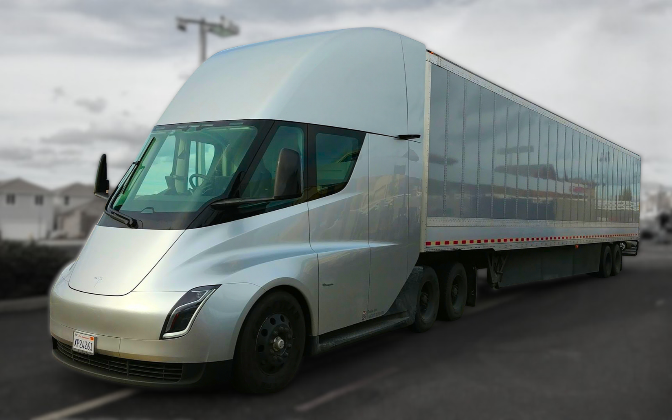
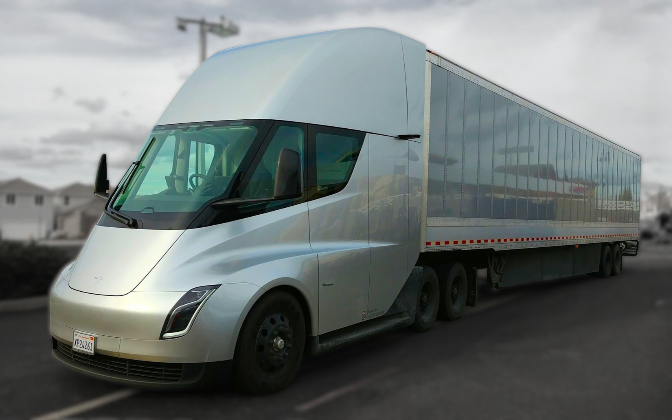
Google’s entrance as a member and buyer in the pilot significantly increases the total number of trucks deployed by the original group, unlocking further economies of scale and deepening the benefits of demand aggregation. More than 20 new battery-electric trucks will be added to the project because of the increased investment, bringing the total deployment to 63 Tesla Semis charged on Greenlane’s Texas network, operating between Houston and Dallas beginning early 2027. These trucks are expected to travel up to 11 million miles annually, reducing an estimated 92,000 metric tonnes of CO2e as compared to diesel trucks over the four-year contract.
Google’s decision to join the pilot speaks to the confidence buyers are placing in book and claim and the value of joining a project to increase scale and impact.
A Tesla Semi, the type of truck that will be deployed in the project
An Evolving Standards Landscape Supportive of Book and Claim
Corporate confidence in the book and claim model has been further strengthened by a series of updates unveiled by critical standard setters that recognize and legitimize environmental attribute certificates (EACs) as a valid tool for companies to reduce their value chain emissions. These standards signal support for book and claim while also providing tactical guidance that can help companies navigate these emerging markets.
Companies can now turn theory into action with the backing of accepted guidance.
AIM Platform Standard and Guidance
The AIM Platform Standard and Guidance, published in April 2026 by the Advanced and Indirect Mitigation (AIM) Platform, offers companies a credible way to account for and report on value chain interventions, such as ZETc procured through GMA Trucking.
Corporate Net-Zero Standard V2
In June 2026, the Science Based Targets initiative (SBTi) released version two of their Corporate Net-Zero Standard (CNZS V2). Updated from V1, the new Standard explicitly recognizes market-based instruments, including EACs from book and claim systems, as legitimate tools companies can use to implement their climate targets.
GHG Protocol Corporate Standard
The Greenhouse Gas (GHG) Protocol is also in the process of making major revisions. In its March 2026 Action and Markets Instruments (AMI) Phase 1 Progress Update White Paper, the GHG Protocol proposed a multi-statement reporting structure for discussion. The proposal, much like the one outlined in the AIM Standard, would allow companies to report a market-based inventory and impact statement alongside their physical emissions inventory, giving buyers of instruments, such as ZETc, a clear and transparent way to report their efforts toward value chain decarbonization.
The update to this Standard is being eagerly anticipated. While SBTi has given the green light to counting EACs toward corporate climate goals in CNZS V2, it has deferred underlying questions about how to account for these instruments in GHG inventories to the GHG Protocol. Important work still needs to be done in this area.
In July 2026, GHG Protocol announced a consolidation of its Corporate Standard, Scope 2, Scope 3, AMI, and ISO’s 14064-1 workstreams into a single, harmonized standard, with an integrated public consultation planned for Q2 2027. While the final standard will likely not be finalized until late 2028, the direction of travel is clear and companies should feel confident they will have an avenue to report EACs, like ZETc, under the GHG Protocol and ISO.
SFC Market Based Measures Framework
The Smart Freight Centre’s (SFC) Market Based Measures (MBM) Framework is also undergoing a revision process ahead of V2 release. This transport-specific document is expected to help fill in some gaps in both the SBTi and AIM Standard for how EACs can be claimed and accounted for, covering such issues as functional unit for issuance and accounting, additionality, issuance process flow and others across transportation modes. A version for public consultation is expected late 2026, with the final Framework set to be published Q1 2027.
While the asynchronous and overlapping nature of the book and claim standards landscape can appear daunting and confusing, behind the scenes many of the key entities and stakeholders working on these issues are in close collaboration and share the goal of greater consistency and alignment. Convergence is appearing, with even greater clarity on key rules and protocols expected in the months ahead.
Establishing Essential Market Infrastructure
Registries are an essential component to a book and claim system, preventing double counting and issuance and validating the claims of the certificate purchaser. They operationalize the standards companies follow when they book and claim EACs by providing the transparency, verification, and documentation needed to ensure the attributes are appropriately created, transferred and retired. GMA Trucking will be working with 123Carbon, a digital registry for environmental attributes across transport sectors, to house the certificates issued through the pilot procurement. 123Carbon has developed a module specific to battery-electric trucks that can track all relevant data to enable transparency and accurate reporting to the participating buyers. GMA is working closely with 123Carbon to ensure that all required information is captured and tracked in alignment with the procurement’s design.
Looking Ahead: Ramping Up for Future GMA Trucking Procurements
Building on the pilot’s success, and with critical market infrastructure coming into place, GMA Trucking is scaling up for the next procurement.
The second procurement is set to launch in early 2027. To maximize impact and drive catalytic investment, GMA Trucking is looking to use its book and claim model to complement other initiatives in the market, including those seeking to aggregate physical demand.
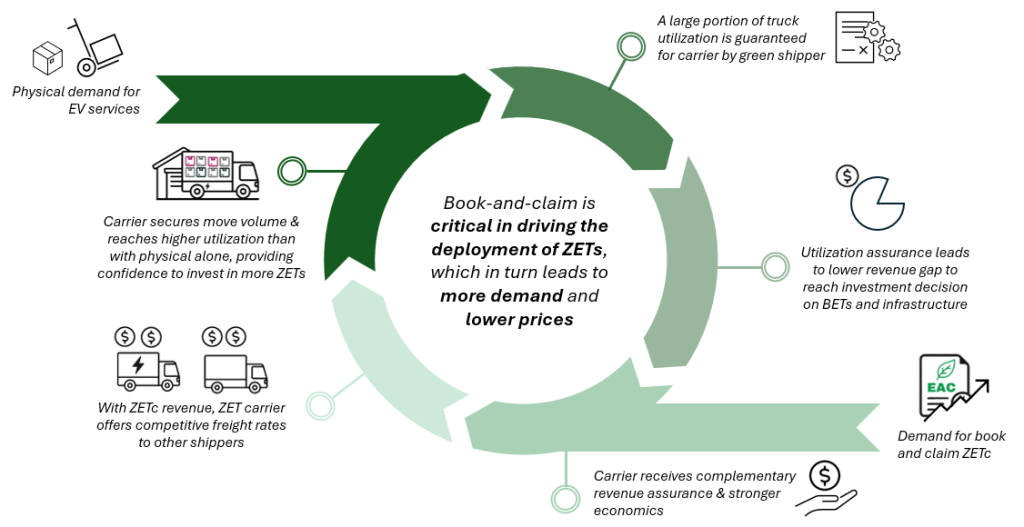
Our expectation is that coordinating physical with book and claim demand aggregation will lead to better economics, scaling the sector faster than either one on their own. The long-term revenue certainty offered by book and claim provides carriers with stronger assurances and financing, leading to more competitive freight rates against incumbent diesel trucks. This, in turn, drives more utilization, as shippers gravitate towards carriers offering competitive rates. As zero-emission trucks are utilized more, ZEV carriers save on operating expenses compared to diesel trucks, maximizing savings and covering any upfront capital or resources used in the switch to electric. The result is a positive, reinforcing cycle, where the ZETc purchaser, carrier, and physical shipper can all enjoy lower prices, revenue assurances, and meaningful emissions reductions in the heavy-duty trucking sector.
Book and claim can help support the positive feedback loop that drives more deployment, lowering costs for all
Members of GMA Trucking have spent the past several months shaping the structure of the second procurement directly, weighing in on requirements, contract terms, corridor priorities, and how book and claim can complement other efforts. Companies who join GMA Trucking now still have time to help shape procurement design before the RFP launches, a level of influence that won’t be available once the procurement is underway.
Certificates from this next procurement are expected to be generated and delivered ahead of and into 2030, meaning companies with decade-end targets have a real, near-term decarbonization lever, backed by a standards landscape that’s more supportive of this approach than it has ever been.
Next Steps for Interested Companies
The time to take action towards decarbonizing value chains is now.
GMA Trucking’s pilot proved the model works; real trucks, real corridors, real emissions reductions, and a buyer base that’s already growing. The second procurement is your chance to help shape what comes next.
Reach out to trucking@gmacenter.org today to start the conversation.
Related News & Resources