
09.22.26
Press Release | Green Fuel Forward Expands Industry Alliance to Support Sustainable Aviation Fuel Adoption in Asia
Center for Green Market Activation (GMA) and Singapore Sustainable Aviation Fuel Company (SAFCo), join GenZero on the Steering Committee, while Amazon, Bain & Company, and Temasek Trust join the growing industry alliance to support credible demand for sustainable aviation fuel (SAF) and SAF certificates in Asia.
22 September 2026, SINGAPORE / NEW YORK – Green Fuel Forward (GFF), launched by GenZero and the World Economic Forum (WEF) in May 2025 to scale demand for sustainable aviation fuel (SAF), today announced an expanded partnership structure and new members as it enters its next phase of market activation.
Announced during Green Markets Day at New York Climate Week, the expansion marks GFF’s shift from building market awareness and procurement readiness to facilitating greater corporate action and participation in SAF and SAF certificates (SAFc) transactions across Asia.
GFF welcomed the Center for Green Market Activation (GMA) and the Singapore Sustainable Aviation Fuel Company (SAFCo) to its Steering Committee (SteerCo), alongside founding SteerCo member GenZero. The expanded SteerCo combines investment, demand-aggregation, procurement and market-development expertise as GFF works to translate growing corporate interest in SAF into credible and scalable demand.
Building this demand is particularly important for aviation decarbonisation in Asia, where much of the sector’s future growth is expected. SAF supply remains constrained by its premium over conventional jet fuel and production capacity that is still developing. Stronger and clearer demand signals can encourage investment in new supply and help lower the cost of SAF adoption.
SAFc can provide these demand signals at scale by enabling companies to support the use of SAF and claim the associated emission reductions towards their climate targets, even where direct access to physical SAF is limited or impossible. To support the development of a robust SAFc market in Asia-Pacific, GFF will work with industry, policymakers and standards bodies to establish a trusted framework for corporate engagement.
Frederick Teo, Chief Executive Officer, GenZero, said: “Given the growth of aviation in the Asia-Pacific, the region has a critical role in decarbonising aviation globally. There is tremendous potential to develop technologies in SAF, source feedstock, build production capacity and drive adoption. Corporate ambition to address air travel emissions can direct financing into scaling SAF adoption through the purchase of SAF certificates. Green Fuel Forward aggregates corporate participation into credible, collective demand large enough to meaningfully support production growth across the region. The expertise that GMA and SAFCo bring in demand aggregation, procurement, and market development strengthens Green Fuel Forward’s broad membership base to translate corporate readiness into concerted market action.”
Kim Carnahan, Chief Executive Officer, Center for Green Market Activation, said: “We know that book and claim and demand aggregation can drive new investment and grow the supply of high-integrity SAF. We are thrilled to be joining the Green Fuel Forward SteerCo to bring this model to Asia, ensure it complements existing global initiatives like the Sustainable Aviation Buyers Alliance, and steer it toward real world contracting that scales SAF uptake in one of the fastest growing aviation markets in the world.”
Seow Hui Tan, Chief Executive Officer, SAFCo, said: “As Asia-Pacific’s aviation sector continues to grow, the region has a unique opportunity to lead the next phase of sustainable aviation growth. Singapore’s early leadership in advancing SAF policy demonstrates how practical regulations, trusted governance and market-based mechanisms can accelerate SAF adoption while maintaining environmental integrity. Beyond supporting Singapore’s national SAF ambitions, SAFCo’s expertise, processes, systems and market infrastructure being developed through the SAF policy can help lay the foundations for a credible and scalable voluntary SAF and SAF certificate market across Asia-Pacific. Through Green Fuel Forward, we look forward to working with partners to strengthen corporate participation, build market confidence and accelerate the development of a trusted regional SAF ecosystem.”
With added institutional expertise and a broader corporate buyer base, GFF is better positioned to help companies move from learning about SAFc to evaluating and participating in procurement opportunities. By aggregating demand and strengthening connections among buyers, market intermediaries and suppliers, GFF aims to create a stronger commercial foundation for SAF growth in Asia.
As GFF moves from capacity-building towards supporting more pragmatic action, WEF will hand over the secretariat function of the initiative to the SteerCo. WEF played an important role in the initiative’s formative year, helping to shape the platform, convene stakeholders, build momentum, and strengthen the understanding of the SAF market.
Pedro Gomez, Head, Industry Agenda, Member of the Executive Committee, World Economic Forum, said: “With GenZero and dozens of private sector companies, we launched Green Fuel Forward to spark interest in SAF in the Asia-Pacific region. One and a half years later, this collective effort has shown that the local SAF market is maturing fast, and more corporates are planning to take pragmatic action and invest in the sector. The World Economic Forum looks forward to seeing this momentum transform into credible demand as GenZero and the new SteerCo take over the strategic leadership of the campaign, bringing experience from transactions that can really scale the impact of Green Fuel Forward in the coming years.”
New members broaden the alliance
Alongside the expanded SteerCo, GFF has recently welcomed Amazon, Bain & Company, and Temasek Trust as new members, broadening the group of companies seeking to accelerate the shift towards lower-carbon aviation. Temasek Trust also joins as a catalytic contributor, providing funding to offset procurement costs and help SAF adoption. GFF’s total membership now stands at 48.
GFF’s members span three key groups: companies with significant business-travel footprints; companies with substantial logistics and air-cargo operations; and international corporations looking to decarbonise their value chains in Asia.
Corporate interest in SAF is growing, but buyers continue to face practical barriers to procurement. Questions remain around how SAF certificate purchases can be reported under the Greenhouse Gas Protocol, while buyers may also have limited visibility of credible regional supply and lack dedicated in-house procurement capabilities.
Through GFF, participating companies can better understand the SAF market, explore credible procurement pathways, and stay updated on accounting and reporting for SAFc. Catalytic funding, including cost offsets and co-matching for select first-time buyers, can also help lower cost barriers and support early participation.
Sam Israelit, Chief Sustainability Officer, Bain & Company, said: “Business travel is the largest share of Bain’s carbon footprint, and sustainable aviation fuel is central to our science-based path to net zero. Having been among the first corporate buyers of SAF certificates through the Sustainable Aviation Buyers Alliance and the First Movers Coalition, joining Green Fuel Forward is a natural next step: it brings that commitment to Asia-Pacific, where aviation’s growth – and the opportunity to decarbonise it – is greatest. We look forward to helping build the credible, aggregated demand that will catalyse new SAF supply across the region.”
Ryan Tan, Head, Planet Collaborative, Temasek Trust, said: “Aviation is a carbon-intensive sector that is an integral part of the carbon footprint of many companies, such as through business travel and value chains. This makes SAF certificates an important entry point for collective action. Through Green Fuel Forward, Temasek Trust is participating as both a member and catalytic funder to lower barriers for other companies and facilitate demand for SAF. This reflects our commitment to catalysing practical, scalable solutions for tangible climate impact.”
About Green Fuel Forward
Founded by GenZero and World Economic Forum in 2025, Green Fuel Forward (GFF) is an initiative designed to scale corporate demand for sustainable aviation fuel (SAF) in the Asia-Pacific region. While continuing to build capacity and increase awareness of SAF certificates, in its second year, GFF will explore more structured procurement of sustainable aviation fuel certificates (SAFc), enabling corporate buyers to participate in SAF markets and address their aviation-related Scope 3 emissions. The initiative complements ongoing work by international standards bodies to advance the use of book-and-claim mechanisms, while contributing to global aviation decarbonisation. Through demand aggregation, capacity building and policy engagement, GFF aims to provide clear demand signals required to lower barriers to SAF adoption, strengthen market confidence and ultimately, catalyse new investments into SAF production across Asia-Pacific.
For more information, visit https://genzero.co/initiatives/green-fuel-forward.
About GenZero
GenZero is an investment platform company focused on accelerating decarbonisation globally. Founded by Temasek, it seeks to deliver positive climate impact alongside long-term sustainable financial returns by investing in opportunities with the potential to be nurtured into impactful and scalable solutions.
Driven by a common purpose to decarbonise for future generations, GenZero recognises the need for a holistic and integrated approach to achieve a net zero world. It adopts a flexible investment approach across three focus areas to drive climate impact: (i) nature-based solutions that help protect and restore natural ecosystems while benefiting local communities and biodiversity; (ii) technology-based solutions that deliver deep decarbonisation impact; and (iii) climate ecosystem enablers that support the scaling of carbon markets and enable broader industry decarbonisation.
For more information on GenZero, visit www.genzero.co.
About the Center for Green Market Activation
The Center for Green Market Activation (GMA) is a U.S.-based nonprofit working to catalyze markets for low- and zero-carbon goods and services in hard-to-abate sectors. GMA develops and deploys demand aggregation, collective procurement and book-and-claim approaches that enable companies to send stronger demand signals for emerging climate solutions. GMA manages buyers alliances across aviation, maritime shipping, heavy duty trucking, cement and concrete, chemicals, agriculture and other sectors, including serving as the Secretariat for the Sustainable Aviation Buyers Alliance (SABA).
About Singapore Sustainable Aviation Fuel Company Ltd (SAFCo)
Established by the Civil Aviation Authority of Singapore, SAFCo builds a transparent, integrated SAF demand market connecting airlines, corporate buyers, fuel producers, registry providers, carbon market platforms and aviation fuel chain stakeholders in Singapore. Its mission is to enable a scalable, credible and efficient SAF ecosystem that supports the decarbonisation of Singapore’s air hub and catalyses regional SAF adoption. For more information, visit https://safco.com.sg.
About Temasek Trust
Temasek Trust is the philanthropy arm of Temasek Holdings, with community stewardship goals of protecting the planet, uplifting communities, connecting people, and advancing capabilities. By forging new pathways in philanthropy and impact investing with like-minded partners, Temasek Trust advances catalytic philanthropy as a force for good. Through the Temasek Trust Collective, an ecosystem of organisations united by a shared purpose of building better for every generation, Temasek Trust builds capacity, convenes partnerships, mobilises capital, and catalyses solutions innovation to drive positive impact. For more information, visit www.temasektrust.org.sg. Follow us on LinkedIn, Instagram, Facebook, and YouTube.
For media queries, please contact:
Michelle Tan, Director, Corporate Affairs & Communications, GenZero, michelletan@genzero.co
Joey Wong, Vice President, Corporate Affairs & Communications, GenZero, joeywong@genzero.co
Tan Shu Ning, Senior Associate, Corporate Affairs & Communications, GenZero, tanshuning@genzero.co
Related News & Resources






09.14.26
Press Release | Food and Beverage Companies Gain New Decarbonization Pathway with Launch of Green Ammonia Buyers Alliance
Center for Green Market Activation, RMI, and 3Degrees partner on new initiative to harness collective demand for green ammonia to reduce fertilizer production emissions
WASHINGTON, Sept. 14, 2026 – Today, the Center for Green Market Activation (GMA), RMI, and 3Degrees announced the launch of the Green Ammonia Buyers Alliance (GABA), a new initiative that will help food and beverage companies accelerate investment in green ammonia production to reduce emissions from fertilizer manufacturing.
The launch of GABA leverages the combined expertise and shared commitment of GMA, RMI, and 3Degrees to accelerate industrial decarbonization through innovative market-based solutions and extends a proven collective procurement approach into a sector primed to convert potential into impact. The program’s founding members include leading companies within the food and beverage sector.
Ammonia production is one of the largest sources of emissions in fertilizer manufacturing. Green ammonia, produced using renewable electricity and water rather than natural gas, can eliminate nearly all emissions from this process. Accelerating its deployment represents one of the most significant and scalable opportunities to reduce emissions from the fertilizer value chain, which generates an estimated 1.2 gigatons of CO2e annually. For food and beverage companies, investment in green ammonia offers a scalable pathway to materially reduce supply chain emissions while decreasing dependence on fossil-based fertilizers that are subject to significant price volatility.
Despite its potential to drive down emissions from fertilizer, green ammonia has proven difficult to scale. Dozens of projects have been announced around the world, but most still face the challenge of securing enough bankable demand to move forward. At the same time, food and beverage companies, many of whom have set ambitious Scope 3 emission reduction targets, sit five to six steps downstream from ammonia producers. This creates a gap between the projects seeking investment and the companies most interested in sourcing low-carbon inputs to address fertilizer-related emissions.
Through GABA, companies will be able to directly support the growth of the green ammonia-based fertilizer market, demonstrate the validity of green ammonia as a key fertilizer decarbonization solution, and advance progress toward their climate and supply chain sustainability goals.
“No company can scale a market like green ammonia on its own,” said Kim Carnahan, GMA CEO. “GABA gives members of key sectors like food and bev a way to act collectively, creating the demand signal needed to help move projects from announcement to implementation.”
By bringing companies together through a shared procurement process, GABA will aggregate demand for green ammonia and create a stronger market signal for producers, project developers, and investors. Through a book-and-claim system, member companies will purchase Environmental Attribute Certificates (EACs) directly from verified green ammonia producers, helping provide the revenue certainty needed to support new projects while enabling companies to address fertilizer production emissions that would otherwise remain out of reach.
“Green ammonia is one of the most important long-term pathways for reducing emissions from fertilizer production, but bringing new production online requires clear market signals,” said Thomas Koch Blank, Managing Director at RMI. “The Green Ammonia Buyers Alliance builds on what we’ve learned across other sectors: when companies come together around credible, long-term demand, they can give producers and investors confidence to move projects forward and accelerate adoption of lower-emissions technologies.”
For many companies, EACs offer the most practical and scalable pathway available today for addressing value chain emissions beyond their direct control. Recent developments in corporate climate guidance, including the SBTi Corporate Net-Zero Standard V2 and the Advanced and Indirect Mitigation (AIM) Platform Standard, provide increased clarity on how companies can account for and report these types of value chain interventions. GABA’s approach mirrors similar market-based systems that have successfully channeled investment into renewable electricity, sustainable aviation fuel, decarbonized shipping, zero-emission heavy-duty trucking, and low-carbon construction materials.
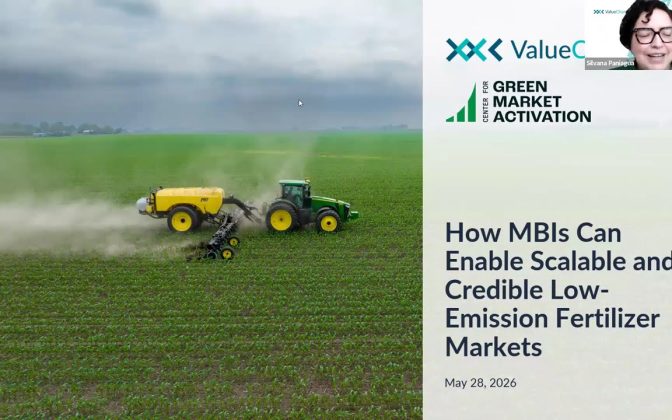
GABA builds on growing momentum in fertilizer decarbonization and emerging demand for lower-emissions fertilizer solutions. Through the Low Carbon Fertilizer Alliance (LCFA), a 3Degrees-led global initiative comprising 25 food and beverage companies, companies have already begun leveraging market-based approaches to decarbonize large scale fertilizer plants through blue ammonia and nitric acid decarbonization.
“We’re excited to partner with GMA and RMI to launch GABA and build on the growing momentum behind fertilizer decarbonization,” said 3Degrees CEO Philippe Vedrenne. “GABA creates a dedicated platform for companies to collectively support the development of the green ammonia market. This platform directly compliments the Low Carbon Fertilizer Alliance, which is focused on retrofitting existing fertilizer production infrastructure through collective action.”
By bringing together 3Degrees’ expertise in environmental commodity markets and early work with fertilizer EACs alongside GMA and RMI’s experience designing high-integrity book-and-claim systems and demand aggregation programs, GABA provides companies with a proven, credible pathway to support green ammonia production. Members will benefit from technical expertise, transparent market design, and a competitive procurement process intended to direct demand toward the most credible and impactful green ammonia projects at the most competitive cost possible for companies purchasing EACs.
GABA plans to launch its first pilot procurement in Q4 2026, giving participating companies an opportunity to help establish one of the first collective demand signals for green ammonia-based fertilizers. Buyers engaged in GABA’s inaugural procurement will have unique opportunities to inform program design and capture first-mover discounts through 2027. Companies interested in joining GABA or learning more about upcoming procurement opportunities are encouraged to contact fertilizer@gmacenter.org.
Media inquiries please contact:
Alison Greene, Center for Green Market Activation: alison.greene@gmacenter.org
About the Center for Green Market Activation
The Center for Green Market Activation (GMA) is a US-based, globally focused non-profit. Through innovative procurement approaches and sector-specific buyers alliances, GMA catalyzes and scales the uptake of low-carbon goods and services within carbon-intensive industries including aviation, maritime, trucking, cement and concrete, and chemicals. With collective decades of experience in environmental markets and alternative fuels and materials, the GMA team works to standardize new, green markets and forges mutually beneficial partnerships between climate-focused companies, suppliers, and mission-aligned non-profit organizations to channel funding to critical climate technologies in pursuit of accelerated sectoral decarbonization. Learn more at gmacenter.org.
About RMI
Rocky Mountain Institute (RMI) is an independent, nonpartisan nonprofit founded in 1982 that transforms global energy systems through market-driven solutions to secure a prosperous, resilient, clean energy future for all. In collaboration with businesses, policymakers, funders, communities, and other partners, RMI drives investment to scale clean energy solutions, reduce energy waste, and boost access to affordable clean energy in ways that enhance security, strengthen the economy, and improve people’s livelihoods. RMI is active in over 50 countries.
About 3Degrees
3Degrees, a Certified B Corporation, makes it possible for climate-conscious organizations to take urgent action on climate change. As a trusted partner in global supply chain decarbonization, 3Degrees delivers renewable energy solutions, carbon project development, and high-integrity Scope 3 strategies. In 2024, 3Degrees founded the Low Carbon Fertilizer Alliance (LCFA), aggregating corporate demand to de-risk and scale factory-level emissions reductions across complex agricultural value chains. Learn more at 3degreesinc.com.
Related News & Resources
08.04.26
Press Release | ZEMBA Announces Catalytic Next Phase at the Center for Green Market Activation
As the initiative’s next step, ZEMBA will transition to the Center for Green Market Activation.
Washington, D.C., Aug. 4, 2026 – On September 1, 2026, after three years of incubation at the Aspen Institute, the Zero Emission Maritime Buyers Alliance (ZEMBA) will transition to become a program of the Center for Green Market Activation (GMA). With two completed tenders that delivered three new ultra-low-carbon fuel pathways into the maritime market and nearly 40 multi-year contracts to date, ZEMBA is focused on its next phase of scaling impact and expanding opportunities for companies to address Scope 3 transportation emissions.
“We are deeply grateful to the Aspen Institute Energy and Environment Program for its leadership and commitment to market-based sustainable solutions,” said Ingrid Irigoyen, President and CEO of ZEMBA. “The Institute’s support as an administrative home during our start-up phase was tremendously successful. Now, ZEMBA is ready for the next step in our evolution, which is why we are seizing the opportunity to create multiplier effects and efficiencies across a range of hard-to-abate sectors by joining an organization specifically created for that purpose.”
“We are proud of growing ZEMBA from an idea to a globally recognized initiative making real impact. The Aspen Institute Energy and Environment Program has a 50+ year history of incubating big ideas and spinning them off as full-fledged programs like this. Going forward, we will continue to identify new ways to collaborate with ZEMBA and GMA to continue to accelerate change across the sector,” said Greg Gershuny, Vice President and Executive Director, Aspen Institute Energy and Environment Program.
ZEMBA’s CEO and core procurement staff will transition to GMA to ensure continuity of program leadership and operations. In addition to having provided key technical support for ZEMBA since 2023, GMA is working to scale the adoption of low-carbon goods and services within a number of high-emitting industries such as aviation, trucking, cement and concrete, and chemicals. This transition will enable companies to participate in a coordinated suite of interventions across hard-to-abate sectors and transport modes, supported by shared infrastructure, consistent procurement approaches, and cross-sector learnings.
“The GMA team has supported the groundbreaking work of ZEMBA and the Aspen Institute since its inception, and we are thrilled to deepen that collaboration by bringing ZEMBA into the official GMA family for its next chapter of continued innovation,” said Kim Carnahan, President and CEO, GMA.
ZEMBA is developing new and cutting-edge ideas to scale impact, expand fuel and technology pathways, and engage a broader set of stakeholders worldwide. During this next phase of ZEMBA’s strategy, it is focused on continuing to drive innovation and economies of scale that enable deep decarbonization in maritime transport. ZEMBA looks forward to engaging stakeholders across the value chain in the coming months as it charts a course toward a sustainable future for ocean shipping.
###
Media inquiries please contact:
Alison Greene, Communications Manager
Center for Green Market Activation
alison.greene@gmacenter.org
Eric Baker, Senior Media Relations Manager
The Aspen Institute
Eric.Baker@aspeninstitute.org
ABOUT ZEMBA
The Zero Emission Maritime Buyers Alliance (ZEMBA) is a first-of-its-kind buyers group in the maritime sector working to accelerate the commercial deployment of clean energy-powered shipping, enable economies of scale, enable transformation across the maritime supply chain, and help freight buyers maximize their positive impact beyond what any one company could accomplish alone.
Technical and legal support is provided by several key partners. Lloyd’s Register Maritime Decarbonisation Hub is an independent, not-for-profit social purpose organization, working towards a vision of a safe, sustainable, and human-centric decarbonized shipping industry for the benefit of society. The law firm Pillsbury acts as legal counsel and provides procurement expertise.
The almost 50 current members of ZEMBA encourage additional companies to join us in sending a growing demand signal for scalable, sustainable shipping through ZEMBA’s collaborative procurements. Learn more at www.shipzemba.org.
ABOUT THE ASPEN INSTITUTE
The Aspen Institute is a global nonprofit organization whose purpose is to ignite human potential to build understanding and create new possibilities for a better world. Founded in 1949, the Institute drives change through dialogue, leadership, and action to help solve society’s greatest challenges. It is headquartered in Washington, DC and has a campus in Aspen, Colorado, as well as an international network of partners. For more information, visit www.aspeninstitute.org.
ABOUT THE CENTER FOR GREEN MARKET ACTIVATION
The Center for Green Market Activation (GMA) is a US-based, globally focused non-profit. Through innovative procurement approaches and sector-specific buyers alliances, GMA catalyzes and scales the uptake of low-carbon goods and services within carbon-intensive industries including aviation, maritime, trucking, cement and concrete, and chemicals. With collective decades of experience in environmental markets and alternative fuels and materials, the GMA team works to standardize new, green markets and forges mutually beneficial partnerships between climate-focused companies, suppliers, and mission-aligned non-profit organizations to channel funding to critical climate technologies in pursuit of accelerated sectoral decarbonization. Learn more at gmacenter.org.
Related News & Resources
05.11.26
GMA Insights | Top Q&A for SCoBA’s RFP for Low-carbon Cement
On April 8, 2026, the Sustainable Concrete Buyers Alliance (SCoBA), a program of GMA and RMI, launched its pilot procurement to accelerate the market for low-carbon cement. Since then, SCoBA has hosted a webinar targeted to suppliers (available to view here) and collected a number of questions about the RFP.
RFP questions and answers were published on April 27, grouped around common themes of ongoing and future engagement opportunities, applicability of the RFP to public procurement, registry development, RFP eligibility, and the content of RFP submissions. If you’re a supplier interested in participating in this RFP process, we invite you to take a look at the most frequently asked questions and answers below, and review the complete collection here. It is encouraging to see the strong engagement to date – there is clear enthusiasm to progress this market and we look forward to a robust set of RFP responses.
Top 3 Questions About the Sustainable Concrete Buyers Alliance Pilot RFP
- Will a registry rulebook be developed by SCoBA Organizers? How can the winning respondent expect to interact with the registry?
Ownership, tracking, and retirement of EACs will be managed consistent with the Book and Claim Framework and AIM Platform Standard and Guidance. Registries are considered best practice for long-term scalability and transparency of book and claim systems, and SCoBA intends to develop or partner with a centralized registry to support issuance, tracking, and retirement of EACs beginning in the second half of 2026.
If an interim tracking mechanism is used, contractual terms will recognize the interim mechanism to ensure EAC integrity and enforceability. For more on this, please see Section 2.3 of the Introductory Materials.
Internal supplier registries do not meet SCoBA’s registry requirements for this RFP. For this RFP, the selected Respondent(s) is/are required to work with SCoBA Organizers to ensure that the environmental attributes procured as a result of this RFP are registered appropriately at the time of cement EAC delivery and for subsequent retirement.
- Are supplementary cementitious materials (SCM) producers eligible to respond to this RFP?
SCoBA Organizers welcome SCM producers to respond to this RFP in partnership with a cement producer. As this procurement focuses on the cement functional unit, SCM technologies are eligible only when incorporated into a cement product that meets the RFP’s criteria including the emissions threshold. Section 2.1 of the Book and Claim Framework articulates the current approach to SCMs and describes a separate ongoing exploration into the potential for direct EAC issuance for SCM producers.
- How does physical delivery fit into the context of EAC delivery? How can physical offtakers get involved in SCoBA?
EACs are generated at the point of sale, after the physical cement product is produced and shipped, at which point the environmental attributes are decoupled and transferred separately to EAC purchasers. Physical offtakers receive the cement through conventional supply chains. To avoid risk of double counting, the physical product recipient is limited to qualitative claims as outlined in Section 2.5.4 of the Introductory Materials. For more information on physical claims, please review Section 8 of the Book and Claim Framework.
SCoBA procurements may incorporate a physical purchase opportunity where relevant and feasible.
The RFP is open until June 19! Companies with Scope 3 cement and concrete emissions who are interested in purchasing through this pilot procurement can explore SCoBA membership by emailing info@buildscoba.org.
Related News & Resources
05.07.26
GMA Insights | Harnessing Green Demand to Drive Sustainable Chemicals Production
Our latest GMA Insights installment is a co-authored article by GMA’s Andrew Alcorta and RMI’s Brianne Cangelose.
Chemicals play a critical, though often overlooked, role in modern society. They provide many of the key building blocks for the construction industry, support agriculture by increasing crop yields, and offer novel materials for a range of products from automobiles to new energy technologies. In fact, chemicals are everywhere, present in 96% of manufactured goods, including 75% of the energy technologies that will be needed to navigate the energy transition.
While chemicals are deeply embedded in modern society, it is equally important to acknowledge the challenges they pose. Among these are the need to reduce reliance on fossil inputs, develop better end-of-life management for chemical products, and lower emissions even as production is projected to grow up to 43% by 2050. More effort is needed across all these fronts, but addressing the 2 billion metric tons — or roughly 5% of global greenhouse gas emissions — from chemical production annually requires particularly urgent action given the long timelines to commercialize new production methods.
Despite these challenges, technologies are emerging to enable low-emissions chemicals production. While many of these technologies show technical promise, few have moved beyond the pilot or early demonstration phase. Scale-up of these technologies is often not held back by technical feasibility so much as by commercial barriers, including uncertainty about demand for low-emissions products and risk-aversion among participants spread across long and complex chemicals value chains.
Clear demand signals from companies that use chemicals in their products and novel mechanisms to bridge chemicals value chains are critical to overcoming these roadblocks and unlocking investment. The Center for Green Market Activation (GMA) and RMI are actively working to establish demand signals by aggregating buyers of low-emissions chemicals and by developing a book and claim system to enable chemical producers to transact directly with downstream companies that have committed to lowering supply chain emissions and are willing to pay a premium to do so.
The Challenge of Decarbonizing Chemicals Production
Scaling low-emission technologies in the chemicals sector is uniquely challenging. Chemical production assets are highly capital-intensive, with investment horizons that span decades. Existing plants, many of which are fully depreciated and can produce at a low marginal cost, leverage processes that have been optimized over many years and produce at enormous scale. The result is constant cost pressure that reinforces the competitiveness of conventional production methods. As a result, even when low-emission alternatives exist, buyers and suppliers alike often default to the legacy status quo.
The diversity of chemical products — and the resulting complexity of value chains required to produce them — results in an additional challenge. Unlike other industries with relatively standardized products, the chemical sector encompasses thousands of molecules, intermediates, and derivatives. This often results in long value chains with multiple layers of intermediaries separating a primary chemicals producer, generally responsible for the majority of emissions, from the better-known companies at the end of the value chain that have made net-zero commitments and are closer to consumer demand. In the middle are specialized producers of intermediate chemicals or products that often operate with thin margins and limited visibility.
In this environment, intermediate producers operating with thin margins have few incentives to source lower-emissions, higher-cost inputs unless they have certainty that their customers are willing to pay an equivalent price premium. The result is an enormous coordination challenge. Multiple parties within a value chain must simultaneously close both procurement and offtake contracts at a material premium to market prices. And all of this needs to occur at a volume that gives the primary chemical producers certainty that customers will pay a premium for most of their output over an extended time horizon. While this may be possible in rare cases where large buyers directly purchase from primary chemical producers, it will be all but impossible in most chemical value chains.
Leveraging Novel Mechanisms to Catalyze Investment
Breaking the deadlock requires both credible demand for low-emissions chemical products and mechanisms to bridge companies across long, complex value chains. GMA and RMI believe that two critical interventions, pursued in tandem, have the potential to address these challenges and unlock investment in low-emissions chemical production: demand aggregation and book and claim.
Demand aggregation is the first necessary intervention. As in many industrial sectors, low-emissions production will come at a price premium, particularly given that novel technologies often operate at small scale and with less historical process optimization than their fossil-intensive counterparts. While new technologies have the potential to decrease costs as they scale, the ability to achieve initial traction in highly price-sensitive markets is often a challenge for these production methods. The presence of buyers willing to purchase at a premium is a critical proof point for projects seeking capital to invest in low-emissions production.
But why is it necessary for multiple buyers to act together in order to provide this proof point? Because chemical assets operate at such a significant scale and because their lifetimes are so long, the purchasing volume required to unlock investment in a new facility can be enormous. By pooling demand, multiple buyers can provide the necessary volume to support an investment decision, thereby decreasing the cost and risk that any individual company would otherwise have to take on.
In cases where physical offtake of low-emission chemicals is constrained, book and claim systems provide a mechanism to aggregate larger demand volumes through the use of Environmental Attribute Certificates (EACs). Under this chain of custody approach, chemical producers generate an EAC for each unit of low-emission product, such as a ton of ethylene, that reflects the reduced emissions intensity associated with production. This certificate is then sold separately from the physical product, which continues through the value chain as a traditional commodity with a baseline emissions intensity. This separation enables chemical producers to receive revenue from EAC sales to cover the premium associated with low-emission production, providing the financial certainty needed to finance capital-intensive projects. At the same time, buyers gain verifiable, traceable progress toward climate commitments through certificates that are independently verified and tracked through a registry system.
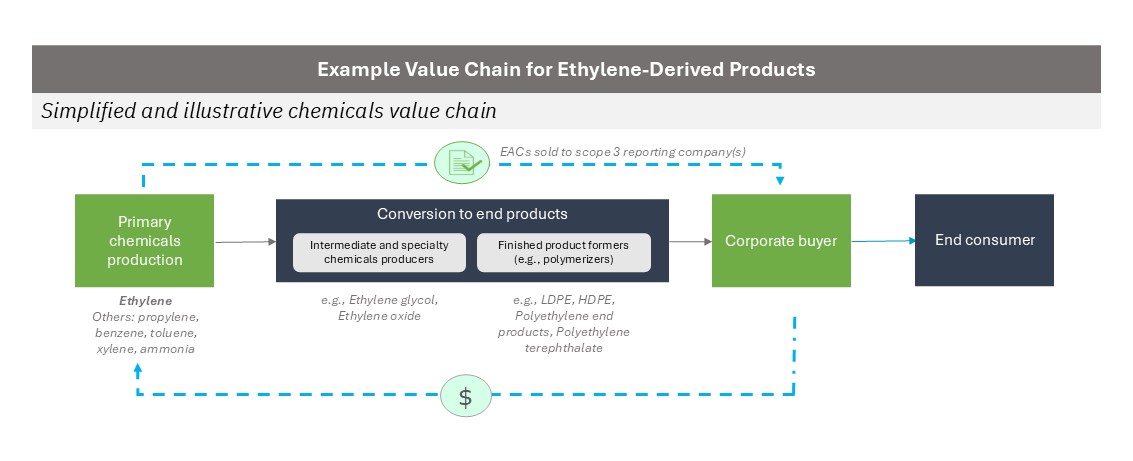
The result is three benefits that can dramatically alter the viability of low-emissions production:
- 1: Value Chain Bridging: Perhaps the most significant impact of book and claim systems is the ability for interested parties to transact efficiently. By enabling standardized transactions between downstream brands willing to pay for value chain decarbonization and upstream producers that most heavily influence emissions, the challenge of aligning multiple intermediaries around price and volume in complex value chains can be avoided.
- 2: Geographic Aggregation: Book and claim provides an additional benefit, particularly in the early innings of the net-zero transition when access to low-emissions products remain limited. Creating an EAC distinct from the physical product means that a producer is no longer constrained to finding customers willing to pay a premium for a low-emissions product near its production plant. Instead, they can sell the physical product locally at commodity prices and cover the green premium by selling an EAC to any downstream user of the product, regardless of geography.
- 3: Product Aggregation: By focusing a book and claim system on high value chemicals, a third benefit can be realized. A traditional demand aggregation approach would need to find buyers procuring identical products. However, book and claim enables demand aggregation across any product that contains a particular molecule. For example, demand for low-emissions ethylene can be aggregated across apparel companies using polyester for textiles, pharmaceutical companies sourcing polyethylene for syringes, and personal care companies using multiple types of plastic for everyday household goods. By focusing on a common and consistent upstream input, substantially more demand can be aggregated and transacted in a single procurement.
Given the immense challenges associated with decarbonizing chemical production, leveraging novel mechanisms to catalyze investment in low-emissions production will be essential. Combining demand aggregation with book and claim in the form of a buyers alliance for EACs offers a unique opportunity to reduce risk for both buyers and suppliers, while driving real investment decisions.
GMA and RMI’s Low-Emissions Chemicals Initiative
An emerging initiative from GMA and RMI to procure low-emissions high value chemicals leverages these approaches to tackle emissions in the chemicals sector. Multiple downstream brands that use chemicals in their products have come together to procure environmental attributes for low-emissions ethylene, with plans to expand this approach to other molecules in the future. In the process, they will provide demand certainty for low-emissions projects while simultaneously finding a pathway to address upstream Scope 3 emissions that had previously been out of reach due to complex, multi-tiered value chains.
Prior efforts from GMA and RMI to pool advanced commitments for low-emissions products in heavy industry sectors have demonstrated how aggregated demand can generate confidence for suppliers and investors. Sectoral buyers alliances such as the Sustainable Aviation Buyers Alliance (SABA), managed by Environmental Defense Fund, GMA, and RMI, have shown how standardized frameworks and collective purchasing can accelerate the deployment of next-generation technologies. Launched in 2021, this effort has evolved from one-year advanced commitments to purchase bio-based sustainable aviation fuel (SAF) to a scaled marketplace and targeted 5+ year offtakes at scale for next generation fuels.
Without credible demand signals and effective mechanisms to translate that demand into firm offtake agreements, the transition will stall. GMA and RMI are working to bring these pieces together—aggregating demand and developing mechanisms to more efficiently enable offtake—to ensure that novel pathways to produce low-emission chemicals are developed. Together with active engagement from buyers and support from the broader ecosystem, these actions can provide the demand certainty needed to unlock investment and enable the chemical sector to accelerate its transition to a net-zero future.
If you are interested in learning more about the GMA-RMI low-emissions chemical procurement that was spotlighted in this article please reach out to chemicals@gmacenter.org.
Related News & Resources
04.29.26
Pilot Procurement Uses Collective Demand to Unlock Investment In Low-Emissions Chemicals
The Center for Green Market Activation and RMI launch first-of-its-kind request for proposals on behalf of corporates to scale low-emissions ethylene production.
The Center for Green Market Activation (GMA) and RMI today announced a first-of-its-kind pilot procurement for low-emissions chemicals, bringing together leading, early-adopter companies across industries, including technology, consumer goods, apparel, and food and beverage. Through a collective procurement, participating companies are sending a strong, coordinated market signal to address emissions embedded deep within the chemicals value chain, targeting approximately 3,000-10,000 mtCO2e per year in emissions reductions from low-emissions ethylene — a key building block used in many everyday plastic products ranging from packaging and medical supplies to construction materials and textiles.
GMA and RMI are now seeking responses from chemical producers capable of supplying verified low-emissions ethylene using eligible production pathways, with transparent emissions accounting and the ability to transact environmental attributes through a book and claim system. The procurement is designed to provide producers with an opportunity to monetize low-emissions production, helping to support the business case for scaling emerging and differentiated production pathways. The inaugural request for proposals (RFP) will also act as a proof of concept for future aggregated procurements of low-emissions chemical attributes.
“With this innovative pilot procurement for low-emissions ethylene, we’re excited to demonstrate the power of collective, corporate demand in the chemicals sector,” said Kim Carnahan, GMA CEO. “Through this pilot, we will have the opportunity to field test and refine our approach with an ambitious group of first movers and lay the groundwork for bigger buys and different molecules in future.”
Chemicals are crucial to modern society, yet little progress has been made toward decarbonizing chemical production. Historically, substantial barriers have constrained investment in low-emissions production pathways. These barriers include capital-intensive facilities, long asset lifetimes, thin operating margins, and complex supply chains that, together, have limited the ability of new technologies to secure the long-term demand needed to justify investment at scale.
As a result, companies that use chemicals in their products have struggled to address value chain emissions. While many are working to reduce or replace emissions-intensive inputs like ethylene, unavoidable residual demand remains, and companies are often several steps removed from primary production with limited visibility into the most emissions-intensive stages of their supply chains. Even where willingness to act exists, traditional procurement structures have made it difficult to translate that intent into meaningful emissions reductions.
This pilot procurement applies a novel approach to break that gridlock and enable action. By combining demand aggregation with a book and claim system, the procurement enables chemical producers to generate environmental attribute certificates (EACs) associated with low-emissions ethylene production and sell them separately from the physical product. This allows producers to receive revenue reflecting the lower emissions intensity of their production, while downstream companies gain a flexible, credible pathway to support low-emissions production and report associated claims in their climate disclosures.
“Voluntary demand has already proven to be a powerful catalyst for investment and innovation in sectors like renewable electricity and sustainable fuels,” said Thomas Koch Blank, managing director at RMI. “We’ve seen how established, forward-looking buyers can grow emerging markets, de-risk investment, and send strong demand signals that unlock capital at scale. We’re excited to explore how this pilot procurement for low-emissions ethylene can bring that same momentum to the chemicals sector.”
Versions of this approach have already been used successfully to jumpstart markets for low-emissions production in other hard to abate transport and heavy industry sectors, including the Sustainable Aviation Buyers Alliance, the Sustainable Steel Buyers Platform, and others. This pilot represents the first known application of a collective procurement and book and claim model to the chemicals sector.
The RFP is available for download here on the GMA website, and responses are due by July 3, 2026. For additional information about the procurement, please contact chemicals@gmacenter.org.
Media inquiries please contact:
Alison Greene, Communications Manager, GMA: alison.greene@gmacenter.org
About the Center for Green Market Activation:
The Center for Green Market Activation (GMA) is a US-based, globally focused non-profit. Through innovative procurement approaches and sector-specific buyers alliances, GMA catalyzes and scales the uptake of low-carbon goods and services within carbon-intensive industries including aviation, maritime, trucking, cement and concrete, and chemicals. With collective decades of experience in environmental markets and alternative fuels and materials, the GMA team works to standardize new, green markets and forges mutually beneficial partnerships between climate-focused companies, suppliers, and mission-aligned non-profit organizations to channel funding to critical climate technologies in pursuit of accelerated sectoral decarbonization. Learn more at gmacenter.org
About RMI:
Rocky Mountain Institute (RMI) is an independent, nonpartisan nonprofit founded in 1982 that transforms global energy systems through market-driven solutions to secure a prosperous, resilient, clean energy future for all. In collaboration with businesses, policymakers, funders, communities, and other partners, RMI drives investment to scale clean energy solutions, reduce energy waste, and boost access to affordable clean energy in ways that enhance security, strengthen the economy, and improve people’s livelihoods. RMI is active in over 50 countries.
Related News & Resources
04.22.26
GMA Newsletter Spring 2026 | Earth Day Edition
If you’d like to have these newsletters delivered directly to your inbox, subscribe to our mailing list through the form at the bottom of our homepage or email pr@gmacenter.org.
Happy Earth Day and happy birthday to us! Fun fact: GMA was incorporated on April 22, 2024, so we get to celebrate both. Not a bad alignment.
We’re so grateful to be doing this work, and our impact continues to grow. Now entering year three as an organization, we’re turning up the dial on implementation with major procurement milestones, new RFPs, fresh book and claim frameworks, and the eagerly awaited release of the AIM Platform’s Standard and Guidance to help unlock the next wave of decarbonization investment. Dive in below for the latest, and if you’re already thinking ahead to New York Climate Week, we’re gearing up for the third annual Green Markets Day on Tuesday, September 22nd — more to come soon.
Watch our latest explainer video, in which GMA’s Joan Gibbons explains why companies often can’t access low-carbon cement and concrete in their region and how book and claim can serve as an unlock and market accelerator.
Program Updates
Aviation
The Sustainable Aviation Buyers Alliance (SABA) has made significant advancements through both procurement and market infrastructure milestones. Infinium’s Project Atlas was selected as the winner of SABA’s next-generation SAF procurement, following a comprehensive, multi-stage review and due diligence process conducted on behalf of SABA’s corporate buyers. In parallel, the SAFc Registry surpassed 500,000 metric tons of CO₂e abated, reinforcing the strength of corporate demand for credible, scalable SAF solutions.
Trucking
The GMA Trucking team’s recently released whitepaper shares detailed findings from its pilot RFP, introduces the challenges GMA Trucking seeks to address, and explores the critical role of demand aggregation and book and claim. GMA Trucking also hosted a webinar on January 15th with speakers from the winning carrier, Nevoya, and corporate buyers Amazon and Etsy. The Trucking team is currently exploring procurement models for its second RFP and planning to integrate physical demand with book and claim for the first time. Get in touch if that sounds as exciting to you as it does to us!
Cement & Concrete
GMA’s cement and concrete program, run in partnership with RMI, finalized a sector-specific Book and Claim Framework in January, following extensive engagement across the value chain. The framework underpins SCoBA’s first RFP, launched in early April and targeting up to 85,000 tCO₂e per year of low emissions cement attributes. We encourage eligible cement producers to submit proposals via the GMA website through June 19, and look forward to seeing this process progress over the coming months.
Fertilizer
GMA Agriculture’s low-emission fertilizer program wrapped up its supplier outreach this spring, drawing responses from producers across a range of decarbonization technologies. The team is now meeting with buyers to define procurement criteria ahead of a formal RFP.
High-Value Chemicals
GMA Chemicals is advancing its pilot procurement for low-carbon ethylene (think plastics!) with an established buyer group and is set to launch its RFP in the coming days — paving the way for the first-ever book and claim offtakes for low-emission chemicals.
Maritime
Late last year, the Zero Emission Maritime Buyers Alliance (ZEMBA) announced that it will facilitate some of the first commercial e-fuel deployments in the maritime sector.
Members are supporting the deployment of both e-methanol and e-ammonia from 2027-2031. Contracting for these landmark deals is currently underway; freight buyers interested in lowering their Scope 3 maritime emissions should reach out through shipZEMBA.org to learn more!
The AIM Platform
The Advanced and Indirect Mitigation (AIM) Platform released V1 of its Standard and Guidance, providing companies with a clear, credible framework for investing in high-integrity emissions reductions across their value chains. The publication follows two pilot processes and public stakeholder consultation periods to ensure the Standard is actionable and applicable across sectors and technologies. A webinar marking the release took place April 21 – a recording is available here.
GMA in the News:
- SABA’s next-gen winner’s announcement was covered by the Sacramento Business Journal and picked up by the Financial Times among other outlets.
- GMA Trucking’s pilot procurement results were covered by Trellis, Commercial Carrier Journal, ACT News, American Journal of Transportation, and others.
- Andrew Alcorta was part of a Q&A article by QCI focused on how EACs can unlock investment in low-carbon fertilizer.
- Bloomberg News highlighted the Sustainable Concrete Buyers Alliance (SCoBA) as part of a January article on data center construction, and SCoBA also earned mentions in Financial Times and others, while the Cement and Concrete Book and Claim Framework was picked up by Concrete Products.
- The AIM Platform’s newly published Standard and Guidance was part of a Trellis article by Jim Giles.
#ICYMI:
- CEO Kim Carnahan spoke with Inder Singh for episode 6 of the Market Shapers Podcast, which will also be incorporated into a class at UC Berkeley on market shaping.
- GMA and partner programs were featured in the International Transport Forum’s recent publication: Claiming the Future: Can Book and Claim Support Low-Emission Transport?
- GMA’s Andrew Alcorta and Akhil Mithal joined RMI’s Patrick Malloy and Tessa Weiss in co-authoring “Cultivating a lower-carbon food supply chain: Unlocking Scope 3 progress through fertilizer emissions reduction.”
- Andre de Fontaine joined the ESG Decoded podcast to discuss how book and claim and demand aggregation can unlock value chain decarbonization.
- Recordings of recent webinars on GMA Trucking, Cement & Concrete, and the AIM Platform are all available here.
Upcoming Events
San Francisco Climate Week
April 18-26, 2026 | San Francisco, CA
GMA is part of multiple events and side-convenings. Reach out to connect!
Click here for more information.
ACT Expo
May 4-7, 2026 | Las Vegas, NV
GMA Trucking will have a number of representatives networking and available for in-person meetings.
Click here for more information.
Home Delivery World
May 20-21, 2026 | Nashville, TN
Clayton Gerber is an invited speaker, including on the keynote panel “Delivering net zero, meeting the sustainability challenge in logistics”
Click here for more information.
Decarb Connect Europe
June 2-3, 2026 | Hamburg, Germany
GMA is an official media partner of Decarb Connect Europe, where Laura Hutchinson is an invited speaker. The conference brings together senior industrials, investors, project developers and buyers who are actively working on capital allocation and deployment decisions in 2026. To receive a special 25% discount on registration, please use the code GMA-25.
Learn more and register here.
Trellis Impact 2026
June 23-25, 2026 | San Francisco, CA
GMA will be a part of multiple workshops and panels, including “Aggregated and Activated: How Buyers Alliances are Accelerating Green Market Transformation” as well as a session focused on environmental attribute certificates.
Learn more and register here.
London Climate Week
June 21-29, 2026 | London, UK
GMA representatives will be circulating at events throughout the week, more details to come.
New York Climate Week
September 21-28 | New York City
GMA will host our third annual Green Markets Day on Tuesday, September 22nd – email pr@gmacenter.org to be added to event-related communications.
Related News & Resources
04.08.26
Buyers Unite to Accelerate the Market for Low-Carbon Cement
The Sustainable Concrete Buyers Alliance launches a first-of-its-kind procurement, calling for proposals to supply low-emissions cement to meet corporate demand.
WASHINGTON, D.C. – Apr. 8, 2026
The Sustainable Concrete Buyers Alliance (SCoBA), a joint initiative of the Center for Green Market Activation and RMI, today launched a request for proposals (RFP) to secure multi-year offtake agreements supporting up to 250,000 tons of low-carbon cement production annually, beginning as early as 2027. It marks the first phase of a procurement designed to overcome persistent barriers that have slowed decarbonization across the construction sector.
Cement and concrete are vital to the built environment, from housing and commercial buildings to data centers and transportation networks, and global demand for cement is expected to increase to 6.2 billion tons by 2050. Cement accounts for most of the sector’s global emissions, yet emissions-reducing technologies often face geographic and cost barriers to scale, limiting access for many organizations. Through this RFP, SCoBA will enable its climate-ambitious member companies to abate up to 85,000 metric tons of CO2e emissions per year, subject to final commercial details.
The procurement will target offtake from innovative cement producers while sending a catalytic signal to the market. The inaugural RFP is open globally to products meeting the Global Cement and Concrete Association’s low-carbon cement definition of Band B or better, roughly equivalent to at least a 67% emissions reduction compared with today’s industry reference level. SCoBA aims through this procurement to pool buyer demand, secure high-integrity supply, and enable innovative, low-carbon production methods to scale.
“Decarbonizing cement is essential to tackling emissions in the built environment, but progress has been constrained by fragmented demand and limited access to low-carbon solutions,” said Bryan Fisher, managing director of RMI’s industries program. “We’re excited to be entering the next phase of our cement and concrete demand initiative with GMA, connecting leading companies with cutting-edge producers to secure the long-term offtake agreements project developers need to confidently pursue decarbonization projects in this critical industrial sector.”
SCoBA launched in 2025 as a program of the Center for Green Market Activation (GMA) and RMI to pool demand from end-use customers and channel investment through bankable agreements, giving low-carbon cement and concrete producers the confidence to scale. Since its launch, SCoBA has engaged the market to design a procurement that is ambitious, globally focused, and capable of accelerating new production of truly sustainable low-carbon cement.
“Our outreach to the market confirms a growing pipeline of low-emissions cement solutions seeking credible demand,” said Kim Carnahan, CEO at GMA. “SCoBA’s innovative procurement brings that demand together, sending a signal individual buyers cannot achieve alone. This is about turning climate ambition into real market movement.”
The procurement will use a book and claim framework developed and recently launched by GMA and RMI, allowing companies to support low-carbon production even when the physical material cannot be delivered directly to their projects. Buyers purchase verified environmental attribute certificates representing the emissions associated with low-carbon cement or concrete, which they can retire and count toward Scope 3 goals, while the material itself is deployed where it is most practical. This model helps overcome geographic and logistical constraints that have historically limited access to lower-emission building materials and provides producers with streamlined access to committed buyers.
SCoBA’s procurement builds on proven demand aggregation models pioneered by the Sustainable Aviation Buyers Alliance and expanded to additional transport sectors such as maritime (Zero Emission Maritime Buyers Alliance) and heavy-duty trucking (GMA Trucking). This program represents a second application of that approach to the built environment; the first being the Sustainable Steel Buyers Platform.
Low-carbon cement suppliers are invited to download the RFP and submit proposals by June 19, 2026. Interested parties can also register for a webinar, scheduled for April 15 at 11AM ET. Companies with Scope 3 cement and concrete emissions who are interested in purchasing through this pilot procurement can explore SCoBA membership by emailing info@buildscoba.org.
Media inquiries please contact:
Amy Yanow Fairbanks, Strategic Communications Manager, RMI: media@rmi.org
Alison Greene, Communications Manager, GMA: pr@gmacenter.org
About the Center for Green Market Activation:
The Center for Green Market Activation (GMA) is a US-based, globally focused non-profit. Through innovative procurement approaches and collaborative alliances, GMA catalyzes and scales the uptake of low-carbon goods and services within carbon-intensive industries such as aviation, maritime, trucking, cement and concrete, and chemicals. With collective decades of experience in environmental markets and alternative fuels and materials, the GMA team works to standardize new, green markets and forges mutually beneficial partnerships between climate-focused companies, suppliers, and mission-aligned non-profit organizations to channel funding to critical climate technologies in pursuit of accelerated sectoral decarbonization. Learn more at gmacenter.org
About RMI:
Rocky Mountain Institute (RMI) is an independent, nonpartisan nonprofit founded in 1982 that transforms global energy systems through market-driven solutions to secure a prosperous, resilient, clean energy future for all. In collaboration with businesses, policymakers, funders, communities, and other partners, RMI drives investment to scale clean energy solutions, reduce energy waste, and boost access to affordable clean energy in ways that enhance security, strengthen the economy, and improve people’s livelihoods. RMI is active in over 50 countries.
Related News & Resources
02.25.26
GMA Insights | Key Takeaways from GMA Trucking’s New White Paper
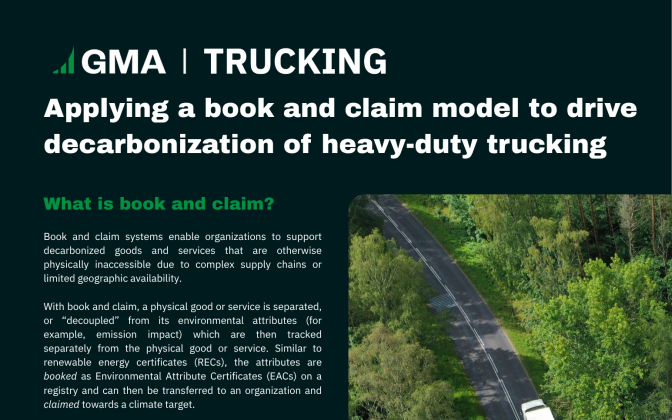
For the latest edition of GMA Insights, we’re taking a look at a new white paper released just this week, “Accelerating Momentum for Zero-Emission Trucking: Lessons Learned from GMA Trucking’s Pilot Procurement.” Assembled by the GMA Trucking program team, it offers a detailed examination of the market challenges GMA Trucking seeks to address, the critical role of demand aggregation and book and claim in addressing those challenges, and key findings from GMA Trucking’s recently concluded pilot procurement that will deploy 40 new battery electric trucks in the state of Texas.
The white paper, available for download here, includes an exploration of lessons learned that can be applied to future efforts, describing the pilot procurement as “an invaluable opportunity to explore the real-world dynamics of the zero-emission trucking market” and “a test case to identify friction points, gather actionable data, and understand the values, priorities, and constraints of different stakeholders.” A summary of insights follows.
Lessons Learned on the Benefits of Book and Claim and Demand Aggregation for the Zero Emission Trucking Market
- 1. Book and claim incentivizes and enables increased truck utilization above typical, current battery electric vehicle (BEV) usage, significantly reducing costs per mile.
- 2. Increased demand, aided by the flexibility of book and claim, can enable charger maximization and optimization, spreading CAPEX across more trucks and decreasing service costs.
- 3. Book and claim allows longer contract periods and the ability to spread costs over an extended time horizon with increased assurance of charger and truck utilization, leading to a reduction in overall project costs and increased bankability.
- 4. Innovative contract structures with tiered pricing of attributes reduces risk exposure, ensures high-integrity outcomes, and aligns incentives across parties.
- 5. A single entity facilitating alignment on key terms such as the criteria for high-integrity zero emission trucking certificates (ZETC), minimizes administrative burden when multiple parties are signing contracts.
Additional resources:
- Press release: First Ever GMA Trucking Procurement Brings Together Leading Companies to Enable Largest Known Deployment of Class 8 Battery Electric Trucks in Texas
- Webinar and Q&A: Webinar Q&A | GMA Trucking’s Pilot Procurement: Lessons Learned and the Road Ahead
- Frequently Asked Questions, including definitions of often-used terms like book and claim and demand aggregation
Interested in getting involved with GMA Trucking? Email trucking@gmacenter.org to get started.
Related News & Resources
02.05.26
Webinar Q&A | GMA Trucking’s Pilot Procurement: Lessons Learned and the Road Ahead
In January 2026, GMA Trucking announced the results of its pilot procurement that will enable the largest known deployment of Class 8 zero-emission trucks in Texas, and which showed the effectiveness of a market-based approach to accelerate deep decarbonization within the heavy-duty trucking industry. Shortly following the announcement, GMA hosted a webinar featuring GMA Trucking team members, the winning carrier Nevoya, and representatives of two corporate buyers discussing the procurement, lessons learned, and the road ahead. A recording and transcript can be found here. The compiled Q&A from that webinar is shared below. This includes questions that were answered live during the webinar, as well as those left unaddressed during the session because of time constraints. Please reach out to trucking@gmacenter.org with any further questions.
| Question | GMA Trucking Answer |
| How are the environmental attribute certificates (EACs) certified/verified? | The ZETc will be verified by an ISO 17029 accredited verifier for the application of ISO 14065, and in alignment with the requirements of ISO 14083 to calculate the emissions intensity of the transport activity (gCO2e/tonne-km). |
| Will the environmental attributes be sold and transferred via a registry? | Yes. Third-party registries are a critical part of the EAC market to ensure transparency and credibility. GMA Trucking is currently finalizing the registry provider but expects to have a functioning registry in time for the first generation of attributes to ensure accurate tracking and transparency. |
| Approximately how many years does it take for the lower operating costs to reach breakeven with the purchase cost of a battery electric vehicle? | There is no uniform answer, as both capital and operating costs will vary significantly across deployment opportunities. It depends on many factors, such as, but not limited to: vehicle mileage, diesel price, electricity price, demand charges, charging ownership model, charging infrastructure costs, and others. This leads to a wide range of payback periods, from only a few years[1][2], to many years, or possibly never. |
| How do zero-emission truck sales compare to overall truck sales? | While global sales of zero-emission medium- and heavy-duty trucks are slowly increasing (on pace for upwards of 4% of all new sales in 2025), that increase is driven almost entirely by China, where sales approach 15%[3]. In contrast, the U.S. market has stalled. Bloomberg NEF and Smart Freight Centre’s Accelerating the Transition report notes that zero-emission truck sales peaked at under 0.5% in Q2 2024 and dropped below 0.1% in the first half of 2025, with fewer than 200 zero-emission medium- and heavy-duty trucks sold nationwide[4]. This is in contrast to the over 200,000 diesel class 8 trucks sold in the same year. |
| Are 45V tax credits for clean hydrogen production still up under the new administration? | Yes, though the deadline for projects to begin construction has shortened. Projects must now start construction prior to January 1, 2028. |
| What is the energy source powering the winning carriers’ electric vehicles, and is GMA Trucking basing its analysis on Well-to-Wheel calculation? | Yes – ZETc are based on well-to-wheel (WTW) emissions intensity. As part of the RFP, GMA Trucking specified that the charging infrastructure used must be backed by renewable electricity. This could be accomplished either by using behind the meter on-site renewables or by purchasing a renewable energy product (e.g., Green-e eligible REC) equal to the volume of electricity utilized to charge the vehicles.
The energy used for trucking services will align with GLEC Framework and ISO 14083, which provides the methodology to measure the WTW emissions intensity per transport activity (tonne-km). This includes an approach to account for losses in the charging infrastructure while considering the data sources available. Per the standard, both location-based (using grid intensity) and market-based (using any contractual electricity certificates) emissions intensities will be calculated. |
| At what point in the process are vehicles purchased by the winning carrier? | The pilot RFP was open to bids for existing and/or net-new vehicles, though there was a preference for net-new.
For existing vehicles, GMA Trucking only considered vehicles that were already deployed but underutilized, or deployed but operating at a loss. |
| When will the trucks be deployed? | GMA Trucking expects the trucks generating the EACs to be deployed and in operation by the end of 2026 or early 2027. |
| Was the winning carrier able to fully satisfy the demands of the GMA Trucking members? | Yes, Nevoya is able to satisfy the final demand of GMA Trucking members. |
| What incentivizes shippers to buy EACs? | Shippers purchase EACs to meet their climate goals when decarbonized trucking services are not available on the routes used to physically move their goods. In these instances, shippers use EACs as a tool to complement their ongoing efforts to push their direct logistics providers to decarbonize their operations. |
| Is GMA Trucking’s model structured so that the EACs are only sold with the Scope 3 attribute, or also Scope 1? | The GMA Trucking program is set up for corporates to buy scope 3 EACs only – the carrier driving the zero-emission trucks claims any impact on scope 1 or 2 emissions. |
| Has GMA Trucking considered sharing lessons learned or releasing recommendations for these types of agreements? | Lessons learned from GMA Trucking’s pilot procurement will be shared in an upcoming White Paper. We are excited to connect with the market to share what we can about EAC offtake agreements. |
| How do you see GMA Trucking’s program scaling? | A key focus for GMA is to grow and scale programs past the pilot stages. The results from the GMA Trucking pilot will drive momentum and interest to scale up future efforts for larger impacts. It will also provide us, and the members, with the information and supporting infrastructure to transact more efficiently, including base contracting language and registry issuances. The standards landscape is also positioning to bolster demand for the program, as SBTi, GHGP, and AIM plan to release updates on the inclusion of market-based mechanisms like ZETc in coming months.
GMA Trucking is currently considering how to structure its next RFP and is considering how it may pair book and claim with physical procurement. |
| Will a recording of the webinar be shared publicly? | Yes. The recording, slides, and a transcript can be found here. |
[1] https://theicct.org/cost-electric-semi-feb22/
[2] https://www.terawattinfrastructure.com/blog/how-to-better-predict-your-ev-fleets-total-cost-of-ownership
[3] https://assets.bbhub.io/professional/sites/24/Zero-Emission-Commercial-Vehicles-Factbook-2025.pdf
Related News & Resources