
12.16.25
GMA Newsletter | A Look Back at 2025
A look back at 2025:
From collective ambition to market transformation
With 2025 soon to be in the rear view, we find ourselves at the midpoint of a pivotal decade for climate action. While the political forecast remains, shall we say, variable, and momentum on climate action has been tested, the organizations we partner with every day continue to champion ambitious voluntary decarbonization commitments.
This year’s progress proves what is possible when motivation is matched with action and grit. (Take a look at our year-end video, above, for some of the high points!) None of it would be possible without the active engagement of hundreds of stakeholders with our programs – thank you for being such a central part of this work.
Before we officially wrap up the year we wanted to highlight milestone developments across two GMA program areas: zero emission trucking and standards and guidance.

A year after launching GMA Trucking’s pilot RFP, we are on the cusp of finalizing contracts for our first procurement for zero emission trucking service attributes. This pilot has shown what’s possible when companies join forces, with demand aggregation and book and claim proving to be powerful levers for getting more zero emission trucks on the road. This effort now sets the stage for even larger procurements starting in 2026.
Among the standout achievements from this first-of-a-kind effort:
- It will result in the largest known deployment of heavy-duty EVs in Texas, and
- It channels catalytic investment to a zero-emissions technology start-up.
(If you missed our announcement of Nevoya as the winning carrier during New York Climate Week, see these video highlights.)
The procurement structure leverages innovative commercial terms, is designed to maximize truck utilization, and helps overcome current barriers to EV trucking. We’ll share more early next year when we announce the full RFP results. In the meantime, mark your calendars for our webinar on January 15 – your backstage pass to lessons learned and what’s coming next.

Companies have been clear – the GHG accounting and target setting standards must evolve to support credible, innovative scope 3 decarbonization. This year, the AIM Platform continued to lead the development of robust methods for companies to take action deep in their value chain and transparently report those efforts.
2025 also saw both the Science Based Targets Initiative (SBTi) and GHG Protocol (GHGP) recognize the importance of value chain mitigation. We applaud their commitment and continue working closely with both to ensure alignment and interoperability across frameworks.
Over 2025, the AIM Platform:
- Conducted pilot tests and public consultation on the AIM Platform Association Test and the Intervention Quality, Accounting and Reporting (QAR) Standard and Guidance,
- Released a draft Electricity Annex for stakeholder consultation, and
- Engaged over 40 leading organizations whose real-world testing is directly informing the tools to come.
This collective input will shape the complete AIM Platform Standard and Guidance we expect to publish in Q1 2026. Stay tuned – 2026 is going to be another big year for game-changing developments in the standards space.
In brief:
- Jim Giles featured multiple GMA programs in a recent Trellis article on the growing use of environmental attribute certificates.
- If you attended COP30, the SABA COP30 SAF platform remains open for purchases through the end of this year. The first several hundred purchases will have double the impact through a matching sponsorship courtesy of Airbus.
- Trellis highlighted the AIM Platform QAR pilot, which was also the subject of a webinar held earlier this fall. You can access a recording here.
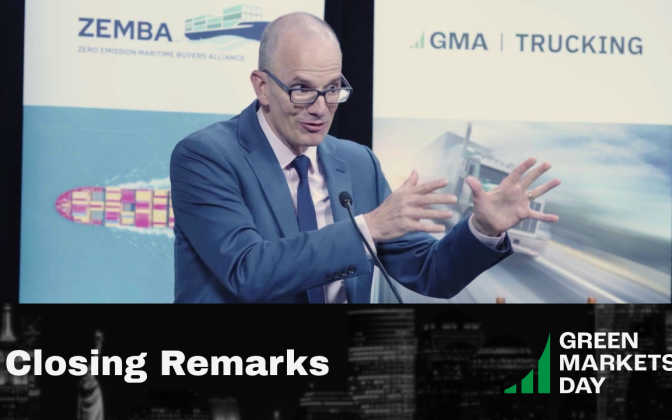
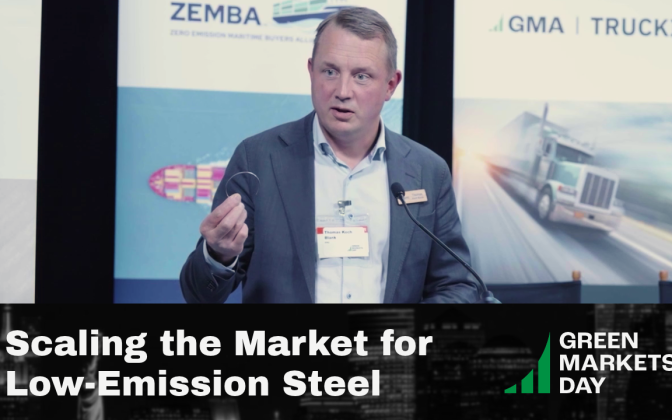
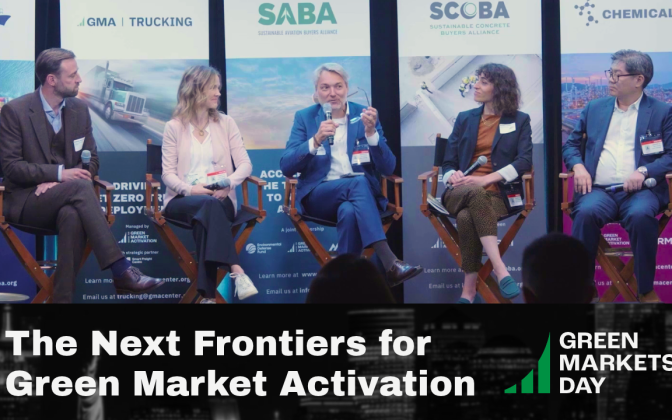
- #ICYMI, a session-by-session video library from Green Markets Day 2025 can be accessed from our website.
With gratitude:
To our partners at Aspen Institute, C2ES, EDF, Gold Standard, RMI, and Smart Freight Centre – we deeply value the opportunity to work alongside you. We are in this together for as long as the need exists, and look to the new year with optimism, excitement, and resolve. And to everyone at GMA – thank you for the irreplaceable skill, commitment, and spirit of collaboration you bring to our work together. We are so fortunate to have each of you as part of this dream team.
Best wishes for a safe, healthy, and happy holiday season!
See you in 2026!
Related News & Resources
12.08.25
As Seen in Trellis: A wonky accounting device is becoming an essential part of climate strategies
In a Trellis article published December 4, 2025, Editor-at-Large Jim Giles takes a closer look at environmental attribute certificates and how they are helping drive new and catalytic investment to decarbonized fuels, technologies and services. The article kicks off with a nod to the growing awareness of and implementation of programs using EACs, followed by a quote from GMA CEO Kim Carnahan:
– – – – – – – – – – – – – –
“This may have been the year when a somewhat wonky component of sustainability strategy — the environmental attribute certificate (EAC) — went mainstream. The past 12 months have seen certificates for low-emission products minted in multiple sectors, including cement, iron and carbon capture. In parallel, standard setters are close to giving companies greater leeway to use certificates in carbon accounting and target setting.
‘It definitely feels like this year something really clicked across the board — with buyers and suppliers, but also the standard setters seem to be getting it, the environmental NGOs, even governments,’ said Kim Carnahan, CEO of the nonprofit Center for Green Market Activation (GMA).'”
– – – – – – – – – – – – – –
The article continues with an exploration of various sectors where EACs are working to overcome market barriers, highlighting individual projects helping decarbonize data centers as well as buyers alliances that aggregate demand for low and zero emission solutions from groups of climate-leading companies, allowing them to send a stronger signal to the market and support growth in supply. These include programs that GMA co-manages alongside our NGO partners, including the Sustainable Aviation Buyers Alliance (SABA), Sustainable Concrete Buyers Alliance (SCoBA), zero-emission trucking and low-carbon chemicals.
Click here for the complete article.
Related News & Resources
11.13.25
Perspectives on SBTi’s Second Draft Corporate Net Zero Standard V2 from GMA CEO Kim Carnahan
Following the release of the second draft of the corporate net-zero standard V2 from SBTi on November 6th, 2025, GMA CEO Kim Carnahan shared her insights on what this update means for sector-level decarbonization efforts and programs that utilize book and claim, and where opportunities remain to refine the final draft to make it most useful and effective. GMA encourages stakeholders to engage with the public consultation period that ends December 8, 2025.
Kim’s original LinkedIn post is copied here, below.
“ICYMI: the next version of the DRAFT V2 Science Based Targets initiative Corporate Net Zero Standard is out.
It’s clearer, (somewhat) simpler, and takes many steps in the right direction.
It includes even more clarity (compared to the last draft) that indirect mitigation will count towards climate targets.
The First Public Consultation Feedback Report, also released today, shows why: ~80% of respondents supported counting indirect mitigation toward target achievement. Mandate sent.
I specifically like several adjustments they made to the indirect mitigation concept – now called “sector level actions.” The Advanced and Indirect Mitigation (AIM) Platform (www.aimplatform.org) supports this theory of change: even if a company lacks traceability or direct access to solutions, they still need to work to decarbonize the sectors that form the building blocks of their business.
Unfortunately, a few BIG holes remain in this otherwise gold star product.
Hole #1
– The draft appears to say that indirect mitigation can count towards some but not all scope 3 target types. I am perplexed as to why the clear mandate received would apply to some but not all target types.
– I get the current situation is complex with the overlapping GHG Protocol revision process. But one thing is not complex: Companies need the strongest and loudest signal possible to invest in critical decarb technologies now – and it is SBTi’s job to give that signal.
– GHG Protocol is policy agnostic and can provide the tools to meet any target. In fact, it has already convened a technical working group (I’m a proud member) to develop them.
Hole #2
Where is project-based accounting for indirect mitigation? I’m a huge proponent of product based, attributionally accounted EACs but some (very important) work requires project-based accounting. There needs to be a clear place for it in target achievement, or it simply won’t get done.
Hole #3
What about companies who already have V1 targets? I realize this standard will apply to future targets but we need a cover page (or similar) that clearly states that indirect mitigation will count, in all the same ways, to V1 targets.
And finally, with the overall complexity of the target setting approach outlined in this draft: I understand what SBTi is trying to engineer with this approach. I’m worried that logic will not equal effectiveness in this case, however. Companies need to be able to communicate these targets, clearly and succinctly – internally and externally. SBTi and all of us who support them will be more successful if companies can distill all the targets and sub-targets into the language we speak now – emission reductions.
All in all, huge progress. I very much believe we will get there in the final draft.”
Related News & Resources
10.29.25
Green Markets Day 2025 – Session Recordings Now Available
Green Markets Day 2025, held on September 23 during New York Climate Week, highlighted groundbreaking efforts and innovative approaches turning climate ambition into real-world action.
The Center for Green Market Activation, in partnership with Lowercarbon Capital and in collaboration with RMI and Smart Freight Centre, brought together suppliers, investors, standard-setters, and policy leaders for an unforgettable afternoon of candid debate, bold advances, and practical insights on scaling solutions in the toughest sectors to decarbonize – no matter which way the political winds blow.
Video recordings and transcripts are available at the links below by clicking on each session title.
Session Recordings
Welcome and State of the Market
Kim Carnahan, CEO, Center for Green Market Activation (GMA)
Trucking RFP Winners Announcement followed by Panel – Big Bet: Unlocking the Future of Trucking
Andre de Fontaine, Managing Director, GMA (moderator)
Christoph Wolff, CEO, Smart Freight Centre
Melissa Bauer, ESG and Sustainability Strategy Lead, eBay
Sami Khan, Co-Founder and CEO, Nevoya
SABA Spotlight: COP30 Campaign Announcement
Andrew Chen, Principal, RMI
Climate Intelligence Spotlight: RMI’s Climate Intelligence ‘Catalytic Procurement’ Report
Josh Henretig, Managing Director, RMI
Fireside Chat: Can Advance Market Commitments Jumpstart Climate’s Hardest Sectors?
David Roberts, Writer and Owner, Volts Podcast
Clay Dumas, General Partner, Lowercarbon Capital
Panel – Reaching Scale, Attracting Capital
Paul Bodnar, Director of Sustainable Finance, Industry, and Diplomacy, Bezos Earth Fund (moderator)
Brandon Middaugh, GM/Partner, Sustainability Markets and Climate Innovation Fund, Microsoft
Laura Helman, Senior Vice President, Brookfield
Rama Variankaval, Global Head of Corporate Advisory and Sustainable Solutions, JPMC
Jigar Shah, Co-Managing Partner, Multiplier
Campaign Spotlight: Mission Possible Partnership’s Build Clean Now Campaign
Michel Frédeau, Senior Fellow, Mission Possible Partnership
Panel – Concrete Steps, Steel Resolve, and Clean Chemistry: Heavy Industry’s Next Moves
Bryan Fisher, Managing Director, RMI (moderator)
Chris Atkins, Director, Worldwide Operations Sustainability, Amazon
Leah Ellis, CEO and Co-Founder, Sublime
Johan Mandaric Reunanen, Climate Impact Lead, Stegra
Hans Olav Raen, CEO, Yara Clean Ammonia
Panel – Founders at the Frontier: Startup CEOs Talk Scaling Climate Tech
Lauren Faber O’Connor, Partner, Lowercarbon Capital (moderator)
Gregory Constantine, CEO and Founder, AirCo
Sarah Lamaison, Co-Founder and CEO, Dioxycle
Sandeep Nijhawan, CEO, Electra
Hiro Iwanaga, CEO, TalusAg
Related News & Resources
10.29.25
Green Markets Day 2025 – Welcome and State of the Market
Kim Carnahan, CEO of the Center for Green Market Activation, welcomed attendees at the top of Green Markets Day 2025.
See below for a full transcript.
KIM CARNAHAN:
I’m Kim Carnahan. I’m the CEO of the Center for Green Market Activation, or GMA, as we call ourselves. Together with our co-organizers, RMI, Smart Freight Centre, and Lowercarbon Capital, I want to welcome you to the second annual Green Markets Day.
If you’ve never heard — [applause] woo! That’s nice. If you’ve never heard of GMA or think it stands for Good Morning America like my mom, that’s okay. Don’t worry. I’m going to fill you in.
We’re a US-based, globally-focused nonprofit with the mission of catalyzing markets for low-carbon fuels, materials, and services in the world’s hardest to abate sectors, particularly heavy industry and transport.
We partner with other nonprofits to stand up sector-specific buyers alliances and sector-specific book and claim systems.
Our buyers alliances aggregate corporate demand, take it to market, and support our member companies all the way through contracting and delivery.
While procurements through book and claim are central to our demand aggregation approach, we are fast moving towards supporting physical procurements as well for some of our buyers.
Now, if you don’t know GMA well, then you probably don’t know our staff very well either. We have grown from 4 to 24 in the past year, and we are very nerdy.
Let me share this scenario with you. For our first ever team retreat, we went to sunny Mexico in January. In their spare time, my team could have been relaxing here. But instead, I found them here arguing about GHG accounting methods. I have no idea where they found that flip chart, but I was so proud of them for it.
Don’t worry, we didn’t let them set the whole program today, though.
We do have a lot to cover in the next five hours, but before we get to it, I want to do a little bit of a review of some of the really good stuff that’s happened over the last year.
Let’s start with chemicals. GMA and RMI chemicals teams have joined forces and launched two new buyers programs, one focused on green ammonia-based fertilizer and the other on low-carbon ethylene and ethylene plastic products. We released our first RFI just last Friday for low-carbon ethylene.
As an aside, most companies think they don’t care about ethylene. I’m not sure I knew what ethylene was before we started our chemicals program. But most companies care a lot about plastics and decarbonizing plastics and reducing their use of plastics. And they have literally tons of it in their greenhouse gas inventory. So even though it is very nerdy, we’re excited about this ethylene program.
Moving on to concrete, a sector I realized I talk about too much because my two-year-old squeals more when he sees concrete trucks than when he sees ice cream trucks. The joint GMA/RMI working group on concrete has now published a draft framework for a book and claim system for clinker, cement, and concrete. It should be finalized by the end of the year, enabling us to move forward towards registry design.
And spoiler alert, we are, in just a few hours, going to announce the first or the launching of the Sustainable Concrete Buyers Alliance, or SCoBA.
GMA Trucking also has a big announcement today. The winning operator of its first ever collective procurement for heavy-duty EV trucking will be revealed here in about an hour, so stay put. Smart Freight Centre has made great progress on its I-10 coalition and ZET SCALE programs this last year, and our partners RMI have their sustainable steel buyers platform. They’re proceeding to bilateral conversations with producers and laying the groundwork for a new RFP in the Asia-Pacific region next year.
I’m going to spend just a tad more time talking about the kind of elder statesmen of the buyers alliances that GMA has the pleasure of supporting. The Zero Emission Maritime Buyers Alliance, managed by our friends at the Aspen Institute, has been running a marathon at a sprint’s pace over the past 12 months. They now have over 45 members and are nearing the finish line in their second tender, which is focusing exclusively on e-fuels, achieving a greater than 90% reduction in emissions compared to fossil baseline. The winner will be announced around the end of this year.
The Sustainable Aviation Buyers Alliance, which launched with RMI and EDF way back in 2021, has set up a new two-track approach to supporting our members’ procurement. The first track is SAFc Connect. It’s a secure online platform that connects corporate buyers with SAF fully vetted by SABA and available today.
The second track is SABA’s Next Gen Procurement. It is aimed at providing an avenue for buyers to engage in multi-year advanced market commitments and drive deployment of e-fuels and advanced biofuels.
In addition to those member-only procurements, SABA is also launching a brand-new platform that enables anyone to address travel emissions to specific events with a few easy clicks. We’re starting with COP 30, and you’re going to hear more about that a little bit later today.
So that was a lot of progress, but I would be seriously remiss if I didn’t highlight in this year-end review all the hoopla surrounding GHG accounting and target setting standards this last year. Because most of the climate action that we’re going to be talking about in this room depends on getting that right.
Let’s start with the AIM platform. It was launched almost 2 1/2 years ago now to fill a gap in the existing standards landscape. The fact that companies didn’t have the ability to account for and report on most of the value chain decarbonization investments that they were making. And that was seriously dis-incentivizing action.
The output of AIM’s work has been released in two chunks this year. The last half was released just last week, is now out for stakeholder comment, and is being piloted by over 20 global companies. And thank goodness we managed to finish that work when we did, because as you all know, I am sure, the GHG protocol and the Science-Based Targets Initiative, the true standard bearers in this space, both began in-depth revision processes over the last year.
Who else read SBTI’s V2 corporate net zero standard the day it came out? ChatGPT doesn’t count. OK, still Devin. We’re alone here. If any of you didn’t ever make it through those 133 pages, we’ve got you. We definitely did.
We also have a great lineup for you today. From some of the most exciting startups out there to our standards to bona fide climate celebrity folks, we’ve got David Roberts from Volts here with us today. Very exciting. It’s going to be a great afternoon.
The theme of this year’s Green Markets Day is Signals That Move Markets. And standard setters definitely fit the bill, which is why we’re starting our day with them.
Before we get going, I want to take this opportunity to thank my truly amazing team at GMA, our teams that we work with so closely at RMI, Smart Freight Centre, Aspen Institute, and Environmental Defense Fund. I want to thank the GMA member companies who use the stuff we build and the philanthropic donors who make it possible for us to build them. And finally, I want to thank Lowercarbon Capital for helping make this event a reality today.
Related News & Resources
10.29.25
Green Markets Day 2025 – Concrete Steps, Steel Resolve, and Clean Chemistry: Heavy Industry’s Next Moves
During Green Markets Day 2025, moderator Bryan Fisher, Managing Director at RMI, was joined by Chris Atkins, Director, Worldwide Operations Sustainability with Amazon, Leah Ellis, CEO and Co-Founder with Sublime, Johan Mandarić Reunanen, Climate Impact Lead with Stegra, and Hans Olav Raen, CEO with Yara Clean Ammonia.
See below for a full transcript.
BRYAN FISHER:
We’ve got four great innovative companies on the panel here. One buyer of low emissions commodities and three suppliers of low emissions commodities, all innovators in their own right. So that would be Amazon, Yara, Stegra, and Sublime.
So why don’t, just a couple of plugs before we start. One is I just want to announce the official launch of SCoBA, which is the Sustainable Concrete Buyers Alliance. We’re super excited about it. Thank you.
Could I actually get a show of hands for RMI and GMA folks that have been integrally involved in it? Please raise your hand. So if you want to know more, thank them for their hard work, first of all. And if you want to know more about it, please find them kind of after this session.
But we’re excited. It’s going to link, obviously, buyers that desire low emissions goods with suppliers that are creating innovative low emissions goods, backed by a high integrity book and claim system. So that’s what we’re all about. We’ve been working at it for quite a while, but our official announcement is actually today live. We issued a press release last Friday on it. So again, super excited about that.
And just a sneak preview, because we’re not quite ready to announce it, but we’ve made a lot of progress in the chemical space as well. And so we have had a number of active discussions. So please, in the next few months, we’re hopefully, with GMA and RMI partnership, launching something in that space.
So enough for the plugs. Let me get on to the panel here. And I’m going to have our esteemed panelists introduce themselves and their companies.
First, Chris of Amazon. You might want to explain who Amazon is, but maybe not. But you’ve been immensely supportive of RMI and GMA’s work in concrete. What does Amazon need from a group like the Sustainable Concrete Buyers Alliance? And what work do you see the alliance doing that Amazon can’t do on it, frankly, on its own?
CHRIS ATKINS:
Great question. And thanks, everybody, for being here. Thanks to RMI and GMA for putting this on and for launching the Buyers Alliance, which we think is integral to what we’re trying to do to bring scalability up to low carbon concrete.
So first of all, Chris Adkins, I’m the Director of Worldwide Operations Sustainability at Amazon. So our focus is on, how do we take our e-commerce division of our business and meet our sustainability targets? So my team works internal to the business units with them to be able to develop new solutions, but then also engaging with our external partners and our NGO partners to figure out how do we accelerate and kind of catalyze the pace of change to meet the climate ambitions that we all know are urgent right now.
And so when we look at that, you know, our fundamental belief is that there’s a mismatch of supply and demand. Over the last five, six years, we’ve seen tremendous reaction in industry to the climate crisis and commitment reaction in industry to the climate crisis and commitment to reach net zero emissions by many, many companies.
We co-founded the Climate Pledge in 2019 as our commitment to reach net zero by 2040, so 10 years ahead of the Paris Agreement, because we believe that we’re going to need leaders on the front edge of that to be able to transition the entire economy to meet the ambitions of the Paris Agreement.
Since that announcement, we’re really excited because we have over 600 co-signatories globally that are companies that see this as something that needs to happen. And we believe the power is not only one company. There’s no one company on Earth who can do the things that are necessary in order to usher in this change. And so the power is in these partnerships. And so we believe that’s really strong.
And with that, the demand is there. The supply for the low carbon solutions that we need is not yet at the production level that we need. And we all know, use the renewable energy example of where we were 15, 20 years ago in the renewable energy markets. When we are able to best match supply and demand, particularly through market-based mechanisms, we see how fast production capacity can grow. And with that, we accelerate learning curves and cost curves in a way that then catalyzes more and more adoption.
Buyers alliances are really critical. I assume I’m not really trying to sell too many people on that. If you’re at Green Markets Day and you have not been already sold to that, come find us afterwards. We’ll try to close you on this idea. But we really believe that what a buyers alliance can do can signal confidence that there are buyers ready to purchase the low carbon solutions that are needed to scale. And that gives confidence to the producers to go out and raise capital and build facilities and sell their products.
And so obviously you’ve got the examples behind us. You’ve got Zero Emission Maritime Buyers Alliance, Sustainable Aviation Buyers Alliance, Sustainable Steel Buyers Alliance. You look at all of these sectors and what we’ve been able to do collectively with the partnerships of so many, many of who are in the room today, we’ve seen this work in other areas. And so it only makes sense for us to move towards doing this in the concrete space. And so we’re super excited about that.
BRYAN FISHER:
Great. Can you touch on why– what’s the value of the partnership writ large and why Amazon just isn’t doing this bilaterally?
CHRIS ATKINS:
Yeah, I mean, look, we have a very large global presence. Everybody’s aware of that. We know that we have a big responsibility as an individual actor when we can to commit to large, long-term commitments to be able to scale up production. And we’re doing that.
But we’re not content to decarbonize Amazon alone. That’s not going to solve the problem that we’re all facing with climate change. And so what we’re trying to do is really catalyze the broader industry. And the way you do that is you bring partners together and you build confidence that supply is there. And so that the producers can now go out and do what they do so well, and they do it at scale.
BRYAN FISHER:
Great. Well, thank you. Let’s switch to Sublime. Leah, first, I’d love for you to introduce yourself and the company and what Sublime does, and talk about the role of like a SCoBA in your ecosystem and how important it is.
LEAH ELLIS:
Good afternoon, everyone. I’m Leah, CEO and co-founder of Sublime Systems. We’re developing technology to make low carbon cement.
So, as you know, cement is very carbon intensive, it’s high in fossil fuel and it’s also made from limestone which is 50% by weight CO2. We avoid both those CO2 emissions from cement making while making a same or better hardened concrete product at the end of the day.
Recently, we announced a large binding offtake commitment from Microsoft, and that was a bilateral agreement, but what matters so much is that… one company can’t make this massive change that we’re all trying to make. So Sublime alone can’t do anything. I think it really takes a village to make these changes happen.
And on Sublime’s side, we’re working with a lot of the incumbents from the industry. So Holcim, Amrize, and CRH, three of the largest cement producers in the Western world, partnered with us about a year ago. And so we’re working with them on a retrofit strategy. How can we move quickly to market using the existing logistics and distribution, mining, grinding infrastructure that’s already there? How can we turn those over and build these plants as quickly as possible?
And then on the other side, they need to see big demand signals that this isn’t a bridge to nowhere, that we’re not exhausting ourselves for naught. And so seeing this big buyers alliance come together, we’re really just building the bridge from both ends. And I couldn’t be more excited by what you’re putting together.
BRYAN FISHER:
Great, thank you. So turning to the next commodity, Johan, Stegra. First, again, could you explain for those who don’t in the room, hopefully everybody knows who Stegra is and formerly H2 Green Steel. But how do you think about the role specifically around book and claim in kind of the European context and where that regulatory framework is? So over to you.
JOHAN MANDARIĆ REUNANEN:
Yeah, hi. I’m Johan Mandarić Reunanen, I’m from Stegra. I’m a climate impact lead. And that means that I lead all the work on EAC and book and claim from Stegra. And Stegra used to be called H2 Green Steel.
We are in the works of producing green hydrogen, green iron, and green steel at scale in the northern part of Sweden. And we sell both green iron and green steel into the market. And by the end of next year, we’ll be at 2.5 million ton capacity of green steel and 2.1 million ton capacity of green iron.
And on the question on what role does book and claim play, so I guess it ties back to the role of offtakes, I would say. Why are off-takes so important to the industry, right? I mean, when Stegra was founded, and it was only four and a half years ago, there was like five people and a PowerPoint, right? And you need roughly $8 billion to construct the site that we’re building now. So how do you do that?
Well, for those of you who listened to the last panel, or the previous panel, you saw that the banks, they’re not going to do anything unless you have offtake agreements. So we had to have offtake agreements, we had to have bold partners, you know, being ready to sign long-term agreements, something that you didn’t do at all in the steel industry, you only buy like one year, year by year. No one pays a premium for anything. Very, very commodity market. But that wouldn’t work as offtake.
So that was one of the things that we had to change from a sector perspective to actually get this project, you know, off the ground and about two years ago, we concluded the financing, and with that, we had the offtake agreements that we needed for roughly 60% of the volume, and five to seven-year contracts, and not 10 years, that’s in SAF, but five to seven-year contracts.
And so the book and claim, that will unlock markets outside of Europe, because the offtake customers that we have now, they’re all within Europe, right? And so, with the agreements of the agreements that we have announced with Microsoft that we’re super happy and proud about, we have a first of a kind shot at what does this mechanism look like for the steel industry? What are the learnings that we can take from SAF and from the cement and from renewable energy? And how do we apply that to steel to unlock even more production sites globally? Where if you don’t have to be in the same geography as your customers, you could establish a steel plant anywhere in the world. As long as you have access to the green electricity, you know, at a reasonable price and some other things, right?
BRYAN FISHER:
Great. So last sector, Hans, Yara, you are selling products into two primary end uses, right? Both shipping and for agriculture. And again, how do you think about, first, we’d love to talk about what Yara’s doing kind of broadly in the space, and then also talk about the role of book and claim and how it might be similar or different than some of the other, in the intricacies, some of the other commodities we just talked about.
HANS OLAV RAEN:
Hey, great to see you. Great to be here.
Let me quick glance, who is Yara Clean Ammonia? So we are a 100% subsidiary of Yara. And our role is to provide Yara with all the ammonia that Yara needs. But we also have other customers. And actually, Yara Clean Ammonia, we are transporting and storing transporting 20% of all ammonia in the world today. We have the largest fleet transporting ammonia, and we actually have 18 terminals. We come back to the challenges or how to scale this up a bit later.
So what we want to do is we want to decarbonize. Of course, today, 98% of what we produce is grey ammonia and grey hydrogen. But in the future, we want to, of course, move into blue and green hydrogen. Actually, today, I think we’re the only producer in Europe today who’s actually producing green ammonia. So we are on that path.
And also very exciting when it comes to our ships, just to show that we’re making steps. We have ordered three new ships mid-sized gas carriers, which will run on ammonia and transport ammonia. And these ships will be running in, first one is coming in two years, and the two others in three years. So it’s really coming.
And also another thing, walking the talk, we are the first shipper, we will have the first container ship running from Norway to Germany end of next year which will run on ammonia. Actually, the ammonia we’re producing today will be put on that vessel, and it’s going to be zero CO2. And we’re going to be the first of its kind starting end of next year. So that’s what we’re working on.
BRYAN FISHER:
Great. And how are you using and working with a book and claim system like this in the context of both?
HANS OLAV RAEN:
Let me, first, before we go to book and claim, I think what is really the challenge for us all here is really how do we scale up demand, right?
Let’s look, there are two markets for me. There is the voluntary market and there’s the regulatory market. The voluntary market, well, it’s a niche market, it’s a small market. We are doing, we are with the food companies, for example, to really produce low carbon fertilizer or green fertilizers, we have we signed actually two weeks ago a big off-take agreement for CEN, which is going to be produced in Latin America, 300,000 tons, which is a small part of what we’re doing. So that’s the voluntary market.
And then when it comes to the regulatory market, that’s where your question about book and claim comes in, mass balance. Yes, it can be, it definitely can help in the beginning as we build the market. Again, the problem we’re facing today is the demand. How do we scale up demand? Where do we scale up demand?
For the low carbon ammonia, you know, we have sectors like the fertilizer, which we, but we also use ammonia for fuel, which tomorrow, and for power. When we burn ammonia for the power, there’s hardly any CO2 coming out. But again, that is more expensive. Today, it’s more expensive. So how do we get mechanisms in place for that? And that’s where book and claim can play a role in the beginning.
But we have to be careful. So it has to be transparent. It has to be controllable. And for us as first mover, it’s important that we keep that. So when we produce it, I think mass balance it has to be the rule. But as you go into the value chain and as you advance in time, then you can go towards book and claim.
BRYAN FISHER:
Great. So let me– and thank you for articulating that. I think it’s debating the merits of obviously kind of these both safety in numbers in terms of having a bunch of buyers that are looking and providing that match for buyers that are looking for low emissions products and suppliers, but also then backed by a high integrity system, right, that we can actually monitor, measure that emissions reduction.
So I want to ask you each of you the same question from your industries. Maybe, Chris, you can answer this as a buyer, but how fast and how big can this market grow? And maybe we’ll start with steel. How does this movie look like in the next one year, two years, three years? I’d love to kind of see baseline, kind of given what today’s environment looks like, and then maybe what could help speed it up.
JOHAN MANDARIĆ REUNANEN:
So the green steel market in general?
BRYAN FISHER:
In general, yeah.
JOHAN MANDARIĆ REUNANEN:
I mean, first and foremost, I mean, we need more green steel production coming online, right? What we’ve seen is a lot of the incumbents they have even gotten huge grants and they still do not go to production, right? So we need more production. Otherwise, Stegra’s production is going to be a very, very niche market. It’s not going to reach the volumes needed. I mean, the European market alone is like 70, 80, up to 100 million and that could be like 20, 25 million green steel, and we produce 2.5 and then 5 million tons. So we need to have more projects coming online.
And from a European standpoint, we need a price on carbon. So we need the European Commission to really kind of keep that course. We need to phase out the free allowances and phasing CBAM.
But from our point of view, if we can, sell the greenness of the production to a global market, then of course it would be a lot easier for us to reach the offtakes that we need for a second site, for a third site. So that will for sure open up.
But what we need to do is really prioritize getting Boden factory built. Because if there’s no factories, we’re not going to produce the green steel anyway, and then we don’t need to talk about book and claim at all. So we really need to double down on getting the thing built.
BRYAN FISHER:
So are you saying it’s more of a supply-ish than a demand issue?
JOHAN MANDARIĆ REUNANEN:
At least in our experience, it is. There’s a lot of willing buyers out there. I mean, we’ve seen a great demand from, for example, the European automotive industry. They are willing to pay the green premium, or today I learned a new word, transition premium. I really like that word.
But yes, they have signed the agreements. And I think depending on how ambitious are you when it comes to addressing the climate issues in your company, and are you willing to put your money where your mouth is, really. Otherwise, you’re not really taking it seriously. And we see that there’s enough buyers out there.
BRYAN FISHER:
Great. What about cement?
LEAH ELLIS:
The question is how fast can it go?
BRYAN FISHER:
What path are we on and what’s it look like in a few years and what can make it speed up or slow down, frankly?
LEAH ELLIS:
Yeah, we’re on a really exciting path. And I think there’s a lot of demand for low carbon cement. I think one of the really special things about cement is that it is so cheap. And that’s really a double-edged sword because it’s both so cheap and so carbon intensive, which means that even if there is a green premium, an innovation premium, or a transition premium, like you say, it actually is such a big lever because it’s so much CO2 for such small amount of dollars. And I think a lot of people recognize that.
And in the building world with general contractors, also time is money. And so knowing that they can just pay for something and then that solves all of their embodied carbon issues with their building. And they don’t have to go around and find energy efficient light bulbs and low carbon rugs or something like that. And they’re just like, boom, low carbon cement, like all of that is gone. I think that’s a really compelling value proposition to a lot of people that we’re seeing.
And so I’m seeing a lot of continued demand for cement, and I think it’s disingenuous to not acknowledge the political landscape and how much that’s changed in the US, and it has had a lot of ricochets around the community. But I think the one thing with cement is that it is an industry with a lot of inertia, and that is a good thing. It takes a long time for things to change in cement, but when they do change, they change pretty decisively, and I don’t think they swing back and forth in the same way that, let’s say, the venture capital community is known to be very skittish.
So it’s just a different game they’re playing. So I’m not seeing any pullback or any loss of momentum. I think that it’s going and it’s going to keep going, and everything you’re doing just helps it make it go faster.
BRYAN FISHER:
Great.
HANS OLAV RAEN:
For low carbon ammonia, it’s definitely demand we are missing, or it’s… We need to scale up demand. Supply is not a problem. We know how to make it.
And then there’s the cost position. As I said earlier, it costs two or three times or two times more to produce clean ammonia. So again, how do we, for the fuel, I mean, we have a real solution here to really decarbonize almost 100%, but that has a cost, and then we’re back to the cost of CO2.
And then the question is also for us as a producer, how do we lower our cost position? Today, it’s more expensive, but when you look at the renewable energy, in the future, we believe that there’s going to be more of that and also cheaper. So then the cost will go down of clean ammonia.
But we need to bridge the gap. And how do you bridge that? What kind of mechanisms do you put in place there? And that’s where I’m really positive. And when you look at ammonia as a fuel, I’m not sure if you follow, but IMO is going to have a meeting soon in London. And the net zero frame is going to hopefully be voted. And if we manage that step in London, it’s going to be a great step forward, a great signal to the ship owners, to the shipbuilder, and the cargo for us. And we’re really taking that step, as I said earlier, by already now chartering vessels for the future. So in the fuel, we have that.
As a power, same we have in Japan and Korea, the governments are subsidizing. In the beginning, again, it’s the CFD, Contract for Difference. So again, for us, it’s really how do you scale up demand.
And then the other challenge we have is, of course, infrastructure. How do we– I mean, when you need an infrastructure to bunker all of this ammonia. And again, there, I think we have to have a step-by-step approach. We, as I said, we have terminals all around the world. There is an infrastructure already existing. We need to scale it up. So today we’re discussing with partners, how can we together scale it up with the financial partners? How can, like Brookfield or BlackRock or whatever.
But the other thing is how– we need the whole value chain here. We need the port authorities, we need the financier, we need the cargo owners, we need the bunkering companies. So everybody needs to take some kind of risk here. And even the financier, they need to take also their part of the risk to get this going.
BRYAN FISHER:
Yeah, well, I think too, One amazing thing is what we could see coming out of the IMO, which is it effectively sets a price for carbon and a kind of a compliance and non-compliance, which would then help create some economic rent for some of those low emissions technologies and leaders in those as well.
And I think the second thing, one, just because we have a buyer that wants to buy a low emissions good, in this case ammonia for a fuel or maybe for fertilizer, there’s a lot more complication in particular shipping where we have to build an alternate infrastructure around the world and make sure that’s consistent in doing that.
So Chris, let me turn it over to you. In terms of a buyer, how do you see this playing out? Is it going kind of as fast as you would like as a buyer? Should it go faster? And what’s going to make it do that?
CHRIS ATKINS:
It’s never going fast enough for what we would like. And at the end of the day, we’re looking at this, I mean, I guess the benefit of where I sit in my role is we’ve already made a commitment. So it’s a math problem at the end of the day. We know kind of where our business is going from a growth standpoint. And so with all those inputs, we take a look at 2040 is our date, net zero. We’re going to make it one way or another. So what are all the inputs that must be true in order to make that happen?
And then you look at it and say, okay, well, we’ve got a time problem. So this is a 15 years, it’s 202, we’ve committed to achieving this by 2040. You look at the development timeline of how long it takes to go raise capital, get permitting, lease or buy land, you’re not talking about a whole lot of leeway there.
And then you’re looking at, well, no business is going to accept a fundamental cost driver that’s going to raise their cost of doing business by 2 or 3x, which some of these premiums are right now, which we understand.
I love the transition, I’ve heard this a couple of times today, I think the transition premium is the right way of framing it. But we know that the solutions are going to have to become competitive with conventional over time, or else they’re not going to scale.
So if you take all those factors together, then you put yourself in some real hard constraints, which allows us, which I love about this, is it allows us to really focus in on what are the problems we have to solve, and then we solve it together with our partners.
And that’s why market-based mechanisms all of a sudden become so important, book and claim become so important. It’s not enough for me when I’m looking at a 15-year timeline to decarbonize a massive global operation to say, well, okay, this is a facility going in, and you name the place, North Dakota, it’d be great as soon as we get a building that’s gonna be proximal to where that is, then we could use those general contractors. Like, we don’t have time for all of that. We have to build scale as fast as possible, and that’s why book and claim and other mechanisms are so critical.
And I guess I’ll leave you, my thought is, we have this phrase internally that we use called Attack the MAC. And the MAC is the marginal abatement cost, the cost to avoid one ton of carbon. So we look at all of our different segments of the industry and we look at what are the inputs that go into that cost? They’re real inputs. It’s not like anybody’s out there, Sublime’s not, I think I’m gonna charge this much. There’s obviously all these inputs that drive the bottom line cost to the buyer.
How do we work with industry to figure out what are the ways we can bring that down over time? What do we need to see? What are the things that the buyers can bring? What are the things that potentially good policy that makes sense can bring? There’s all these components, and I think when we get to really thinking about that, and if we think about it as a systems problem, you were talking about, you’ve got the infrastructure, and you’ve got, how do you get that from the port to where you actually have the bunker, the fuel for the vessels? We start thinking of this as a holistic system rather than isolated problems to solve, then that’s when we make this massive progress, which is, again, why coalitions like this are so important.
HANS OLAV RAEN:
I just want to, I mean, I’m probably preaching for the choir here, but that’s exactly my message to you out there. We all believe in decarbonizing this world and the energy transition. And we have a unique possibility in the next weeks to really make a big step. So I’m coming back to the IMO so that your products can be transported by containers and with almost zero CO2. We can really make that happen.
So each one of you, we represent a lot of nationalities here, I’m sure. And what you can do in the next weeks, go and influence your representative in IMO. That’s really, really a request. If you really want to participate, if you do it personally, then you can make a change in the next weeks. That’s important.
BRYAN FISHER:
This is a really, really big deal, and it could happen imminently.
So I learned a lot today, thanks to our esteemed panelists, talking about all of the wonderful opportunities, some of the risks that we face.
But I think the takeaway I get is, this is complicated. But if we work together, if we work across and redefine supply chains, as we work in a group of buyers, as we work across buyers and sellers, we can get this done, and we can get this done with a transition price, which will then help it be a parity in the next few years.
So again, thank you to our panelists for today.
Related News & Resources
10.29.25
Green Markets Day 2025 – Spotlight Session: Mission Possible Partnership’s Build Clean Now Campaign
During Green Markets Day 2025, Michel Frédeau, Senior Fellow with Mission Possible Partnership, took the stage for a spotlight session featuring MPP’s newly launched Build Clean Now campaign.
See below for a full transcript.
MICHEL FRÉDEAU:
[I want to tell you about a program] that is being launched, which is called the Build Clean Now. And in fact, we’re going to move from the green market demand to the green market supply.
The promise is clear. You can show the first slide.
The promise is clear. Clean industry will deliver a stronger economy. Each country will benefit from jobs, from an industry that survives, resilient supply chain, and greater energy and food security. All that for a healthier planet.
At the same time, those who will move earlier will build a competitive advantage. And what becomes clear, even though I recognize that the current context is a bit complicated, those who move too slow will lose everything.
So the way, and you can move to the next slide, the way the world produces the materials, chemicals, and fuels, we rely on this transformation. So as you can see, there is already a clear pipeline of projects to decarbonize those industries, whether you talk about steel, cement, aviation, et cetera.
And you’ve got nearly 70 clean industrial plants that are operating worldwide today, with more than 700 projects across 70 countries. So it’s not just limited to one country.
This data is from Mission Possible Partnership, Global Tracker Project, which geo spots the pipeline of commercial scale net zero aligned clean industrial plants across energy-intensive industrial sector, as you can see.
And as you can see, we have the projects. We know where they are, quite precisely. All we need now is the money.
And you’ve always attended all this discussion about finance telling you where are the projects and projects telling you where are the finance and the policymakers saying, and what about my economical development?
I mean, you’ve got the answers here. You have the projects, And it’s clear that on the economical development, if you don’t adapt your strategy industrially, you’re not going to be among the winners in the future.
So we can unleash unstoppable progress in the next five years, and we have to do it, in fact. The projects exist and the benefits are within reach, but we need acceleration.
It’s the whole climate story, okay? That’s what you hear all the week. We need acceleration. It’s not enough. We need to go faster.
Here we have it. We have it.
So that’s why this campaign is quite critical because, you know, at the end, the clean industry is the third pillar of everything that we’re trying to do on the energy transition. Tripling of the renewables, doubling of the energy efficiency, the third one is the clean industry.
And if we’re not going to make that happen, it’s not going to fulfill the goals that we need to have.
So now is the time to instill the same momentum on clean industry, relying countries, companies, and capital providers to make sure that we unlock the next wave.
So if you go to the first slide, this is where I wanted to head, on behalf of the MPP, that the Build Clean Now is a global campaign to fast-track this clean industrial revolution. The mission is to accelerate the pace at which clean industrial projects are financed and built year on year.
Currently, it’s 15 a year. We need 50. And therefore, this acceleration is necessary over the next four to five years.
How the campaigns will work, working with governments, industry, financial institutions, and civil society partners, the campaign will help celebrating the success, of course, but adding value because sharing intelligence from real-world projects, experience on the most effective actions to fast-track plans.
So the more we do, the more we know, the better we are at it.
And running country workshops, bringing together policymakers, industry leaders, and investor and civil society just to make it happen and to have more and more countries developing their industrial strategy in a clean way.
So on the last slide, this is the time to build a clean now, to seize the economic development and the opportunity. And you have here the code and the website is open, so we count on you to participate actively to this campaign.
Thank you very much.
Related News & Resources
10.29.25
Green Markets Day 2025 – Founders at the Frontier: Scaling Climate Tech in Hard to Abate Sectors
In the final panel discussion of Green Markets Day 2025, moderator Lauren Faber O’Connor, Partner at Lowercarbon Capital, led a conversation featuring Gregory Constantine, CEO and Founder of AirCo, Sarah Lamaison, Co-Founder and CEO of Diocycle, Sandeep Nijhawan, CEO of Electra, and Hiro Iwanaga, CEO of TalugAg.
See below for a full transcript.
LAUREN FABER O’CONNOR:
I’m not kidding when I say this is the most exciting panel of the day. This is like the discussion of how we are realizing all the net zero goals and commitments that are represented across this room, across GMA. So I’m really excited to get us going.
Very quickly, I’m Lauren Faber O’Connor. I’m a partner at Lowercarbon Capital. You heard from Clay, our GP, earlier today. So I don’t have to explain what Lowercarbon is and what we do and who we invest in.
But I will say that for the buyers in the room, one note is I feel you. I understand your world and I empathize with you. I’m a former CSO myself, not of a large company, but of a large city. The next largest city to the city that we are in right now, just due west of here.
And I really do understand the feeling of charting out your net zero goals, understanding your scope one, two, three emissions, and then figuring out what to do. And I will tell you that 20 years in climate in my career, I have never been more optimistic about our ability to meet those commitments and meet a net zero future than I have just in the last couple of years at Lowercarbon being immersed with the entrepreneurs that are solving our problems for us. And we have to show up for them.
And so who we have represented on the panel today are honestly some of the most exciting and important entrepreneurs on the planet right now as it relates to decarbonizing these hard to decarbonize sectors.
They’re hard to decarbonize not just because of the technology, but these are very intricate supply chains and markets that we’re infiltrating. So in order to do that, we have to be really smart and savvy and develop technologies that are truly, as Clay was talking about earlier in the Lowercarbon way, better, faster, cheaper, on a path to commercialization, and what can we do to make them go faster.
And so we’re going to get going. And I’m going to start by first letting everyone kind of go across the board and tell us who you are. Tell us about your innovation, the problem that you’re solving as it relates to climate, but you’re also solving other problems too. And so feel free to talk about that in terms of why you’re so attractive to buyers. And then we’ll get into specifics of how you all are engaging in the market.
So Sarah, I’ll start with you.
SARAH LAMAISON:
Great. Well, I’m happy to be here. Thank you, GMA, for today and for everything behind today and that you’re doing. It’s super important.
I’m the CEO and co-founder of Dioxycle. And so what we are doing at Dioxycle is that we are developing a novel technology to convert carbon emissions into key chemicals, key-based chemicals that go into, for example, footwear, apparel, plastics, medical device, PVC pipes, a number of things that we touch.
And so these small primary carbon-based chemicals are like ethylene, propylene, acetic acid, formic acid. And together, they represent over 2% of the world’s emission and a $350 billion combined market.
And so just to give a bit of background, we started in January 2021, and before that, with my co-founder, while in grad school, we came across a technology that, instead of using fossil fuels to make these chemicals, could make them just using water, electricity, and captured carbon.
And you know, skeptical at first, we did start investigating. And so we stayed for five years really working on that technology. And so in the last 10 years, really this carbon electrolysis technology, which is a field, it’s not something we invented, has really got a tremendous amount of academic momentum.
But it was facing really like three big hurdles, which were, I mean, still are in some version of the technology: energy efficiency, durability, and of course, scalability.
And so what we’ve done since we started, we developed an actual new pathway that go through carbon monoxide electrolysis for like the techie of the room. And that actually can cut by nearly half the amount of energy you need to make ethylene from carbon from CO2 if you were to do the full pathway.
And then we also got the system stable by advanced engineering on the catalyst for thousands of hours versus the hundreds of hours reported in the literature, which has been very important.
And finally, we’ve scaled from an electrolyzer of a postage stamp to a car-sized electrolyzer. And you need very modular technology. And so once you have one module, you’re just stacking the same module and then paralyzing the same stack.
And so moving forward now, we are ready to do our commercial demo, which will be our next step in the next two years.
Yeah, and so with this, we’ve been super, super lucky to attract in fact, very, very ambitious clients and sign like binding off take in the, example, like cosmetics industry or consumer goods industry.
And the reason behind that is because these people really value our unique value proposition, which is like virgin-like quality, which is very important. No downgrading, like in certain recycling, because we are making the same molecule from emissions.
Of course, sustainability. You can reach the lowest carbon footprint, of course, when you’re using just electricity to convert carbon oxide into the chemical. And finally, the past parity, which is very rare, as you know, in a carbon utilization field. So yeah, that’s us.
GREGORY CONSTANTINE:
Impressive.
LAUREN FABER O’CONNOR:
Right, exactly. So carbon free, recycled carbon, fossil fuel free, plastics, no big deal. So Greg, let’s talk about SAF.
GREGORY CONSTANTINE:
Greg Constantine, co-founder and CEO of AIRCO. AIRCO’s been on a mission for the last seven or eight years to commercialize an array of carbon dioxide to chemicals and fuels technologies.
Over the course of the last seven years, we’ve commercialized a CO2 to ethanol technology, a CO2 to methanol technology. We’re on the commercial pathway towards a CO2 to aviation fuel and rocket fuel technology.
And in those sectors, we work with a bunch of different customers across both the public and the private sector as well. So I know there’s a lot of potential customers in the audience tonight. So excited to talk through a little bit about that.
I think the reason in which we’ve gone after a lot of the sectors that we have is it’s where the impact is the greatest, but also it’s some of the largest chem industries in the world, obviously similar to some of the chemicals you’ve done.
We’re very much focused on the, almost a Daft Punk saying there, we’ve harder, better, faster, stronger. I think you said faster, better, and cheaper.
I think that’s just the core of what we do is how fast can you continue to move in a rapidly changing environment? How can you continue to build a business that generates near-term revenues and long-term revenues as well? And how can you continue to wade through all the ups and downs and the changes that happen throughout, obviously, the US, but also globally as well?
So we’ve got an incredibly bright team that’s underpinning all the work that’s being done as well. But yeah, happy to dig into a lot of the work that’s happening.
LAUREN FABER O’CONNOR:
Awesome, which we will. All right, Sandeep.
SANDEEP NIJHAWAN:
Thanks. Sandeep Nijhawan. I am the co-founder and CEO of Electra. We are a clean iron company.
Iron is, believe it or not, everywhere. We live on the planet made out of iron. But it’s a key element of steel. And 98% of steel is actually iron. And steel is an industry, as we’re all aware, that’s massive carbon footprint, roughly 3.6 gigaton. And if that industry was a country, it would be ranked third in its emissions globally. And 90% of those emissions actually come from refining iron, from the ore that we dig out of the ground.
So from the problem statement perspective, of course, it’s an emission-related thing. But there is a second part of this problem statement that we don’t talk about, which is the sustainability of the entire value chain, which starts with mining. And we actually leave a lot of mined, but resources like the ores that cannot be used in any of the iron making process today or what we are thinking of in future.
So roughly for every ton of iron that gets iron ore that gets shipped to go mix steel, some of the mines can leave a two ton behind that has already been dug out of the ground, and it’s just baking in the sun.
So as a company, we took that head on as a challenge, that how we can solve for this two-headed or two-faceted problem. And what we have is a solution that’s an electrified process combines chemistry, specifically electrochemistry and electrolysis, with hydrometallurgy, which is how every metal has been made in the world except iron to date.
And bringing that for iron making in a way that not only abates that emission, so as long as your electron is renewable, there is that emission-free product. And the end product is pure metallic iron, so we don’t feed forward any impurities.
And in fact, anything that is in the ore, and our ability to use a wide, broad range of ores because we use hydrometallurgy, allows us to refine those, what’s in the impurities as byproducts and co-products as well, and which by their very nature, hence, are also green minerals, that can feed into adjacent markets and industry.
And I would say, I mean, we are in the same situation as some of the folks on the panel said that the other problem we are all trying to solve for is how do you take what we have and scale that? And it’s like, feels like moving a mountain. Everything from contracted offtakes to how do you build together a financial model that allows these technologies to scale as rapidly as possible.
LAUREN FABER O’CONNOR:
We’re going to attack that mountain in a moment. So Hiro, over to you.
HIRO IWANAGA:
Oh, thank you. So ammonia is the second most produced chemical in the world, 80% of which is used as fertilizer. Half of the nitrogen in your body started as ammonia. And so it is this raw material that’s critical for global food security.
But there are two problems. One is it is 1.5%, 2% of global carbon emissions by itself. The more immediate problem, really the one that we started addressing from the beginning, is that we produce it in giant centralized plants. China, Russia, the United States are the largest producers, and ship it all over the world.
And that works for places with well-developed and reliable supply chains, although over the last few years I think we’ve realized that those supply chains are more brittle than we thought. It doesn’t work in many parts of the world.
And so at Talus, we build modular green ammonia systems. We are a green infrastructure company. We deploy these systems on our balance sheet, sign 10-year fixed price offtake agreements, and lower the cost of fertilizer by 20% to 50% in different markets. We guarantee availability of supply, sign long-term fixed price contracts, so guarantee price of that supply. And our systems are– a nice side effect of being green is that our systems are fully carbon free.
So we are working with a couple global food companies that are off-takers for our agricultural projects, for our environmental attributes, and then with large agricultural distributors and large commercial farms and large mining companies to deliver green ammonia to them now.
I think what differentiates us is we are, yeah, we’re deploying now and scaling now versus years from now.
LAUREN FABER O’CONNOR:
Well, let’s talk about partnerships then. And so I want to throw it back to you and maybe Greg as well. We’re going to pop around. So maybe here on then, Greg, can you talk through one of those partnerships, what it kind of took to get there? And then, Greg, I’m going to ask you the same.
HIRO IWANAGA:
Yeah, absolutely. So we have $1.3 billion in LOIs and offtake agreements in the US alone. We are working with PepsiCo on environmental attributes and a couple other global food companies.
What it takes– I think there are two things. One, our attributes are priced competitively. Our fertilizer is 20% to 50% cheaper than market incumbents. And so we don’t need to charge a lot for our environmental attributes. So we use a standard market benchmark and price it off of that.
And as a result of that, I think some people ask us, why is it hard to sign long-term offtake? And I would argue it’s way easier for– most of our customers, whether it’s the product itself or the environmental attribute, are attracted to a 10-year fixed price offtake that’s 20% to 40%, 20% to 50% cheaper, depending on where you are, and so in those cases, I actually think the long-term offtake is one of our– is a feature, not a bug. And so they’re difficult agreements to sign. They just take a long time to work through large companies.
But we’ve been really grateful for the support that we’ve had from our large agricultural partners, large consumer food companies that have been instrumental in our early scaling and hopefully continue scaling.
LAUREN FABER O’CONNOR:
Good. We’ll create some FOMO for others in the room that are hearing about the great deal and then they’ll want to come and do more.
HIRO IWANAGA:
Yeah.
LAUREN FABER O’CONNOR:
Greg, over to you.
GREGORY CONSTANTINE:
Yeah, I think, you know, so we’ve done, we’ve had commercial arrangements across the gamut of our business. I think there’s a couple, there’s a couple of key throughputs that sit within them all.
And one of the examples I’ll give is that we do a lot of work with the US Department of Defense for our aviation fuel. And some of the things that rang true in that technology along with the others are transparency. So whether you’re doing well or not, well, always being upfront with a partner, especially in the developmental stage of a contract, even in the actual commercial stage of a contract as well.
And then at the end of the day, results, right? If you’re saying you’re going to deliver something, you do everything in your power to deliver that. And then that will, at least for us, have led to subsequent contracts there on after. We’ve won multiple contracts with the USDOD through different vehicles.
But it’s all come down to saying we’re going to do something, delivering on that something, and then doing that again the next time. And then that continues to grow and develop trust with those partners as well. And being transparent along that whole journey is really, really important, has led to some of the contracts that we’re continually winning as well.
LAUREN FABER O’CONNOR:
And it’s an interesting point, because, as we know, the U.S. government isn’t doing, and particularly when it comes to anything that the defense sector is doing, they’re not doing it to be green they’re doing it because this is a key part of their defense strategy, so… there’s a lot of reasons to commercialize these technologies and being able to move faster through the larger buyers agreements, advanced market alliances make a big difference.
So I want to turn to Sarah and to Sandeep because while this is true of, in some ways, everybody– I feel like on the plastics, the chemicals, and the steel side, you are deep in a supply chain. This can be true of everyone, but let’s pick on you guys. You’re deep in a supply chain. You’re in some cases like an input to an input to the product, and then you’re trying to work with the downstream brand, or maybe it’s the upstream, you know, chemical provider, and so what does it look like to engage with those different upstream and downstream partners and what can they be doing to facilitate that engagement?
SARAH LAMAISON:
To downstream and upstream partners?
LAUREN FABER O’CONNOR:
Yeah, how like the partners that you’re working with how can they make it easier for you to help them? Like, help me help you.
SARAH LAMAISON:
Okay yeah. I have a great advisor who always tell me it’s easier to pull a string than to push a rope. So based on this, I was like, okay, we have to start downstream and really working with partners who are facing consumers. They have taken, they have committed to do things for, whether it’s like reducing their amount of virgin fossil plastics in the final product.
So yeah, our strategy has been to go downstream initially, and so really find these customers who value the features of our offering, which, as I said, was really on the virgin-like drop-in quality, while also having the sustainability and the cost competitive of it. So that has been a big work.
But of course, you also need to make sure you assemble the value chain there, because they are, I mean, the next question they have is how are you gonna make that happen? And so, I mean, when you look at how we’ve structured our business team, actually, there is one person in charge of downstream, one person in charge of upstream polymerization partners.
And so the idea for us is really to go downstream, get these offtakes agreements, and then have a, whether it’s soft tolling agreement or things like this, to make sure we also retain the value and don’t get completely crushed. I mean, our value doesn’t get shrinked in the transaction. So that has been a first thing.
One specific example I can cite where we see really the complexity of the value chain is, for example, footwear. So, you know, ethylene, acetic acid, these are things that are used in footwear, for example, in shoe soles and things like this. And that’s a very, very complex supply chain because a lot of the production, I mean, the production of the base chemical, of course, happens in the US, in Europe, in a number, in Asia, pretty much everywhere. But then when it comes to actually making the, I mean, the intermediate to the final product, like the shoe sole, then everything is happening in Asia.
So that’s where I think, typically, environmental attributes would be an amazing thing. So hopefully, GMA is going to continue pushing that effort because you now have a disruption between the final customer, so the footwear brand, and the supply chain. You’re not going to make ethylene in the US and polymerize that and then ship the pellets somewhere else and then ship back the meat sole of your shoe to the US. It doesn’t make sense from an environmental standpoint, from an economic standpoint.
So that has been the difficulty we have seen on implementing, once you have the contract, on implementing the thing.
LAUREN FABER O’CONNOR:
Interesting. So in some ways, can the EAC, the book and claim work decouple some of that so that you can overcome some of those supply chain issues?
SARAH LAMAISON:
Yep.
LAUREN FABER O’CONNOR:
Sandeep.
SANDEEP NIJHAWAN:
So in steel industry, I mean, the supply chain, first of all, is as entrenched as it can be. Today, the way it exists is that it is four miners in the world that produce 90% of the ore that the world uses. And 70% of that actually goes to China. So highly entrenched on the ore side.
And then it goes into what’s called integrated iron and steelmaking. That part of the value chain is not broken. It is together. They make first what’s called pig iron, then they go make steel. And then it goes to the end users, whether it’s going into automotive, let’s say, part or in this building. So that’s what is existing today.
And the way we think about it and the way we have built the company from the day number one is you have to really lift the value chain from what you’re trying to do from end to end. And one of the key things that is going to happen through this transition is that steel is going to break into iron as a separate aspect of the value chain, and then steel that converts iron into steelmaking for a various number of reasons. And what we have been trying to do is align our value proposition from what we believe is an end-to-end solution across the value chain.
So let’s just take that and unpack it. So when we have a discussion with the ore companies, because we also need the ore to convert that, the discussion there is that, look, our value proposition is we can take the ore that is sitting in the mine, baking in sun, that you cannot sell today. That means that your mine life, without digging more and developing more mines, can be extended for another 20 years, 30 years, 50 years. There’s a value to be harnessed there. Let’s work together to capture that value.
When we go having this discussion, we are the iron supplier, so we are in the next, and then we go to the steel guy. Our value proposition to them is like, look, we do not feed forward any impurity to you. Okay? We will refine it. We’ll give you pure metal that you need. And hence, that simplifies your steel making step. And so there’s value being created in terms of a better product. That creates more efficiency in your system, productivity, yield. And we quantify that to the nth degree to say, how do we capture with you that part of the value and price that product.
When we go and talk to the end user of steel, and this could be a car company, let’s say, the discussion is, well, our product will help enable the environmental attribute you’ve been wanting for. They don’t care as such. Steel is steel is steel. At the end of the day, they are looking for that environmental attribute. There is a sustainability story to be harnessed there at that point, but it is really about not just the carbon, which we focus a lot, but also the overall sustainability of the value chain. So there the discussion could be book and claims, EACs, to either bundled or unbundled physical product that provides that premium.
And last but not least is that in this whole ecosystem, there is again circularity in this whole thing as the world is transitioning towards things that should be recycled more. So that means you can also recycle more of the extended steel. So how can a scrap and the end product that comes back into the cycle of the value chain, how we can enable that as well to make it more circular at the end of the day.
So it’s really about aligning that value chain and the supply chain. And in fact, crafting different parts of the story to the audience that is sitting across from you.
LAUREN FABER O’CONNOR:
And to your point, when you said, at the end of the day, the car companies just want steel, steel is steel is steel. They want the environmental attributes, but steel. And we’ve had a bit of this over the course of the day, which is, the EAC market is seeming to provide a level of stability in terms of these long-term off-takes, bankable off-takes, but you all are developing physical products that live in the physical world that also have to make it into a market physically as a commodity.
What about that part of the equation? Is there a role for the EAC buyers to facilitate that through their supplier network, through co-development, through– how do we square that whole piece together? And anyone can jump in on that.
SANDEEP NIJHAWAN:
I can jump into it. Look, I mean, no doubt the book and claim and what the hyperscalers are trying to do is a very important piece of the puzzle. At the end of the day, that physical good has to create and get embedded into the physical world we live in, which is where we are today.
So the way we see it is this is one of the few ways we have to go about doing it. And what we find is that, let’s say we have a discussion with a book and claim type of methodology with a hyperscaler, and they’re happy to take that attribute, and then you’re selling a gray commodity back into the market.
But the minute we have the discussion with the automotive company, they said, hold on, hold on, hold on, we also want that attribute. And it creates that healthy tension in the negotiation that, look, somebody has to pay for this. And it has to be bankable.
So a car company, the procurement process, if any of you are familiar with it, it doesn’t get more difficult than that. It does not. And they are fighting for every cent, every penny, a tenth of a penny on the pricing contract with you. And it is really about putting that tension and fear of missing out, like FOMO, in the equation, that is a very important tool to make this all come together, as well as bring new parties into the equation that are willing to off-take the physical good, because it is still, in our case, even if it’s a gray iron, it is still pure metallic iron with no impurities. So there’s still value to be harnessed without that green iron attribute that they’re willing to go take.
But we take the tension out of the room that, all right, who’s going to pay for that environmental attribute? And if a hyperscaler is willing to do that, then we can connect that back into the value chain. So a hyperscaler can go into the data center, or somebody can, if it’s a logistic company, can be putting trucks and moving goods. And the trucks need steel, and the steel needs iron, and iron comes from us.
So it absolutely has to be physically connected back together. It’s a harder thing across the value chain from an accounting perspective, no doubt about it. If I could, I would just sell a bundle product any day of the week if I can.
LAUREN FABER O’CONNOR:
Well, and then we’ve talked about this is– book and claim systems are maybe a means to an end and not the end itself per se. But do others have a perspective on getting the physical product into the ecosystem and if there’s a role for the EAC buyers to participate in that?
HIRO IWANAGA:
Yeah, so we think about the world differently. We sell a commodity. It needs to be price competitive or cheaper, that’s it. And it needs to be reliable.
And so when we go to an off-taker, whether that’s in Kenya, Del Monte, or Kenya Nut Company, whether that’s Ilovo or Zambia Sugar or the big US co-ops that we serve now, they only care that we can deliver a ton of ammonia reliably and cheaper than the long-term average. And so we only deploy systems where we can be cost competitive or cheaper.
And the environmental attributes represent 5% of our revenue, 7% of our revenue. So it doesn’t really drive our revenues. And so it’s helpful because we have a captive supporter. But fundamentally, if you have a commodity that’s half the price of the existing commodity, demand’s not the problem.
LAUREN FABER O’CONNOR:
We’ll be coming on to audience Q&A in just a moment. So be thinking about your question. I don’t know if there’s someone running around. Okay, so thinking about your question.
In the meantime, I would love to hear, you know, if you have kind of an anecdote of talking to a potential customer, a potential buyer about your technology, about your solution, and is there anything that sort of surprised them or kind of gotten over the hump to be talking from, going from like, tell me about this, this sounds really interesting, to let’s do something, let’s make something real happen.
GREGORY CONSTANTINE:
I’m happy to jump in. I think there’s a couple things, at least for us specifically, that have really kind of gotten us over that hump or hurdle, I would say, is the level, the time frame in which we actually have the ability to get there. I think that for at least if we just talk about the aviation fuel as an industry specifically and kind of SAF and then PTL within there, I think the perception is that the time horizons are really far out, which they are for a lot of organizations as well.
I think for us specifically, we’ve had the ability to really collapse those time frames. And I think that, as with anything, faster and speed is the core to everything. And we’ve able to come up with a lot of those solutions through just innovative business model thinking as well and finding kind of, I would say, gaps in the way that you get to there.
But also just continually pushing teams to meet those goals, meet those deadlines, essentially. But I think speed is just so integral for any new innovative technology and delivering as well, and making sure that you’re delivering is kind of quintessential or has been for our kind of moderate level of success, I would say.
LAUREN FABER O’CONNOR:
Yes, we all live on these tight timelines. Agreed. Sarah?
SARAH LAMAISON:
Yeah, I think in our case, I think it’s, I mean, this time, it’s more for the intermediate players, so the source of carbon emissions, and who are very often the polymerization partner as well. I think the fact that it’s a retrofit is interesting to them, because they see this as a way to learn how to use a new technology to produce the chemicals they know how to produce, but also as a way to extend the lifetime of their asset, which is already amortized, and so just add more production, while also having this dual decarbonization, the existing emission by capturing them, converting them, and also producing this good for electricity.
So I think that has been important because then they see that because of the modularity as well of that technology, if you can piggyback all the back end of their processes, for example, separation, it’s really just adding electrolyzer, which are modular. And in that case, they see this opportunity as a way to kind of de-risk the scale up and just see first on a few modules and then have the possibility to grow.
LAUREN FABER O’CONNOR:
Okay. Fantastic. Do we have any questions from the audience?
ANDREW ALCORTA:
Hi, Andrew Alcorta. So one question that I have here is, how are you all thinking about capital scarcity and availability as you scale up, and in particular I’ve already had several conversations today about the missing middle. And as a former DOEer, we were trying to step into the missing middle, and we are clearly not now. And so I’m just curious how you really think about bridging that gap as you’re getting to folk demonstration in particular. And are there particular needs that this audience or the investor community more broadly that you would highlight in that space?
GREGORY CONSTANTINE:
I’m happy to go again. No, I think we would do it as capital availability. I think there’s plenty of dry powder out there for businesses that are actually delivering on what it is they are saying they’re doing. I think it’s definitely a challenging environment for a lot of organizations. But if you have a clear strategy and you’re executing on that, and you have a clear pathway forward to not just revenue, but even potential profitability in the future, there will be funders out there for that.
I think the last point I would make is, you’ve got to get creative with it as well, right? It’s not just going to, it may not just all come from one source of capital.
And so from our business perspective, we obviously do a lot of work with the US government that is bringing in not only sources of non-dilutive capital across grants, but also revenue as well. And then working in the commercial sector, bringing in revenues as well as contractual obligations with large organizations as well.
Bankable off-take agreements is obviously like an underpinning for a lot of the customers that you have. So I think that we view it as availability, but it’s just being creative with what’s out there as well.
Yeah, go ahead.
SANDEEP NIJHAWAN:
I’ll add one more color to this discussion. So I think the challenge, I think a lot of what we do sort of fits into the first of the kind risk that is underlying to a lot of stuff we do. And what happens at the end of the way the math works is against you is that given the capital intensity, you need to put in the capital stack together and the risk that remains, you try to size the project smaller and smaller in some way, which goes against the economics, unit economics that you’re trying to drive. And very soon, as your unit economics goes up, to be then financeable, you’re trying to drive price higher and to get back the IRR that you need to match the capital.
So it’s just a difficult math that you’re trying– that’s what you’re up against. So there is one source of capital that I just want to put it out there that we have been very successful is that does not look at IRR as a metric for financing. It’s called the strategics.
LAUREN FABER O’CONNOR:
Strategics.
SANDEEP NIJHAWAN:
Strategics are there for a strategy. They’re here for a reason. And as long as that value proposition exists, they can come in and they can help you take that risk and sort of help you go through that piece where the typical financial sources of money, whether, of course, equity always takes more risk, but other parts of the capital stack, like debt, and that you need to lower the cost of the capital, it doesn’t take a risk.
And the name of the game is how are you de-risking this? So in that sense, having a solution in today’s world that is highly modular makes a lot of, helps you a lot, because in our case, we want to build, let’s say, 100x plant, like let’s call 100 units it wants to produce, but we can roll out the first train of 10 units, okay? And let that be equity financed predominantly. And then the next 10 and the 20 and the 30th, you’re basically now sliding down on that capital stack and helping drive your unit economics down. You are reducing the risk down and hence you’re able to build that capital stack.
So there is, I mean, obviously, it’s a very hard math that you are trying to attack. So I don’t want to, by any means, say it’s easy. But that’s what we have been using.
LAUREN FABER O’CONNOR:
It’s a little bit like what we were hearing on the two panels ago, the finance panel, with what Jigar was saying about the role of strategics, and with Brandon at Microsoft talking about the multiple roles that they have played in terms of investment and off-take and direct purchases. Yeah, so see here.
I know we’re coming to time. I do in the spirit of action, I want to take a chance for everyone to go down the line and just tell us, coming out of today, people have spent the day here, you’re spending your lives developing these solutions that we all need and want to see in the market, what can we do here today? What do you here today want to have happen before, while we go off and have drinks shortly?
SARAH LAMAISON:
Well, there was like some Lego executive who was supposed to attend, and I think he’s not here. So if someone knows him, I’d love to talk to that.
LAUREN FABER O’CONNOR:
They use a lot of plastic.
SARAH LAMAISON:
Because toys are great!
LAUREN FABER O’CONNOR:
Toys!
SARAH LAMAISON:
They make life more fun.
LAUREN FABER O’CONNOR:
I have a seven-year-old, and it’s like stressful the amount of plastic in my household. I get it. OK. All right. Plastics.
GREGORY CONSTANTINE:
I think getting in early is really important. You mentioned strategics, I think, crucial to the success of probably all of us up here on stage and many, many more. You’re not going to win them all. You might not win any, but you may take a winner or two along the way.
But I think it’s very, very important for people to try to come along that journey and place some of those bets, whether strategics or otherwise, on companies that are out there trying to do this sort of stuff because it’s not easy stuff, but there will be companies that persevere and prevail. So I’d say get in early and be involved.
LAUREN FABER O’CONNOR:
Get in the game. All right.
SANDEEP NIJHAWAN:
Lauren, it’s late. Can you repeat the question? I’m spacing out.
LAUREN FABER O’CONNOR:
Before you go, what do you want to have happen in this room to help scale?
SANDEEP NIJHAWAN:
Oh, yeah. Thank you. Thank you. Oh, very easy. Buy, buy, buy. If you can buy the product, everything will come together. If people can off-take the product, that is what creates the pull. And every piece of the puzzle will fall into place, in my opinion.
LAUREN FABER O’CONNOR:
All right, Hiro. Close us out.
HIRO IWANAGA:
I think I will go back to the question I was asking from the audience. We’re raising our $200 million project finance facility, which we aim to close early next year. I think it’ll be fine. But–
LAUREN FABER O’CONNOR:
Off-take helps. Off-take helps.
HIRO IWANAGA:
Yeah, and we have 150 of it secured now. So I think we’ll get there. But it’s not there until it hits your bank. So it is fundamentally, we have the off-takes. We have our demonstration systems in place. As we look forward over the next six, twelve months, we still have incredible capital and execution risk. So the good thing is a lot of that’s on us. And so it’s less about what we need from the world, more—
LAUREN FABER O’CONNOR:
Things in your control.
HIRO IWANAGA:
Yeah, I mean, we’re probably 10 months behind schedule of our original plan, but at least now—
LAUREN FABER O’CONNOR:
Transparency as we were talking about there, Greg.
HIRO IWANAGA:
Most of it is within our control going forward.
SANDEEP NIJHAWAN:
Well, if you’re not, there’s something wrong.
HIRO IWANAGA:
Yeah.
LAUREN FABER O’CONNOR:
Well, this is fantastic. Thank you guys so much. Please give all of them a round of applause.
Just hang on here for a quick second. I’m going to take a second just to close us out. And thank you so much to Kim and Kari and the GMA team for an amazing day today.
My kind of conclusion that I want to leave you all with is that as we were just discussing up here, we have all of those important, key, crucial ecosystem partners literally here today. And so GMA has done that. We have together brought in the entire piece of the how to make all systems go between the buyers, the sellers, the investors, and other pieces of the supply chain. So please use this moment.
For buyers, you, and I know in a lot of cases, tons of people who are in this room probably speaking to the choir, but not necessarily across the board, you really are the master of your destiny here. Being part of these alliances does help you reach scale so much faster. And so just implore you to take these opportunities seriously.
And to the entrepreneurs, the innovators, the investors, this event is a testament to the fact that there is a market. There is a market for these products, and we know that we can get there if we all step in. We heard JP Morgan say, we all were a little bit outside of our comfort zone, and that’s what made it go. And that’s what we have to continue to do. Everyone has to just move a little bit outside of, doesn’t have to be a comfort zone, just things we haven’t done before. It’s only discomfort because we are just getting started. But we’re all here to do that, and that’s the ecosystem that we’re building.
And so thank you to GMA. Lowercarbon is really proud to be a part of this as well. And let’s go make things happen over drinks and small bites in the other room. Thank you all.
Related News & Resources
10.29.25
Green Markets Day 2025 – Reaching Scale, Attracting Capital
In this panel discussion during Green Markets Day 2025, moderator Paul Bodnar, Director of Sustainable Finance, Industry, and Diplomacy for the Bezos Earth Fund, is joined by Laura Hellman, Senior Vice President at Brookfield, Brandon Middaugh, GM/Partner, Sustainability Markets and Innovation Fund at Microsoft, Rama Variankaval, Global Head of Corporate Advisory and Sustainable Solutions at JPMC, and Jigar Shah, Co-Managing Partner at Multiplier.
See below for a full transcript.
PAUL BODNAR:
My name is Paul Bodnar. I represent the necktie industry.
Actually, I’m the Director of Sustainable Finance, Industry, and Diplomacy at the Bezos Earth Fund. And it is my great pleasure to moderate a dynamo of a panel on the question of capital and how we bridge early-stage investment in climate hard tech and get to the point where we’re putting steel in the ground, often at billion-dollar scale.
So we’re going to be talking about that handoff between early stage venture funding and large scale capital deployment. We’re going to be talking about the market signals that trigger investors to move from pilots to deployment and figure out what are the models, the collaboration models among corporates, innovators, financiers, and sometimes governments that can make that possible.
So we’ve got a fabulous panel for you here to talk about that. Immediately here to my left is Brandon Middaugh, who is Senior Director of Microsoft’s billion-dollar Climate Innovation Fund, where she drives investments in breakthrough climate technologies and previously also led Microsoft’s Global Distributed Energy Strategy.
Then we have Rama Variankaval, who is the Global Head of Corporate Advisory at JP Morgan, overseeing teams focused on finance strategy, M&A structuring, climate transition, ESG, and infrastructure.
Okay, I need to pause after that one.
Laura Hellman is Senior Vice President at Brookfield Asset Management, which, as you all know, is one of the largest investors at scale in our space. And she specializes in transition and renewable energy investments and will tell us about a very exciting deal that she led last year, I believe.
And last, maybe not least, Jigar Shah. Could be least, we’ll see. Co-managing partner at Multiplier, LLC, a clean tech advisory firm. But you may know him from his podcast, Open Circuit. And he previously led the US Department of Energy Loan Programs Office, deploying $108 billion for clean energy and transportation projects, founded SunEdison, co-founded Generate Capital, launched the Carbon War Room.
So what better group could we have for discussing this interesting topic? So first we’re going to talk about getting from zero to one and how we get from venture, which we’ve talked a lot about here recently, to large-scale infra. And of course, we talk about the valley of death. There are probably several little valleys of death in that larger valley of death between early-stage pilot funding and deployable scalable financing.
So I’m going to ask each of you from your vantage point and experience, what are the biggest obstacles blocking capital from flowing across that gap?
And Jigar, I’m going to start with you. You had this amazing experience overseeing LPO. Tell us what you saw, because this was your job, was to deploy capital at scale. What did you see? What was the bridge that you tried to build? What went right, what went wrong? How should we think about this problem more generally?
JIGAR SHAH:
Well, I think when you have a working public-private partnership, I do think that there is a major role for coordinating across private sector and public sector and figuring out how you do big things, right? I mean, in our case, it was providing low-cost debt to get to much higher, more stable returns for the equity because we were patient capital, right? So we weren’t going to seize control of the assets. We weren’t going to figure out how to foreclose on the assets. The goal of the US government is to have these technologies actually stay here, employ people here, right? Scale up here, right?
I think that, but when I left office, I talked to over 120 companies, right, that weren’t in front of the Loan Programs Office, but just, are great companies. And a lot of what I heard from people is that I think a lot of what we’re doing wrong right now in our sector is figuring out where the right time is to exit. So I think there is a laziness in our sector around trying to copy tech models. And it doesn’t work, right? Whether it’s SaaS or whether it’s whatever it is, like our models don’t have the same trajectory.
And so what you find is that the seed stage and the A stage folks, I think, are doing a good job and they’re identifying companies and giving them cash. But a lot of these companies actually just need to be sold after the A round, right? Once you achieve product market fit and once you’ve got like two great customers, like you sort of need to be a part of somebody’s catalog, right? You go into Schneider, you go into Siemens, you go into whatever else, it’s $75 million.
And what’s happened recently is I think a lot of folks have raised all this money because their venture capitalists want to give them more. And then they’re priced out. The people who would buy them are like, we’re not going to pay $500 million for you. And so suddenly, they’re priced out of the market. They’re unlikely to be a publicly traded company because they’re not actually in charge. They’re a single point solution.
And so we’re in this weird spot where I don’t think we’ve done enough soul searching around that valley of death, right? Part of the valley of death is that there is no valley of death if you’re part of a large corporation who sees it as their strategic mission within their– their, like, actually catalog management in this moment. There is a valley of death if you’re an early stage company who now needs to get $100 million and now needs to burn capital for another three years to get to that next level of success.
And so part of what we’re doing at Multiplier, but also like I’m doing broadly, is investigating what that looks like and how we get entrepreneurs better exits, which oftentimes could be earlier in the process.
PAUL BODNAR:
Does that mean you think there needs to be more corporate M&A? Because most of the companies are not destined to just go public as freestanding entities?
JIGAR SHAH:
Yeah, I mean, almost all of the companies are not destined to be freestanding entities. I think when you look at the vast majority of these companies, right, they… like fix HVAC or they fix like this. I mean, even like companies who have gone public, like Nextracker, you’re looking at them and going, should they be independent companies, right? Or should they be part of a larger conglomerate of manufacturing companies, right?
I just think that when you think about how these things work, you know, like I think that we just all just default into whatever the tech, like sort of supply chain, you know, sort of value chain looks like. And I don’t think that works for our businesses.
Some of the things I learned at the Loan Programs Office is the folks who were the best investors in our projects were strategics, right? Like the Koreans and the Japanese companies, others. Why? Because they didn’t care about the return on those particular investments. Like what they cared about is being in the beginning stages of a transformational technology. And if it worked here, they could take it back to Korea or Japan and really scale it up and make it a multi-billion dollar business, right?
And for a lot of our growth equity funds, et cetera, I mean, they have to demonstrate 20 plus percent return investment to their LPs, which these projects may or may not be able to do.
PAUL BODNAR:
Great. Ram, I’m going to turn to you on this. Given that your mandate, you have a mandate that focuses on climate and transition, but you have this broader corporate M&A mandate. What do you think of this problem and what are the solutions?
RAMA VARIANKAVAL:
Luckily, we do both M&A and IPOs. I’m indifferent.
I think, again, I’m going to take the easy way out and agree with Jigar, mostly. Some companies, I agree, 100% are just really outsourced R&D department. That’s what it is. They should realize that that’s all they are. They’re outsourced R&D for some other large corporate. Their destiny is to just fulfill that role and then become part of large corporate, 100%.
The one maybe additional point I will say is there are such things as business cycles, and we are in the trough. I don’t think we have to be patient. There is nothing we could do. There was a 10-year period when money was free and everything could be funded, and we funded everything, right?
Now money is not free, and we are in a different part of the cycle. Risk premiums are a little higher, especially for very long duration cash flows. The discount rate is higher. It’s just the valuations don’t look great. A lot of VC and private equity sponsor companies, even away from climate, are struggling for exits, right? Because the vintage was 2019, 2020, 2021. Those valuations might be very hard to replicate now and to deliver returns to LPs, exactly as you said. So, and that’s a cyclical issue. I think we will get out of it. We need to be patient.
And there is this kind of identity crisis, right? Is this a SaaS business model? Some might look like it. And a lot of people started kind of, a lot of climate tech look very SaaSy. And I think those businesses, I’m personally…
JIGAR SHAH:
You were very sassy.
RAMA VARIANKAVAL:
I didn’t really, you know, not a big fan. Exactly.
And some are really infrastructure businesses, but they require so much capital that the venture community is just not the right place. And for banks to step in, we need offtake. There isn’t really any other, nothing else works. If you don’t have a customer who signed a contract with you, don’t bother coming to us. There’s just nothing we could do. We’d like to help, but there’s nothing we could do.
PAUL BODNAR:
Go ahead.
RAMA VARIANKAVAL:
The best people to sign off take? Microsoft. We love those off takes.
PAUL BODNAR:
The only people…
BRANDON MIDDAUGH:
Today we put out our mid-decade market development paper, and it highlights technology demand and capital as the core elements of the flywheel, and then you can make it go faster with other things, policy accelerants and so on.
But I think that what you raise about the venture and growth challenge of exits today, there’s an analogy in infrastructure as an asset class as well, which is we’re all of us spending this week talking about this very specific tranche of capital, stage of capital, and how you solve for that. And for the entities that are ready to step into that space, I think, you know, especially if there’s an out of market risk element, you know, and you’re going beyond a pure risk adjusted return calculation, one of the things that’s needed is an opportunity to recycle that capital and early exit.
So I would say take out finance on the infra side would be my answer to your question, which is once something is partly or largely de-risked and operational, how do you then pull that capital out and be able to put it back in earlier?
PAUL BODNAR:
Equity?
BRANDON MIDDAUGH:
It could be equity or debt. It depends on that. It depends on the entity you’re talking about. This is relevant for strategics, but also for the financial services industry.
And so I think from where we sit as both an investor and a buyer, it’s really important to create those tools for recycling the capital and those aren’t really used today, and they’re not really prevalent in the sort of infra and project space either.
I teed you up.
PAUL BODNAR:
So you have this great perspective. You took a brave new technology, and you got a billion dollar project to financial close.
LAURA HELLMAN:
A billion dollars is the total deal, which is the framework for future projects.
PAUL BODNAR:
Okay, well, so tells us how you got there as a commercial investor.
LAURA HELLMAN:
So I’m gonna approach this from the infrastructure lens because that’s really how we think about investments. And it’s hard to say what exactly, and there isn’t a single thing about the Roadrunner project that Infinium is constructing that like got us over the line per se. It is everything from fee stock agreements to advanced enough technology that was commercially operating and demonstrated, to advanced enough engineering, to the right project site.
Importantly, offtake. I think that for me, as somebody looking at that project, was a distinguishing factor. And we talk about offtake all the time, but it really matters, especially in these sectors that are still starting to scale up where we can’t sell SAF at jet fuel prices today. Everybody knows that, I think. So you need an off-take agreement that is at term and bankable with real counterparties.
And when we first started looking at Infinium, they had an off-take agreement. And there were other elements of the project that were close to FID, but not at FID. And they continued to be able to develop those. But it was exciting for us as investors to be able to be able to see a project that really looked like infrastructure. So that really allowed us to get over the line.
I think more broadly on this problem of valley of death, I think like the… They’re solving for the companies and how they’re going to raise capital and what their financing is and making it exciting for founders. And there’s also how do we build an ecosystem of projects that work so that we can deploy these at scale and build an actual industry? Because a couple of SAF projects is not going to make the SAF industry work. We need a lot of these projects developed.
And so I think whether it’s having a corporate fund everything past Series A and they give the development capital, or you raise through Series C and you’re able to finance the development capital that way, or you’re raising development loans, it doesn’t really matter. But as a developer and technology provider, you need to be laser focused on getting your project to look like an infrastructure piece that somebody can come fund with large scale capital. Maybe that means that it’s not on your balance sheet entirely, and you’re not funding your project through your Series C, D, and E.
PAUL BODNAR:
So can you tell us about the off-take piece then? How was that solved in this case?
LAURA HELLMAN:
Yeah, so I think the first off-take agreement that they got was with American Airlines and Citi.
PAUL BODNAR:
This is eSAF, just and a little E-Diesel and E-Naphtha, right? Okay, go ahead.
LAURA HELLMAN:
Did your homework.
PAUL BODNAR:
It’s a famous project.
JIGAR SHAH:
Paul stayed at the Holiday inn Express last night.
LAURA HELLMAN:
Yeah. exactly. And so that agreement is sold to American Airlines, and they’re selling the Scope 3 credits to Citi. And that is a partnership that helps finance the project.
We also have an offtake agreement with IAG, a parent company of British Airways. Like both of those were very helpful. And the American Airlines Citi one came first.
And so even though it didn’t cover the full volume of the facility, it demonstrated that there was a clear long-term demand at a fixed price.
PAUL BODNAR:
And OK, and how long is that off-take agreement?
LAURA HELLMAN:
Ten years.
PAUL BODNAR:
Ten years.
Well, just to put a plug in for some work that Rama and we did last year, which GMA was also involved in, there’s another mechanism, which is the market maker, which tries to solve this off-take problem. And the leading proponent of this has been a non-profit called H2 Global, which we fund at the Bezos Earth Fund. So if you’re interested in understanding how you can make a very muscular intervention in a market and create a pool of capital that serves as the buyer of first resort and the seller of first resort and bridges some of these tenor issues in off-take and price issues in off-take, look up H2 Global and the Green Market Maker model.
Just one more question on this round. So we started Jigar, with you saying we may have learned, like we’ve learned the wrong lessons from tech or other sectors. This sector is not like other sectors and we might do it differently. Why is it not like other sectors? How is it not like other sectors in relation to this particular problem we’re talking about?
JIGAR SHAH:
Because in the end, the upside is not infinite. Right, like when you’re working in something where you’re getting advertising dollars, right? I mean, that’s basically what all tech companies do, and then ultimately, like you’re in a greenfield space and your upside is infinite, that’s great, but in our space, like there actually is a price for Avgas. There’s a price for steel, there’s a price for cement, there’s a price for all the things that are up here, right? And so Brandon might be able to pay 2X the cost, but she’s not gonna pay 12X the cost, or if she does, it’s like a tiny, tiny amount of volume, right?
And so in the end, no matter what it is that you’re doing in our space, there’s only so much wealth creation that can be created by your innovation, right? And so then the question becomes, how do you stack the capital to make sure that everyone has enough room to make money, like within the value creation that is allowed for within the off-take agreements, right?
And at some point you need the cost of capital to be lower, right? Like that’s just it, right? And so then the question is, for that next round of capital that has a lower cost of capital, what do they want to see to get involved? Right, they might want to see product-market fit in the first two customers, they might want to see an off-take agreement, they might want to see a big pipeline of conversations, whatever it is they want to see, and then what you end up with is…
Sort of like a lot of companies, I mean, I don’t have to name them just because I don’t want to shame them, but there are a lot of friends of mine where they took a big slug of capital from Warburg Pincus, or they took a big slug of capital from this group or that group. And then they sold the company six years later. And guess what? The valuation for them personally was exactly the same six years later. And I was like, so you worked for free for six years? And they’re like, yeah, you know, that sucks. Right? That sucks, right?
And so they could have sold it six years earlier and then made it Warburg’s problem, right, to figure out how to scale that business to the next level. Or they become like a CEO of that entity that Warburg owns, right? They’ve already gotten a mini exit and now they have performance-based bonuses to meet whatever it is that company has to meet in terms of size and putting capital to work or whatever. But now their family like has their mortgage paid off.
I just think that in this space, like we have so for so long talked about doing well by doing good. And we have done so much good, and we have not delivered on the doing well part.
RAMA VARIANKAVAL:
It’s a combination of capped returns and need for very high quantum of capital. It’s a combination that kills the sector.
PAUL BODNAR:
Okay. Brandon, you mentioned something earlier that you’re both a buyer and an investor, right? So in some ways, I could see that it’s easier to be a buyer, you can say, well, if you build it, I will come. If you supply it, I will buy it. I’ll back these different sector efforts. But as an investor, how do you think about the difference between your role as a buyer, as a procurer, and as an investor in these technologies?
BRANDON MIDDAUGH:
In an ideal world, a corporation like Microsoft would be able to sign one of the bankable contracts that we were just talking for, for offtake. And then send that company, that counterparty to the banks. And in some cases, that works, and that is sufficient, especially in some de-risked sectors, or sectors where there’s a long history of institutional capital participation. We can talk about the JPM Chestnut Carbon as an example there.
I think in other emerging sectors, we have to be more involved in how we participate. And certainly in a lot of the work we’re doing on sustainable materials, sustainable fuels, it requires novel offtake contracts. We are both buying physical steel from Stegra, everyone see Johan afterwards, as well for our suppliers, as well as buying environmental attribute certificates for that. And we are an investor.
And so I think in some of these emerging sectors that you were hearing about in the sessions earlier, it’s really important for the strategics to get involved and have a high degree of alignment when they’re building out these novel contracting mechanisms.
PAUL BODNAR:
Would you guys like to talk for a minute about the Chestnut Carbon Project?
JIGAR SHAH:
You should, because it’s awesome.
RAMA VARIANKAVAL:
We love talking about Chestnut.
PAUL BODNAR:
Well, I just raise it because we just had a panel on, or we had a discussion about advanced market commitments. And the interesting thing about carbon removal, unlike some of the other commodities and sectors we’re talking about, is that these are demanded in the real economy, right? People need steel, they need cement, they want trucking services and aviation services and shipping services.
But carbon removal is tougher because it’s not a product that has a natural value in the real economy. So from an off-take perspective and from a valuation perspective, I imagine it was especially interesting for you guys.
BRANDON MIDDAUGH:
So do you want to go first?
RAMA VARIANKAVAL:
So carbon removal, CDR, a company called Chestnut, a project developer. Microsoft was the off-taker, a new 25-year off-take contract. And again, if you step back, pretty much all of these carbon removal companies or carbon companies are 100% equity financed, right? And the cost of capital issue is very, very problematic, so expensive.
So the idea was, how do we bring down the cost of capital? And again, we tried to take the project finance model and take this contract. And again, Microsoft and Chestnut were kind of to bring us in very early when they were still negotiating the contract so we could give suggestions on how to make the contract actually bankable before it was kind of pinged.
So we did that, and they did that really. We were kind of giving suggestions on how to kind of create the contract. And then again, several specific things again, twenty-five-year contract is fantastic. Microsoft as a counterparty is fantastic, but Chestnut itself is a very, very credible management team, owned by Kimmeridge, so we know that side as well. That was very important.
It was, again, the leverage ratio, the debt service was very healthy, so we did not overlever. There were a variety of project milestones. And so we tied our financing to all the milestones that Microsoft was demanding of Chestnut. And then we will sign more offtake if you buy more acreage or buy the seedlings. And we said, okay, we will release more funds when you do those exact same things.
So we were able to kind of connect those two things. And then just some characteristics of the project were very helpful. So I think spread over 8, the land is spread over 8 states, 7 or 8 states. So it helps us from kind of risk management perspective. There’s a fire, it’s not like the whole thing is going to go down.
We were able to convince some insurers to come in and provide us a backstop because there was some risk that Microsoft did not want to take, JP Morgan did not want to take. So we were able to kind of get insurance to take some of that risk.
So I think it’s fair to say we all kind of went a little outside our comfort zone. to make this work. And it’s only about $210 million of debt financing. And the only reason we spend months and all the time is because I think this is replicable. I think this sets a template for taking otherwise quite difficult to finance contract and make it financeable.
So we’ve been kind of quite actually interested, of course, the other big thing is we can’t just have CDRs as a trophy asset, or any of these things, Green Steel, SAF, it can’t just be a trophy asset that one or two guys want to buy. It has to be an asset everybody wants to own, right?
And Microsoft obviously is great, but we are talking to consumer companies, industrial companies, other tech companies. A number of people are now interested.
Now that there is the mousetrap of how to finance it and bring down the cost of capital, we’re getting a fairly good traction, I think.
BRANDON MIDDAUGH:
One of the things I love about the Chestnut transaction is the shared diligence. And I think that that is a generalizable function that I hope will be replicable across not just the carbon removal space, but some of these other sectors as well. Our teams do a tremendous amount of technical diligence, sustainability diligence, financial diligence, and so on, and to share that with a banking partner and then help that be part of what builds the bridge to bring them in. I think that’s something that’s really important as you’re looking at these sectors, too.
JIGAR SHAH:
I mean, the other thing that’s valuable here, though, is to Rama’s point and to Laura’s point, is it I mean, this is a really high quality team that have built like LNG assets, like natural gas assets, et cetera. They actually knew how to do a project in steel, which is great. And they got DBL to invest in to the round, et cetera, right?
And I think, and so like, I mean, one of the big challenges that I see right now is that there actually are like a certain number of teams that actually have this expertise. It’s actually not infinite. And it’s certainly not most of the 5,000 people who got venture capital since 2017.
And so part of the challenge is like, do we expect these teams to actually gain this knowledge? I doubt it. So then how do they rent this knowledge, right? And is that like strategic hires that they’re making that actually have this experience? Or are there like teams that they can partner with so the checklist that they’re pursuing gets to what Laura needs?
PAUL BODNAR:
So Laura, a question for you on this. Feel free to weigh in on this too. But as a big infra investor that’s done a lot in this space. What relevance do buyers alliances, advanced market commitments, and the sort of demand pull, demand aggregation side have for your willingness to underwrite deals?
LAURA HELLMAN:
It’s extremely important to have these associations. It is very, very helpful. And it sends the right signals to get the companies formed and starting to develop their technology. It gets early investors willing to fund the development capital.
Importantly, like these need to translate into bankable long-term offtake agreements as well, in order for the projects to fully get built if we’re talking hundreds of millions of dollars or a billion dollars on the line because nobody’s going to put up that money purely based on a market signal, but you need the market signal to get it catalyzed.
So it’s extremely important, but it also needs to come with real term offtake contracts and feedstock contracts, if that’s relevant. You need EPC contracts. You need the full thing to be infrastructure.
And one point you made that was super relevant and important is the replicability of these projects. We don’t spend the time looking at something to put $100 million into it and then call it a day. We’re spending time looking at scaling these technologies because we believe that there’s a path to scale them so that we can invest $1 billion or $2 billion and somebody else can do that and we can develop an entire industry. So you want to create something that can be done and is replicable.
JIGAR SHAH:
Well, I mean, to your point, the EBC contracts we reviewed hundreds during the Loan Programs Office, were in general in terrible shape every time we saw them. And it is another thing that I think Breakthrough Catalyst tried to bring some of that discipline into some of that. But I think it’s a huge problem.
And for some of the projects that we’ve had the most trouble with out of the Loan Programs Office, there were one-sided risks that the companies were taking that they didn’t really realize and ultimately didn’t have the quality construction team in-house to manage those risks. And so then when costs ballooned, they didn’t really know what to do about it and they couldn’t raise more equity. And then, the whole thing falls apart.
I do think that whole EPC thing is hard because we don’t actually have amazing EPC contractors in the US. Like we do from a solar and wind perspective. But like when you look at Kiewit or Mortenson or like some of these other companies, they’re not experts in building like monolith materials as OC1 plant or all these other things.
So you’ve got startups like Unlimited Industries that Andreessen Horowitz has backed to try to figure out a way to fix that, figure out how to get better feed studies, better cost studies, et cetera. But it is not a practice that we’re good at as a country in terms of actually getting proper EPC wrapped projects.
PAUL BODNAR:
Okay, I’m gonna ask you guys each the same question. I’m springing this question on you, and then if we have time for a couple audience questions, we’ll do that. When you think of, besides the projects we’ve mentioned, the Infinium Project Roadrunner and the Chestnut Carbon Project, what is a deal that you’ve seen recently that you find exciting in terms of how it’s trying to innovate and solve some of these financing or structuring problems? Who would like to go first?
LAURA HELLMAN:
Can I take an easy one and say the Stegra Deal is really exciting? The Stegra deal. Green steel. I’m excited about green steel and I think it’s… It’s been a market that needs to develop, and getting off-take contracts in the steel industry is very hard. And so I think it’s really creative.
BRANDON MIDDAUGH:
Yeah, and I’m happy to yes, and that one. I think that with Stegra, one of the interesting things was learning from other sectors. In carbon removal, we’re a large part of the end market, but in steel, we’re quite a small part of the end market. And so learning from the automotive sector on how to bring offtake contracts to bear in a very multi-layered supply chain is super interesting. This is a pair of offtakes where we’re combining both physical supply for the suppliers and then environmental attribute certificates and thinking about how those two combine to provide the bankability that Stegra needs in order to build their plant.
PAUL BODNAR:
And this is one of the first to do that, right?
BRANDON MIDDAUGH:
Yes.
PAUL BODNAR:
Yeah, okay, great.
RAMA VARIANKAVAL:
Slightly out of maybe scope, perhaps, is this deal with MP Materials? You heard of that?
PAUL BODNAR:
No.
RAMA VARIANKAVAL:
This is in the railroads magnet space. It’s a mining company, right? The only off-taker better than Microsoft that I know of is the U.S. government. We were representing MP Materials–
JIGAR SHAH:
So I’m just saying, MP Materials has never processed rare earths before. They’ve never made permanent magnets for it. No one is ever going to buy them. And we’re in this weird spot where we’re like celebrating…
RAMA VARIANKAVAL:
Jigar, these two agreed. We don’t have to disagree. You can agree with me.
JIGAR SHAH:
I’m just saying, like, we’re destroying the entire marketplace right now. Like, if you’re in the rare earths permanent magnet business, would you possibly want to compete with the US government right now?
RAMA VARIANKAVAL:
Well, the US government has always picked winners and losers. That’s something they’ve done.
But the point is finding an offtake. And again, MP Materials, right now there is obviously energy security is what sells. And if you are in the business of providing energy security, how will you define it? I think that is a massive advantage right now and there is a ton of capital. And again, I think MP Materials, whether you’re on the side of Jigar saying it’s a bad deal or not, it sets a template.
PAUL BODNAR:
What’s innovative about it?
RAMA VARIANKAVAL:
The US government provided an offtake and a price flow.
PAUL BODNAR:
For the entire volume?
RAMA VARIANKAVAL:
For the majority of the volume. And also provided, again, this is where I think Jigar is probably going, they provided essentially guaranteed EBITDA to the company. So that is, again, very generous. And maybe they will replicate it, maybe they won’t, but the idea is the US government cares merely about energy security, and there are lots of things in the critical mineral space, in the mining space, which I think would qualify.
PAUL BODNAR:
Sounds like a defense sector to you.
RAMA VARIANKAVAL:
I don’t think so. A lot of these are kind of used in climate tech, a lot of the input.
PAUL BODNAR:
Jigar, what would you nominate? MP material is taken.
JIGAR SHAH:
Yeah, I’ll definitely not be bringing that one up. Maybe I’ll do a little bit of a throwback.
I think, when I was at Generate Capital, we put several $100 million behind anaerobic digesters, right, and are now the largest food waste digester operator in the United States and Canada.
I think even with that work, which is one of the things I was talking to Dave Roberts and Clay about with my question, is it like, it sort of stalled, right? I mean, if you look at all of the industrial food companies in the country that have already made mandates to not put their food waste into landfills because of their scope 2 and scope 3 emissions, and they want it processed, we are short 40 digesters just for them to actually like, you know, process all of their food waste in Canada and the United States, right? I’m sure these guys would love to fund it. I’m sure lots of other people would love to fund it.
But even though we’ve got, like five or seven, of these already built, we’re not getting the next thirty built. Like those off-takes are not going into place, the construction’s not happening, the process is not happening.
LAURA HELLMAN:
The feedstock.
JIGAR SHAH:
The feedstock is already like the industrials have said that they want to take it somewhere. They’re not going to give you a 20-year feedstock agreement because they don’t know how much waste they’re going to have per year. But they’re like, we’re going to give you all of our spoiled ice cream or whatever it is that they give you, right? I know that the Generate Capital facility in Cayuga just like processed a bunch of mislabeled White Claws.
So I think that, but I think it’s something that I worry a lot about is that from the Loan Programs Office perspective, we did all these first of a kind deals, which I’m very proud of. But the point of it is actually to get to gigaton scale, right? The point of it is not to stop at five or seven units, right? And I worry that we’re not spending enough time thinking through. Like what’s causing these things to stall out after the first five or seven of them got built and NextEra bought the like, more dairy digesters and then BP bought more dairy digesters, et cetera. But like I think it’s stalled out now, we’re not—
PAUL BODNAR:
And why has it stalled out?
JIGAR SHAH:
I don’t know exactly, but I think that, but I think some of it is enthusiasm, right? So some of the industrial companies are like, well, I got 5% of my stuff into the thing and like I’ve checked that box and like it’s not clear that I actually want to like put a full-time person on getting it to 100%.
And some of it also could be like, crazy people in New York who listen to some crazy Cornell professor who hates all RNG, right? And so now we finally got that fixed last week, but it took seven years of work to fix that, right? Michigan, right, like some old Sierra Club person basically created a fake Facebook page, which then caused the digester to shut down prematurely.
And so like part of this is like there’s real risk, right? Like, I mean, you think about it as infrastructure for 25 years and like, and then something bad happens and then it creates a shadow over the industry, right? And so I just, like one of the things that I care deeply about is whether the stuff that we’re doing in the first five to seven plants like actually then scales to 100.
AUDIENCE MEMBER:
Can I come in on this one?
PAUL BODNAR:
Yeah, we’re just over time, but please do just.
AUDIENCE MEMBER:
There’s more– to connect back to the earlier panels, where you have offtakers who can’t get credit in the greenhouse gas system for the –
JIGAR SHAH:
Well, that’s right. The protocol, book and claim.
AUDIENCE MEMBER:
There are systematic issues, not just, it’s the things you talked about and more–
JIGAR SHAH:
Oh, totally. And what he’s talking about is the WRI led, well, it’s actually spun off now, but the Greenhouse Gas Protocols where the book and claim like process itself is now being, you know, like contested not just within that process, but like the entire government of Canada is now questioning book and claim, right, for their credit process, right? And you’re like, what are you doing? Book and claim by definition means you can’t double count it. They’re like, well, we’re not sure. And so it makes it difficult to figure out what the actual off-take agreements look like.
PAUL BODNAR:
OK, well, I’ll just close by saying that you mentioned spoiled ice cream, something that—
JIGAR SHAH:
That’s Unilever.
PAUL BODNAR:
Yeah, well, someone told me yesterday, just remember, institutional investors only like vanilla ice cream.
JIGAR SHAH:
So I don’t know, Paul, it’s a bit of a rocky road.
PAUL BODNAR:
All right, please join me in thanking the panel.
Related News & Resources
10.27.25
Green Markets Day 2025 – RMI’s Catalytic Procurement Report
In this Spotlight Session during Green Markets Day 2025 at New York Climate Week, Josh Henretig, Managing Director introduces RMI’s Climate Intelligence “Catalytic Procurement” report. To learn more, visit the RMI website.
See below for a full transcript.
JOSH HENRETIG:
My name is Josh Henretig. I’m a managing director for RMI. I lead the Climate Intelligence program at RMI.
The Climate Intelligence program is really focused on how to catalyze and scale these consequential climate-differentiated markets that we’ve been talking about here. We do that by bringing product-level data together with robust carbon accounting standards, market incentives, and mechanisms like we’ve talked about here on stage. And we use those things to try and scale the markets that we can see around us now — markets like energy, like aviation, like steel.
So I’m excited to be here today to talk to you about a new report. The TLDR here is that we have a new report out that I’d encourage you all to download. There’s a link here and a QR code you can scan.
Before joining RMI, though, I spent almost 20 years at Microsoft, where I helped establish and lead the company’s climate strategy and investments. And Microsoft’s early sustainability journey borrowed a page from what was discussed earlier on stage. It was a fail-fast culture, and fail we certainly did.
I vividly remember two defining moments from the 2010 era — for those of you that can remember that far back. Around that time, we created the company’s internal carbon fee. It was groundbreaking at that time, and remarkably, it’s still around today.
But we also declared a commitment to carbon neutrality, which at the time we thought we could meet by making a set of investments in RECs — unbundled RECs, to boot. Unfortunately, those didn’t work out how we thought they did. And among the reasons that they didn’t is, of course, we know now that they don’t really bring and catalyze new energy on the grid.
That realization was pivotal. And in 2012, shortly thereafter, we made a big pivot and started an investment in many rounds of long-form PPAs — the first of which was a Kichai wind project in Texas. That really moved Microsoft then from a passive buyer to a catalytic market maker — a role it now occupies today.
And that experience really taught me that it’s not just what the company is buying — it’s really how companies are buying. And thankfully, companies don’t need to stumble in the dark like I did in 2010.
RMI’s new report, which you can download here with the QR code, is really about catalytic procurement and providing a roadmap for how corporations can participate and lead in a green commodity transition. It really focuses on how to move beyond symbolism and how to tip entire industries — like steel, aviation, shipping, and cement — forward with clean, differentiated, low-emissions products.
There are really three insights that stand out to me.
The first is that the scale of this potential is massive. For low-emission steel alone, we think that could reach 45,000,000 tons by 2030 — sufficient to justify building at least twenty first-of-a-kind plants in the sector.
Second, first movers win. In aviation, members of the Sustainable Aviation Buyers Alliance have already committed nearly $200 million toward sustainable aviation fuel certificates, which can unlock the equivalent of 50 million gallons of cleaner jet fuel. That demand signal is really bankrolling next-generation SAF projects that otherwise wouldn’t be built.
Last but not least, we need to rethink the tools. Direct physical purchase — as discussed earlier on stage — of low-emission products really should come first, and demand aggregation through buyers alliances can help pool purchasing power to make this more feasible.
But when physical delivery isn’t possible, which isn’t the case in every scenario, Environmental Attribute Certificates, or EACs-based procurement, facilitated through book-and-claim systems, may actually be essential to scaling these markets. Done right, with credible registries and standards, they allow buyers downstream in the value chain to cover the green premium and bring new supply online.
So the call to action here — the lesson we’re trying to communicate — is that whether you’re in steel, cement, fuels, or plastics, catalytic procurement isn’t about buying the label. It’s about using your demand signal. It’s about using your platform and capital to catalyze entirely new markets.
Corporates are essential drivers, but they’re not doing this alone. It’s policymakers, financiers, NGOs like us, like GMA — they must all play their part. So I’d encourage you to read more about what we found in our research. You can scan the QR code, share with your friends, and let us know what you think.
Thanks so much.
Related News & Resources