11.02.26
Green Markets Day 2026 | Scaling the Market for Low Emission Steel
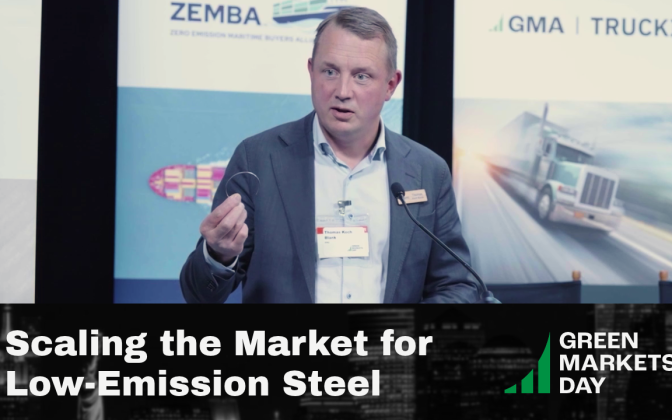
Thomas Koch Blank, Managing Director at RMI, discussed the state of the low-emission steel market and announced the release of a new book and claim framework for steel. Developed with more than 20 organizations and based on real market transactions, the framework is designed to build the systemic trust that buyers and producers need to transact at scale, since the emissions benefit of low-carbon steel can’t be seen or tested in the product itself.
See below for a full transcript.
TRANSCRIPT
THOMAS KOCH BLANK:
Good afternoon. We’re running towards the end of a busy day, so I will try to keep this fairly short. Thanks for joining us here this whole afternoon together with this amazing set of partners that were here to really work on activating supply chains and reducing emissions in our Scope 3 footprint.
We have heard throughout the day the value and the need for standards and market infrastructure and early transactions to lead the way in shaping these transitions. I’m going to talk a little bit about the steel sector where we can really see examples of all of these imperatives.
The industry is indeed moving. There are some real strong evidence of availability of supply and demand connecting, but we still need a stronger demand signal and we need credible market mechanism to support the supply chain. We even have representatives in this room that are building the next generation steel plants that will allow us to actually make a significant reduction in the steel supply chain footprint.
So there’s no longer really a technology question in the steel sector. Of course, there is a question of whether, you know, which technology will capture market share in the end, but there is not a question of whether or not there is a technology available.
So what we need now are conditions to finance and conditions to deploy and scale these technologies. Connecting demand with supply is critical, as critical for the steel sector as for any sector that we engage with. And to facilitate this, we, as an organization, together with many of you in this room, work across multiple enablers here to create transparency, financing, procurement practices through a number of different platforms.
I think, in an essence, part of the problem here is that we can’t — we’re trying to facilitate transactions of a value that you want to pay for that you can’t really see in the product that you’re buying. So I’m wearing this bracelet which is made out of fossil-free steel to remind myself that the technology is available, but I’m also claiming that right now and there is no way for you to prove whether that’s right or wrong. You can’t sample it, you can’t test it, you can’t bend it to see whether it’s fossil-free or not. You’re going to have to take my word for it.
Now, that’s one problem that we are trying to address with the market mechanism we’re putting in place. There’s another problem with dilution of demand signals. There’s a problem of cost and logistics of a bulky product. All of these barriers are addressed with what we all know and are familiar with as a book and claim framework. And while it’s not a sort of a silver bullet for market conditions, it’s actually quite helpful for early transactions.
But in the end, going back to my bracelet, the foundation of the market is trust. So you can choose to trust me when I claim that it’s a hydrogen-reduced piece of steel. But it’s better for all if it’s a systemic and institutionalized trust base that allows everyone to transact at scale.
So questions like what qualifies as low carbon? What emission reductions are verifiable? How do you make sure you have integrity in the transactions are really, really critical. And it might sound like basic fundamentals, but we need to create that trust in the market because it’s not automatically there.
So what we have done to contribute here is to… if this works. No, it did not work. There we go. Maybe it was up already.
We have released today a book and claim framework for steel that is bringing what we consider to be a well already tested framework. We’ve based this on real transactions in the market with again with multiple participants in this room. But we’ve also done it in a collaborative effort with more than 20 organizations involved. We have facilitated this in our independent nonprofit position of getting both buyers and producers, tech suppliers and academics involved in creating this standard or this framework. So this collaboration is important because that’s how we move the trust in the solution from a single organization into a more systemic and established trust base.
We’ve gotten some positive response already from this framework. We see that it’s being used already in some real market transactions. I think it’s worth noting that as these frameworks are developed not only in steel but in other sectors as well, we’re all involved in moving these forward. For each sector, we dig into the details of the transaction mechanisms. We learn something that we can bring with us to the next sector we work with.
We are addressing at this point a number of sectors. I do not remember the exact number that we’re working on here together with GMA and others, but we’re knocking on double digit, which is really exciting. And across all these sectors, of course, the goal is to convert demand into investment so that we see new technology deploy. And we see real impact on the supply chains. Right.
So I’ll close out here because I realize that I’m almost the last thing between everyone here and drinks by inviting you all to continue collaborating with us as we move this work forward across more sectors and more transactions. Thank you very much.
Related News & Resources