11.02.26
Green Markets Day 2026 | From Demand to Deployment, Scaling Zero-Emission Freight
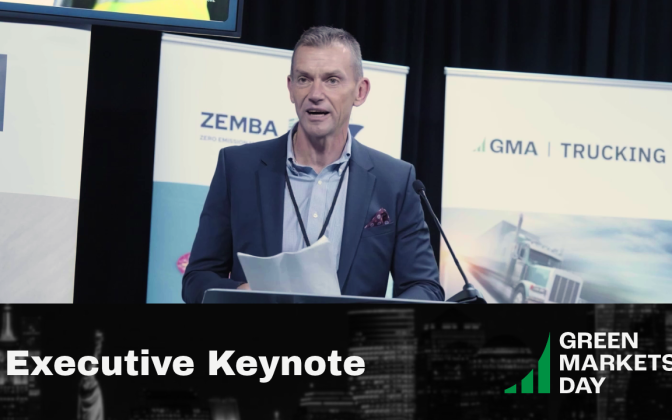
Christoph Wolff, CEO of Smart Freight Centre, announced the largest electric truck order in US history: 2,500 battery electric Class 8 trucks, ordered through ZET SCALE together with Catalyst Mobility. He explained how pooling shippers’ freight demand, concentrating deployments in high-density freight hubs, and giving carriers demand certainty broke the chicken-and-egg problem holding electric trucking back, and how the next wave, in partnership with GMA, will combine physical procurement with book and claim.
See below for a full transcript.
TRANSCRIPT
CHRISTOPH WOLFF:
Good afternoon. Thanks for Kari, Kim, Andre and the GMA team for inviting us. Exciting things happening today.
I’m going to start with the headline because it’s a big headline. Today, and that meant 9 o’clock this morning, we, and this is Catalyst Mobility and Smart Freight Centre, announced the largest electric truck order in US history. 2,500 battery electric Class 8 trucks. A single order large enough on its own to nearly double the entire electric Class 8 fleet on American roads today. Thank you. A single order large enough on its own to nearly double the entire electric Class 8 fleet – I said that.
And here’s the part that matters most. This did not happen because a truck got cheaper by accident or because one company placed a big bet. It happened because some of the world’s largest shippers did something none of them could have done alone. They pooled their freight demand and they built a market that didn’t exist before.
That’s what I want to talk to you about for the next few minutes, not just what we accomplished but how it became possible and where it goes from here.
Let me set up why this is hard because it explains why it hasn’t happened until now. An electric truck today costs roughly three times what a diesel truck costs. Now, the technology works, the trucks are real and they’re on the road. But you can have the best technology in the world and still not have a market. And that price gap is exactly why electric trucking has been stuck in small-scale pilot for years.
Think about the position that everybody is in. A carrier can’t invest in trucks that cost three times as much without knowing the freight will be there to pay for them. A truck maker can’t bring the price down without volume. And they can’t get volume until the price comes down. And a single shipper, no matter how committed, can’t pay a high green premium on a lot of its freight. Multiple chicken and egg problems all around. So everybody waits for somebody else to go first. The technology is ready. The ambition is there. Nothing moves.
That’s what ZET SCALE was built to break. And this is how we did it. We went to the shippers, the companies whose products move on these trucks, and we aggregated their demand. Not vague interest. Real freight on real lanes. And they were willing to put behind this. In total, the demand we’ve aggregated is equivalent to more than 20,000 trucks. We took fragmented interest, scattered around dozens of companies and turned it into one credible, actionable signal.
And that signal changes economics in three specific ways. First, it pools volume so manufacturers can finally price at scale. When you show a truck maker thousands of trucks instead of a handful, you give them a reason to sharpen their pencil. And as you’ll see, they did. Second, we concentrate the deployments in about ten high-density freight hubs, places where the routes are strong and the economics already work best. That concentration drives up utilization of both the trucks and the charging, which pulls the total cost of ownership down further.
Third, it gives carriers demand certainty. A carrier can invest with confidence when they can see the freight is committed on the lanes they have run, they are running. That certainty is what turns a good intention into an order.
Put those three things together, and you’ve done something important. You’ve taken a desired goal and turned it into a calculated business case. And the scale of that opportunity is real. For the price reductions we achieved, more than half of the demand we aggregated could reach cost parity with diesel. That’s the whole game. And that’s how trucks leave the pilot phase and scale.
This has been the work of the past 18 months, with shippers, carriers, and manufacturers, and our finance partner. It was not fast, and it wasn’t simple. First-of-a-kind coalitions never are. But the result is not a pledge or a press release. It is a committed firm order.
Let me be clear about the ambition first, because it frames everything. Our goal with ZET SCALE is 10,000 trucks over the next few years. That’s a level we believe creates a self-sustaining market. The point where electric trucking no longer needs a coalition to organize it, because the economics carry it on their own. So this first round is the first 2,000 trucks toward that goal.
And to place that order, we ran a competitive RFP, open to every manufacturer offering– offering a battery electric Class 8 truck in the United States. We evaluated on price, performance, production capability and maintenance support. Here’s the most single, most important result. Every bidder lowered its price in response to the scaled demand. That’s the proof the model works. The process didn’t just get us one good deal. It moved the whole market at once.
From that process, we selected Tesla as a primary OEM for the first 2,500 trucks. Chosen on price, performance, production capability and maintenance support. And for carriers who want other options, additional qualified manufacturers are available to them as well. This was never about picking one OEM and closing the door. It’s about giving carriers real competitive choice.
Now a truck order is only half the puzzle. The other half is who pays for it. So we brought in a dedicated finance partner, ZET Financial, who will purchase the trucks and lease them to carriers and critically absorb the residual value risk. That’s the fear of what the truck is worth at the end of the lease and that it’s kept a lot of carriers on the sidelines. Taking that off their books is a big part of what makes this bankable.
Step back for a second because I don’t want the numbers to obscure the point. What we have really done is align an entire ecosystem and lower the risk for every part in it. The shipper, the carrier, the manufacturer, the financier, the charging provider. Each of them was waiting on the others. Aggregated demand gave all of them a reason to move at the same time.
And that’s the insight I ask you to take away. When you aggregate demand, you turn a desired goal into a calculated business case. And that’s how costs actually move. Not with a subsidy, though they help us move faster. Not with a press release or press conference. With a real organized signal that the market can price against. And that’s how electric trucks leave the pilot phase and scale.
So where do we go from here? This is round one. The opening chapter, the overture, not the ceiling. Remember the ambition is 10,000 and beyond. And we get there on two reinforcing tracks. The first is more physical procurement, more waves like this one. Every wave adds volume to the pool, which pushes prices down further, adds routes that lift truck and charger utilization and strengthens the demand signal. For the next round, it compounds. It creates a flywheel.
The second track is newer and I’m excited about it, book and claim. Book and claim lets the shipper fund electric trucking and claim the environmental benefit even when they can’t yet route their own physical freight onto an electric lane. In the next wave, in partnership with GMA, we’ll combine physical procurement with book and claim. So a shipper whose freight does not yet run through one of our hubs can still put demand into the system, fund real emission reductions and strengthen the business case for carriers.
Why does that matter? Because it widens the pool of shippers who can participate far beyond those who can physically deploy today. And the physical deployments stay the anchor. Real trucks on real routes doing real work. Book and claim doesn’t replace that. It extends it. It expands it.
Together, physical and book and claim create a positive feedback loop. More physical demand lets carriers offer competitive rates, which pulls in more book and claim buyers, which funds more trucks and pushes utilization even higher. That loop is how we scale faster than either lever could get us there alone.
I want to leave you with that. The math only gets better from here. Every shipper who joins adds volume. More volume improves utilization. Better utilization strengthens the signal. And a stronger signal brings the next round of trucks down in price again.
So if your freight moves through these corridors, or you want it to, there’s a seat for you at this table. This is the moment the market for electric trucking stopped being something we simply hoped for, and it started being something we are building together. Thank you very much.
Related News & Resources