11.18.26
GMA Insights | Book and Claim for Cement and Concrete: What’s New in V1.1
The Center for Green Market Activation (GMA) and RMI have released V1.1 of the Book and Claim for Cement and Concrete framework, with three changes designed to help emerging low-carbon materials scale through environmental attribute certificate (EAC) contracts. This article shows what has changed and why.
In January 2026, a Working Group of more than 30 organizations across the concrete value chain informed, approved, and published the Book and Claim for Cement and Concrete framework. The effort, led by GMA and RMI (together, the “Organizers”), provides first-of-its-kind guidance for using book and claim to support the production and adoption of low-carbon cement and concrete. Since then, buyers and suppliers around the world have shown strong interest and shared feedback as they work to sign contracts and issue their first certificates.
Based on that feedback, extensive stakeholder engagement, Working Group sessions and a six-month review of what is holding back investment in supplementary cementitious materials (SCMs), the Organizers proposed three changes, which the framework’s Steering Committee approved in October 2026:
- 1) Adding a new direct pathway for non-traditional SCMs to issue environmental attribute certificates (EACs)
- 2) Setting a clear limit on how much traditional (non-activated, non-beneficiated) fly ash and ground granulated blast furnace slag (GGBFS) can be used in blended products that issue EACs
- 3) Extending eligibility of GCCA Band C products to 2035
The Organizers believe that these changes will support the development of robust and high-integrity markets for low-carbon cement and concrete environmental attribute certificates. Together, the changes enable an additional set of low-carbon material producers and a broader range of potential buyers to engage with the market, while also putting safeguards in place to ensure that existing products are not inappropriately utilizing EACs to monetize production methods that are already commonplace and inherently linked to the fossil energy system.
Framework Updates
New direct issuance pathway for SCMs
Non-traditional and emerging SCMs are critical for reducing global emissions from concrete production and use. Many of these products can be produced with a fraction of the emissions of clinker, the primary ingredient of conventional cement, and industry sector transition scenarios rely on the adoption of SCMs to cut clinker use. For example, the Mission Possible Partnership Sector Transition Scenario targeted a global clinker factor of 0.52 by 2050 vs. 0.63 today.
Stakeholders raised concerns that novel SCMs will continue to struggle to scale, despite their decarbonization benefits, unless they can participate directly in EAC markets. While, under the original framework, SCM producers could partner with cement or concrete manufacturers issuing EACs, these contracts are usually too short in duration for the SCM producer to raise the capital required to build a plant. Direct issuance gives SCM producers a path to firm, long-term offtake contracts that can unlock financing and production at scale.
However, SCMs present an accounting challenge because they differ from clinker, cement, and concrete. SCMs cannot replace 100% of clinker on their own in a cement or concrete blend and, consequently, EACs from SCMs cannot directly replace cement or concrete emissions in a company’s inventory without specific guardrails or transformations. Doing so would overstate what is technically feasible and risk undermining the credibility of the broader book and claim system.
The Organizers identified a way to allow SCM issuance while managing this complexity. The approach combines three inputs: the SCM’s “replacement rate” (the share of traditional cementitious material it can replace), its global warming potential (GWP), and the GWP of ordinary Portland cement (OPC) in its market. With these inputs, the SCM producer can issue a “cement-equivalent product” EAC, which can follow all other guidance in the framework under the cement functional unit.
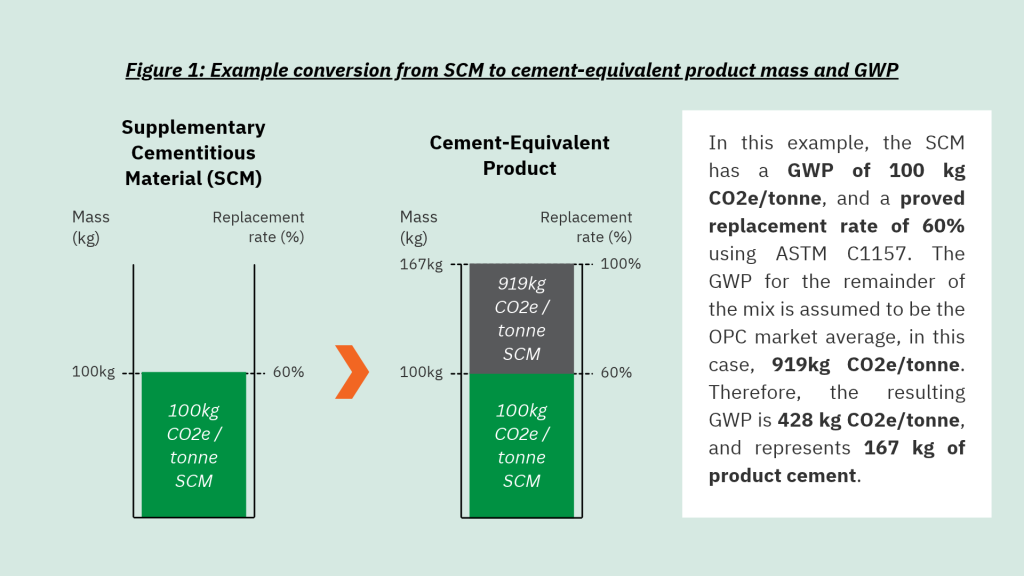
This option was chosen because it balances consistency with the existing framework, comparability to other EACs, and environmental integrity and accuracy. It incorporates the limits of SCMs while creating a verifiable way to determine the key unknowns. SCM EACs issued this way can also use the existing cement eligibility criteria, so no new SCM-specific thresholds are needed. Finally, it gives buyers a clear way to compare EACs from SCMs and cement products.
While this change is important to enable financing of novel SCM production, not all SCMs need book and claim. Conventional GGBFS and fly ash are widely available, cost-competitive, and already in common use. They are also supply-constrained: most of the world’s supply of these industrial byproducts is already consumed, so more use in one place often just shifts it from one project to another, rather than adding new product to the market. For these reasons, conventional GGBFS and fly ash cannot issue EACs directly. GGBFS and fly ash remain vital to reducing clinker consumption, but do not need this additional pathway to do that.
Clearer limits on GGBFS and fly ash
Building on the prohibition of non-beneficiated, non-activated fly ash and GGBFS from issuing EACs, V1.1 of the framework similarly places firm limits on the use of these materials in blended cements and concretes. Section 3.3 of the V1.0 framework stated that “EACs should not be issued for blended cements or concretes for which non-beneficiated or non-activated traditional SCMs, defined as fly ash from coal-fired power plants or GGBFS, represent the primary driver of emissions reductions relative to the appropriate baseline for the cement or concrete mix.” Because this was a recommendation, not a requirement, buyers and sellers were left to decide eligibility themselves.
This led to confusion and inconsistent interpretations among buyers contracting for products that use these materials. V1.1 revises Section 3.3 to state that, while these materials can be used in a blend, they cannot be the primary driver of decarbonization. Additionally, it sets a specific definition to enable producers and companies to verify compliance with that requirement. Because product emissions calculations and scopes vary, the evaluation focuses on the proportional mass of materials in the cement or concrete mix issuing an EAC: conventional GGBFS and fly ash may not exceed 50% of all low-carbon cementitious materials, which includes clinker made with CCS, other SCMs, alternative cements, and the conventional GGBFS and fly ash.
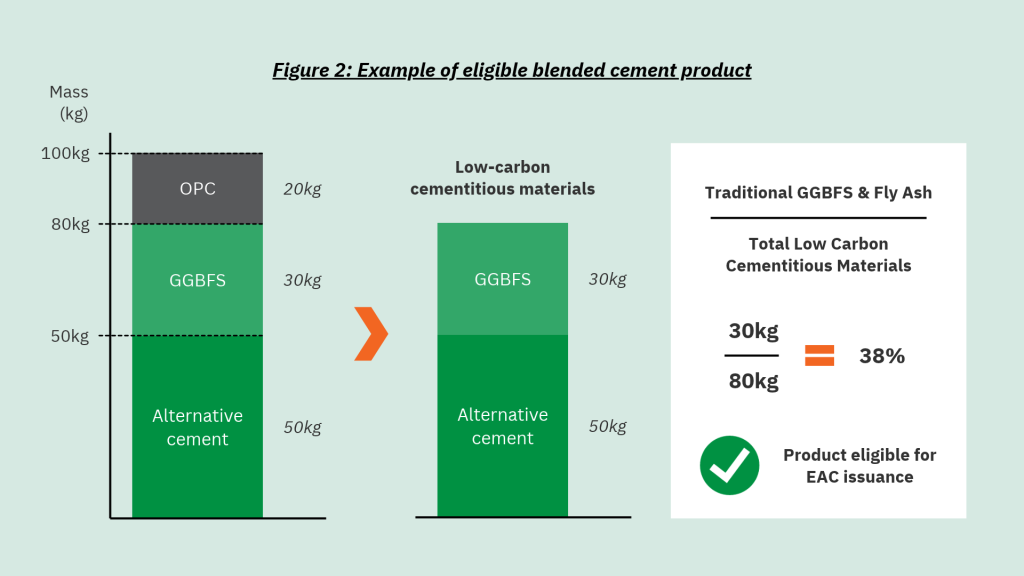
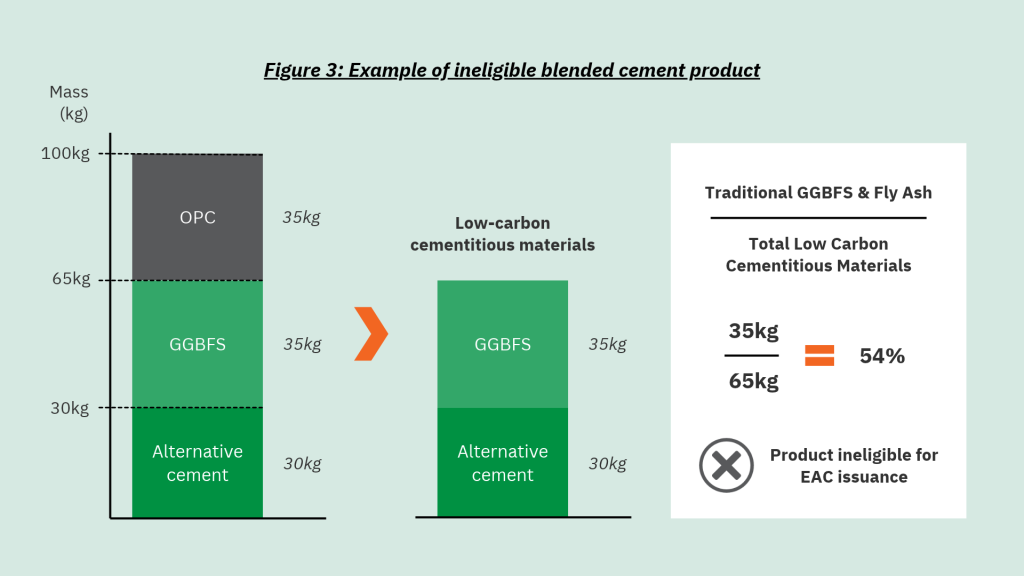
Rather than excluding these products entirely, this approach keeps book and claim focused on novel technologies without disrupting common commercial products. For example, CEM III blends, which contain large shares of GGBFS, are commonplace in Europe. If every cement blend containing GGBFS were ineligible, even CEM III blends made with low-carbon clinker produced using CCS would be unable to generate EACs.
This update will provide greater clarity and ensure that business-as-usual blends are withheld from participation, and emerging technologies are prioritized for EAC issuance.
Band C eligibility extended to 2035
V1.1 extends Global Cement and Concrete Association (GCCA) Band C as the minimum emissions-intensity threshold for EAC eligibility through 2035, five years longer than V1.0 allowed. V1.0 had called for the threshold to rise to Band B in 2030, to raise ambition and push the market toward deeper decarbonization.
The challenge is that many novel products, from alternative cementitious materials (ACMs) to SCMs to clinker with CCS, have great potential to decarbonize the industry but do not yet meet the Band B threshold. Further engagement with producers of these novel products reinforced that eligibility would be needed beyond 2030 because more than 5 years of firm revenue would generally be required to finance a plant producing low-carbon products. In short, restricting eligibility of Band C products to 2030 is stalling contracts today.
Additionally, deeper engagement with potential buyers of EACs has surfaced that a substantial pool of demand in the traditional real estate development community is most likely to participate in markets for low-carbon materials in the near-term only if premiums are modest. Engaging this buyer group, while simultaneously pushing more ambitious buyers towards products unlocking deep decarbonization, will help ensure the market for low-carbon materials becomes broad and strong. Over time, this provides the basis to ratchet up ambition as the system limits eligibility to only products meeting Band B or better.
Lastly and critically, concerns around extended eligibility of Band C products focused on the sale of EACs from fossil SCMs that are commonly used today. The explicit exclusion of these products from the SCM issuance pathway and the constraints on their use in blended cements and concretes dramatically reduce the likelihood that a business-as-usual Band C product can issue an EAC.
In light of these considerations, the Organizers and Steering Committee voted to extend Band C eligibility to 2035. This allows more novel products to use the book and claim market to grow production, without flooding the market with EACs from traditional, currently available products.
What’s Next for the Framework?
Addressing these challenges gives the market the clarity and stability it needs to sign contracts and issue EACs. GMA and RMI do not plan further revisions for at least one to two years, barring the emergence of material implementation challenges or areas of divergence from the broader standards landscape.
Meanwhile, GMA and RMI are focused on building the infrastructure for EAC transactions. This includes the currently active Sustainable Concrete Buyers Alliance (SCoBA) procurement, which recently named Fortera the winner of its selection phase. Once contracts are finalized, SCoBA will turn to growing demand and launching its next procurement round.
RMI and GMA also recently issued a request for information (RFI) to find partners to build a data registry for clinker, cement, and concrete EACs. The goal is to build a registry for concrete and connect it with registries in other sectors, such as aviation, maritime, and steel, to provide buyers with a “one-stop shop” for all EACs.
With a stable framework, a demand aggregation function, and a credible data registry, the market for concrete EACs will have the tools it needs to scale. Read the full V1.1 framework, and contact info@buildscoba.org to get involved.
Related News & Resources