11.02.26
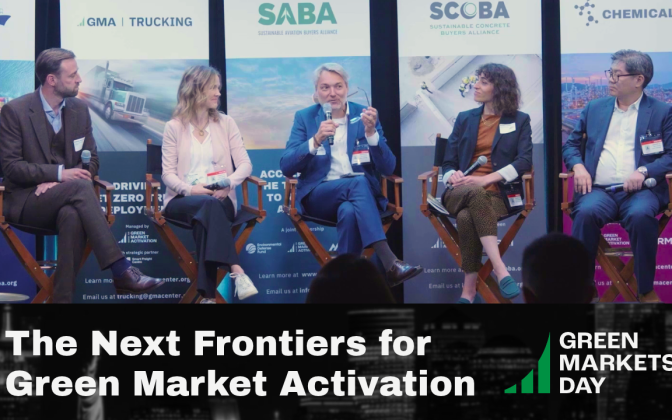
Green Markets Day 2026 | Panel: The Next Frontiers for Green Market Activation: New Technologies, New Sectors, New Regions
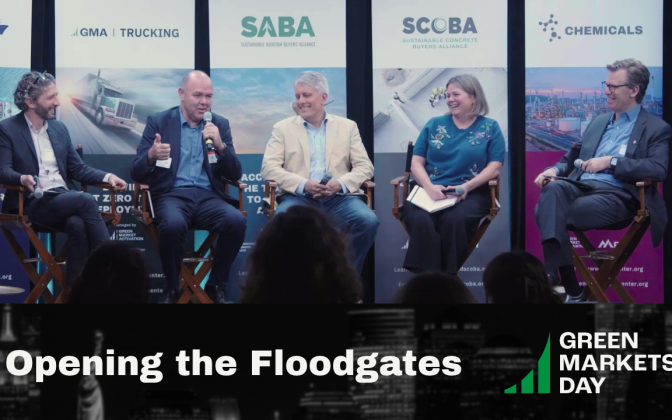
Moderated by Andrew Alcorta, Senior Director at GMA, this panel featured Philippe Vedrenne, CEO of 3Degrees; Frederick Teo, CEO of GenZero; Rachel Lichte, Interim CEO of the Good Food Institute; and Devon Lake, Head of Net Zero Strategy at Meta. The panelists explored where demand aggregation and market mechanisms should go next, from new sectors such as metals, plastics, low-carbon fertilizer, green ammonia and alternative proteins to new regions, especially the Asia Pacific. They also discussed the standards and market infrastructure needed to work across geographies, and shared what success could look like five years from now.
See below for a full transcript.
TRANSCRIPT
ANDREW ALCORTA:
So, first of all, thank you to the panelists and we’ll do introductions in just a moment. But I just want to start with some reflections and perhaps some framing for this conversation about new frontiers for demand aggregation and market mechanisms.
Every Green Markets Day, I find myself kind of looking around the room and seeing all the various folks that I know from past lives and that I know from some of the work that we’re doing within various GMA initiatives. And it is hard not to be blown away by the amount of good work that is happening in this space, even in spite of some real headwinds that I know many of us are feeling at the moment.
And so I think it’s important to start by recognizing that there is real progress happening here and that deploying things like demand aggregation, deploying market mechanisms and book and claim is allowing us to really create wins in a number of sectors that have been very challenging to move forward for quite some time.
And if I think back to the deals that move markets panel earlier in the day, I think it is a reflection of the fact that we are seeing real projects move forward that either would have taken much longer or might not have been able to move forward absent these mechanisms.
And it’s a good opportunity to step back and really take stock of the fact that we have something that is working, right? And we need more of it and we need more of it faster, but we have found something that really is moving the needle and not only allowing projects to move forward to FID, but ultimately is going to put steel in the ground for low-carbon projects that we can point to as a demonstration that this is possible.
And so I think it’s against that backdrop that it’s important to really ask the question, where else can and should we be applying these mechanisms? And that’s what we’re going to explore on the panel today and we want to take that from two lenses.
The first is what other sectors might be ripe for demand aggregation, for market mechanisms to really be applied and to accelerate progress beyond what we’re seeing? And the second is what new geographies can we bring these mechanisms to or scale these mechanisms in more aggressively and how can we do that effectively?
On the first one, as we think about additional sectors, there are two places that I just want to pause on and frame out. I think it’s important to step back and look at the entire emissions stack that we’re trying to solve for.
25% of emissions come from industrial production. Cement and concrete, steel, copper, aluminum, a lot of things that we take for granted and don’t think about, but that are responsible for this structure that we’re in today, are responsible for the phones and laptops that we are doing business on every day. And it is a sector where, despite the fact that we all know there is a huge impact and a huge challenge that we need to tackle, very little progress has been made to date in many of these sectors. And we have seen some announcements here and there about low-carbon production, but they are still the exception and not the norm. And I think understanding how we can be applying some of these mechanisms to industrial commodities and to industrial production is a question that we really need to seriously ask here, particularly when a lot of the market failures that we have successfully addressed in some of the transportation sectors are also present in industrial commodities. And I think we could bring some of the same solutions to bear.
Another sector that we need to look at here is agriculture, which is another 20 to 25 percent of emissions and is another place where there are some really challenging problems. And we are beginning to move forward and get traction on some of those, but we have a very long way to go. And so thinking about how can we accelerate some of that progress is really, really critical.
If I switch and think about the geographic side for a moment, many of us live in this world and we’re trying to figure out how to get these projects across the line. But I think it’s really important to step back and remember that while many of the interactions we may be having on a day-to-day basis or with colleagues in the U.S. or North America or sometimes Europe, the projects that can really deliver here can happen all over the world. And particularly when you look at the global south, some of the energy cost fundamentals are incredibly compelling in terms of being able to bring new technologies to the market at effective costs if we can solve for the capital stack.
And at the same time, there is demand all over the world. I was looking up some stats as I was preparing for this, and it is remarkable to think, I think for many of us, that only 10% of the validated SBTi targets come from companies headquartered in North America. 35% of the targets come from companies headquartered in Asia. And so there is an enormous amount of opportunity. And if we are going to make the voluntary markets drive the change that we need to see and live up to their potential, we need not just the first wave of demand that some of the folks, including people here on the stage, are delivering, but we need to figure out who is going to follow that demand. And part of that is recruiting the next set of buyers in the markets that we’re operating in today, but part of that is also expanding the aperture and looking at new markets. And so that’s what we get to explore over the next 35 minutes or so, and I’m really excited to get into the conversation. And we’ll talk about the sector element of this, the geographic element of this, and– and I want us to really pause and talk for a few minutes about, okay, well, if we execute on that and if we do it right, what does the world look like? I think it’s easy for many of us to get caught up in the day-to-day of the work, and it’s important to step back and say, what is the vision here and what can we actually achieve if we are effective in rolling these mechanisms out? So with that, I will pause.
I would love to turn to the panel here and ask everyone on the panel to provide a very quick introduction, name, organization, perhaps a little bit of context. And I can start here briefly. My name is Andrew Alcorta. I’m a senior director at the Center for Green Market Activation. I lead our low-emissions materials work, which includes both cement and concrete, ammonia, and other high-value chemicals. And I’m very excited to be here with you all today. Devon.
DEVON LAKE:
Hi. Devon Lake. I’m the head of net zero strategy at Meta. And I think this is my third Green Markets Day. And it’s just a thrill to be here and see how many different sectors are represented. I’m really excited to talk about the new sectors that are coming. And my team leads basically all of our work, investing in market mechanisms across many of the commodities and technologies that we’re talking about here.
PHILIPPE VEDRENNE:
Hi, everyone. I’m Philippe Vedrenne, CEO of 3Degrees. 3Degrees is a global climate solutions provider. We help companies to reduce emissions on Scope 1, 2 and 3. We have been in the business now for more than 20 years. We are a B Corp. We’ve just reached the $1 billion turnover. Joined this company one year ago. I spent 25 years before in the energy space. Still new in this space, but very excited about what we try to do all together. Thank you for having me here.
RACHEL LICHTE:
Hello. Wonderful. Hi, I’m Rachel Lichte. I’m the interim CEO of the Good Food Institute, or GFI. We are a nonprofit think tank, and we focus on unlocking the resources and the knowledge to change how meat is made in order to create our vision of a thriving world fed sustainably. We just celebrated our 10-year anniversary. We have a presence here in the United States, and we have affiliates around the globe, so we’re a global network. And I’m absolutely thrilled to be talking about new opportunities for aggregating market demand.
FREDERICK TEO:
Very good. Hi, my name is Fred again. I’m CEO of GenZero. I think GenZero is probably the baby on the block here. So we are just slightly over four years old. We are a climate investment company headquartered in Singapore, wholly owned by Temasek Holdings. We invest into nature, technology, as well as climate ecosystem solutions. And we have been focusing on delivering both sustainable financial returns from our investments, as well as to deliver climate impact from our investments. Thank you.
ANDREW ALCORTA:
Wonderful. And thank you all for joining us today. Devon, I want to start with you. And, you know, as I think about the challenge that Meta is tackling here with the net zero goal, the supply chain that you all have to manage is incredibly complex, right? And it spans power, cement and concrete, steel, all sorts of metals, from products to data centers, and even food, right? And so as you are thinking about the next set of opportunities, what are you all focused on as the sectors that you really want to try to deploy market activation techniques in and move the needle in?
DEVON LAKE:
Yeah, no, that’s a great question, and it’s one that my team really loves kind of digging into. So the sectors that you mentioned, cement and concrete, steel, iron, we’re now on our third, fourth, fifth transactions in each of those sectors. And it gets easier. The AIM Platform is our bible. I say this all the time. We now have guidance, which we didn’t three years ago, in terms of what makes a quality investment of this kind. The book and claim systems are out there. We’re getting the sector guidance that docs in. So the whole process from an investment point of view is really becoming much easier. And the counterparties, the folks bringing us the projects, whether it’s through buyers alliances or directly, are also much more mature. So all that to say, you know, I have a lot of hope for where this can get to.
It’s been interesting to start to work, for example, on the trucking sector. That was one of the things that I have to do is to get my leadership excited about every new sector we go to. It’s not enough to say that deep in the bowels of my Scope 3 EEIO factors, like this emissions is there. That doesn’t, you know, that doesn’t, it’s not going to get the money moving. So instead, what we do is we really help communicate what are the sectors that we drive through our business and that our suppliers operate in, what are the solutions that those sectors need to decarbonize, how can we do investments now so that in five or ten years our suppliers can be using these solutions directly, or we can be using these solutions directly.
So one of the sectors that we’ve been spending more time in is plastics, which is what we’ve named chemicals, because chemicals didn’t capture the imagination, but plastics people can touch and feel from a data center perspective. So we actually just did our first plastics project, which was announced today with Macrocycle this morning, and we’re learning in that sector. And so I think another sector that we’re really interested in continuing to explore is, what are the other metals that we can be doing work in? Copper, aluminum, we know that these metals are relevant to us and our suppliers, and we’re still very early in terms of figuring that out.
ANDREW ALCORTA:
Wonderful. Thank you, Devon. Philippe, I want to turn to you. And I would ask that maybe you share a little bit about what 3Degrees is currently doing in regards to low-emissions fertilizer, low-emissions ammonia. And if you can say a little bit about why book and claim might be particularly important in this sector, it would be wonderful.
PHILIPPE VEDRENNE:
Yeah, this is actually one of our core topics. I mean, when we are talking about low-carbon fertilizers or fertilizers, generally speaking, what are we talking about in terms of emissions? This is a really hard spot. I mean, fertilizer industry emits roughly 1.3 gigaton of emissions on a yearly basis. I think it’s nearly a quarter of total U.S. emissions on a yearly basis, or equivalent of 300 million of vehicles powered with gasoline. So it’s really a very, very important sector in terms of emissions. And 40% of these emissions resides in the production of these fertilizers.
So end of 2023, 2024, 2025, we decided to launch the Low-Carbon Fertilizer Alliance, bringing together actually consumer brands, forward-looking companies who wanted to accelerate the decarbonization of this space. And technologies exist, actually. You can use catalytic technologies to abate nitrous oxides in nitric acid plants. You can install CCS, carbon capture and storage when you produce ammonia. And you can in the future even produce green ammonia with green power, water and air.
Now, you need investments to deploy these technologies. And these emissions happen very upstream in the value chains of these big brands. And so there is a huge and very complex supply chain that sits in between. I mean, these potential investments and this ultimate consumer brands company.
Now, that’s where actually collective action and market-based instrument comes into play. With market-based instrument, as long as you can associate your intervention or investment to, let’s say, a geographic boundary which makes sense towards your value chain, then you can overcome this problem of not being able to do direct procurement from your fertilizer industry. And so you can deploy market-based instruments collectively. And that was the other element which was important.
When you need to invest in these assets, and we mentioned that earlier in the day, I mean, no one can afford investing in a single asset. So having a collective approach, a pool of investors that can fill their actual capital through these technologies, make these technologies accessible, lower the initial ticket for each of them, and building a coalition of buyers as well, resolve a risk management issue, which is, in general, these budgets are only yearly budgets, and you want to have a steady flow of money over the years to finance not only the capex but the opex of these technologies.
So one of our first interventions was with CF Industries, which is a large fertilizer producer in the United States. We finance a catalytic-based technology to reduce emissions by 600,000 tons per annum, so that’s a significant one. We have currently 25 members in this LCFA alliance. We are going to add new projects, and the next step now is what you see on the left side, the Green Ammonia Buyers Alliance. We want to replicate what we have done with the Low-Carbon Fertilizer Alliance in the green ammonia sector. We will have exactly the same concept.
Coming from the renewable energy certificate business, actually we experienced today what we experienced 20-25 years ago, when actually through RECs we were allowing end consumers to have access to renewable power without having to manage the complexity of the supply chain and the logistics of power. So that’s where we are today, and we are still at the beginning with a lot to come, but with a good start.
ANDREW ALCORTA:
Wonderful. Thank you, Philippe. And we have been incredibly excited about the collaboration and the ability to move the Green Ammonia Buyers Alliance forward here. Rachel, let me go down to you, and I mentioned briefly in my opening that as we think about new sectors, industrial commodities is one space we need to think about, the agricultural sector is another. And there are some real tricky challenges when you start breaking down emissions from food and beverage and the agricultural supply chain more broadly, and animal proteins are at the heart of a lot of that. And so we’d love for you to share a little bit about, maybe just some context on the challenge as you see it, but also the solutions that you all are working on at the Good Food Institute.
RACHEL LICHTE:
Absolutely. So, you did speak to the overall global emissions of agriculture, but if we look at animal agriculture in particular, it’s 12% of global greenhouse gas emissions. So there is a huge percentage that we can focus on, just from animal agriculture. Animal agriculture is also incredibly inefficient. 80% of farmland is used for just 17% of the calories that are produced. And the demand is increasing. Right now, the projection is that it’s going to increase 50% by 2050. And animal agriculture is connected to some of the biggest issues that we face as a globe. So in addition to greenhouse gas emissions, we’re also looking at biodiversity loss, land use issues, water pollution, a whole slew of human health issues as well, zoonotic disease, antibiotic use resistance. There are a lot of issues that are connected to livestock and to animal agriculture.
So at GFI, we really focus on not trying to get people to change what they eat, but rather to look at how meat is made, how our protein is developed. And if we can produce those foods differently, then we have an opportunity to drastically reduce some of the negative side effects of it.
So at GFI, we focus primarily on three different types of proteins. So one of them is plant-based. Perhaps you have had it before down the street. You can get products like a Beyond Burger or Impossible that is primarily a plant-based protein. So meats that are made from plants. But we consume them, and they perform, and we experience them just like a conventional animal product. Another technology is fermentation-derived. So those are foods that are made. If you were to, you could walk in, at industrial scale, you could walk in and see huge tanks. They’re like three floors tall. They even go multiple floors through, and it looks like a big brewery. But rather than producing beer or yogurt, they’re producing proteins. And these proteins are used in really small amounts, but they provide critical functionality or performance or taste benefits to products. And then the third technology that we use or that we focus on is called cultivated meat. So these are meats made from animal cells rather than whole animals.
And across the board, we see that there is the emissions reductions are absolutely incredible. So through this and as we think about a buyer’s alliance here, we’re really focused on precision fermentation and in particular whey, so a dairy protein and eggs. And the emissions reductions potential there is significant. So with whey, we’d be reducing emissions by 77% land use. It’s less than 99% more efficient from a land use standpoint. And with egg, it’s 55%. And it continues on as we look at plant-based and cultivated as well. So huge, huge potential as far as more environmental benefits and in addition to others.
Over the past 10 years that GFI has been around, we’ve seen incredible development in this space. So 10 years ago, alternative proteins and protein diversification wasn’t really talked about a whole lot. But we have seen tremendous scientific advancement around the globe. There are three countries that have already approved cultivated meats. So in the United States, there are different restaurants and states you can go into and purchase cultivated meat right now. We have seen precision fermentation products, plant-based products make tremendous strides.
And we’ve also seen some headwinds. Over the past few years, we have seen that products were too expensive. Products did not meet the performance expectations. They didn’t taste quite right. They didn’t feel quite right. So we did not see them perform as businesses would have expected. But there is a whole set of technology that has continued to develop but is now really kind of caught in this middle where they have, there is technology that is ready to scale. There are businesses that see, that have invested in these technologies that have seen some benefit but there is a real need to scale them up more. So we’re in this kind of stalemate situation with technology that is ready to scale. Businesses that see some benefit, that see a value proposition primarily around the sustainability benefits or the price stability benefits, particularly as there is price volatility with dairy and eggs. But there is a big risk in investing.
And so as we think about opportunities to support and address this market failure, we’re very excited about what we’ve learned with GMA about the opportunity for something like a Buyers Alliance that would allow us to aggregate some of that demand and really signal that there is demand for these products in order to unlock that financing that can help scale up these technologies. So there is demand for these technologies. We’ve seen some from some of the large companies around the world, like JBS and Novonesis. There is technology that is ready to scale. There is tremendous greenhouse gas emission savings. And so we’re really excited about the potential for precision fermentation technology in particular.
ANDREW ALCORTA:
Wonderful. So, I mean, it’s really exciting to hear both the appetite to look up in upstream and supply chain and really understand what are those remaining hotspots. And a lot of what I’m hearing here is industrial commodities, right? Metals, materials, as well as ammonia into fertilizer is key opportunities in places where action is already taking place. And then, Rachel, I am hearing, you know, perhaps kind of the new frontier here as being how can we start applying demand aggregation to some of the other big problems that we know we have ahead of us in the transition.
I want to switch gears here and start moving to the second lens that we teed up at the beginning of geography. And Fred, I will start with you. And, you know, I think it’s important to start with the incredible work that GenZero is already doing on applying this model. And at least part of how I think about it is, you know, ultimately so much of what needs to happen to deploy these models is building understanding and building trust. And I think having folks that are operating in market and know the key players and can do that translation work is critical as we think about building those things. And so would love to hear how you are thinking about opportunities to apply demand aggregation and market mechanisms within the Asian context more broadly, both on the supply side, but also looking at the demand generation side of this.
FREDERICK TEO:
Sure. I think when we think about market activation, and that’s true in Asia, that will be true anywhere else. I think that I’ve got a couple of things that you probably need, especially when we’re talking about green solutions. The first is that you’ve got to be very clear about the policy and regulatory framework and environment. Whether it is about standards on what kind of new foods you will need to have, and Singapore went through that process as well, right? Or setting a sufficiently ambitious carbon price to be able to incentivize change and transformation. You’ve got to have the enabling regulatory and policy environment. Otherwise, it is also going to be very difficult for many corporates to make the case to often pay more, right, for some of these solutions. That’s one.
Two, given the current macro environment especially, it is important for us, when we’re talking about activation, to be able to connect to the audience. In other words, can we speak the language that people will understand? For many of us in this space, right, I mean, we are sometimes lost in our own alphabet soups and our own technical jargons, which only we understand. But the point of it is that when you are talking to others, you’ve got to be able to relate to them and explain things to them and have these solutions become appealing.
So, for example, all the good stuff that Rachel is talking about will not work if it doesn’t taste great, right, because food is experiential. We’ve got to find a way to tell people, look, you know, all of us love to travel, we want to see new cultures, new places, we’ve got to fly. Now, how do we do this in a way that doesn’t also make you feel bad about the impact that you are, you know, having on the planet, right? So, we’ve got to think about changing the narrative. So, both of these things actually require us to develop a little bit of an innovative framework and I will relate to some examples out in Asia on what we are trying to do.
Let’s talk about the narrative around climate and maybe shifting it from clean energy to a question around energy security and resilience. This issue around biofuels that we spoke about has actually come to the fore more recently, not because we all want to have like SAF for aviation but because you don’t want to be vulnerable to a single choke point somewhere in the Middle East. And that means that you’ve got to diversify your feedstock, you’ve got to diversify the way that you have access to fuels and that means in the near term biofuels or renewables or many other kinds of things. So, where we see an intersection between climate impact and energy resilience, that is a good place to activate.
Now, even on the food question, we work on carbon projects that are nature-based around the world. One very interesting project is in India where we talk about sustainable rice farming and that involves teaching some of the smallholder farmers practices around alternate wetting and drying. Now, why do we do it? When I visited some of the farmers in India, I asked them, you know, this practice has been around for a long, long time, why are you doing it now? And they said that that’s because over the past few years, the average rainfall in that part of India dropped by 50%. And as you know, rice farming involves continuous flooding of the rice fields. And so if you don’t have enough water, you’re going to have a real problem. So teaching them how to save water is important for their ability to continue to grow rice. But for us, it results in lower anaerobic decomposition, less methane emissions, and we can then credit it, right, and draw additional revenues. Now, so there is actually an adaptation concern here as well, right, because you are teaching them how to deal with agriculture in a much more water-constrained environment. And then there is a food resilience component to it.
But I belatedly also realized that there’s something else happening. With climate change, farmers need to adapt to very new conditions. So that means that they are sometimes switching out from food crops to cash crops. Take, for example, oil palm that uses about a third of the amount of water to produce the same amount of product. And each ton of that product, crude palm oil versus rice, is probably three times more valuable. If you are the smallholder farmer facing some of these challenges, it’s kind of like a no-brainer. But carbon revenues, for example, can then channel additional economics to the smallholder farmers to perhaps alleviate some of these negative disincentives. So this is important for us.
So in other words, change the narrative. We don’t need to always talk about climate impact. We don’t always have to talk about doing clean energy, low-impact food. Sometimes it’s about food resilience, energy resilience. We can talk about it in a language that others can understand. Secondly, we’ve got to corral each other or support each other to be able to get the correct policy frameworks to encourage action. And finally, I will also say that we’ve got to find the correct economic incentives because we have got to make sustainability sustainable. Great. Thanks.
ANDREW ALCORTA:
Thank you, Fred. Philippe, I want to turn back to you. And I know 3Degrees has operated across a range of markets and has sold market mechanisms ranging from RECs to other EACs in a number of markets. And, you know, I think as we are thinking about applying and scaling this model in new places, one of the questions is how do we need to adjust this model? Or to what extent should we be prioritizing consistency and standardization? So I’d be curious what lessons you have learned about, you know, where and how these models might need to be flexed in different policy or infrastructure or demand environments as you have operated in various geographies.
PHILIPPE VEDRENNE:
Yeah, I will share, I mean, our experience more on the REC side. I mean, we are operating nearly in 65 different EAC markets globally. And some of them are very mature. REC markets are very greeny markets. Here are very, I mean, standard liquid. Some others are much less. So we face a huge diversity in terms of market infrastructures. And when we look at these market infrastructures, four dimensions are important for us. The registries, I think we mentioned that in a previous session. The chain of custody, how we track actually the commodity. The local regulation. And I put that last, but I think it’s the most important, the accounting standard and target setting standard. And I will come back to that.
Of course, when we are talking about registries, there’s a question of cost to trade. There’s a question. I mean, registries are super important to, I mean, validate the eligible environmental assets that are registered. The claim and the environmental certificates you can issue from them and avoiding the double counting. So that’s super important. It’s important as well to make sure that, I mean, you have easy access to them. You can lower your cost to operate with them. And we’re not necessarily at the same level of, I would say, sophistication across the world. So that’s something that might be an impediment to development of a market-based mechanism.
Chain of custody. In the renewable energy certificates, we talk about book and claim, where you can completely separate the flow of the environmental certificates with a physical power. In other commodities, you talk about mass balance, which is probably a more precise system to track the environmental attributes across the value chain within blended systems. I mean, both of them are valid. I mean, one is probably easier to manage and create more fungibility. So it helps. So the book and claim system helps actually to create more scale in terms of tradability. Mass balance is probably a more challenge from that perspective. That’s the one we have typically in the biomethane sector globally. But nothing that you can’t overcome.
Then you come with the regulation. I mean, the regulation has two sides of the coin. Positive signals in terms of price and value that actually give incentives to the demand to be there and to actually buy for these environmental attributes. The other side of the coin is a regulatory uncertainty. As long as we can complain about voluntary markets because actually the demand is difficult to trigger and that’s come back to what is the correct narrative to have company making actions. We like sometimes having more regulatory, I mean, strong frameworks to incentivize these interventions. But actually on the other side, you take the risk of change of regulation and that might be as well a difficulty.
Last point I think which is important is accounting and target setting framework. I think we had a great discussion earlier with David from SBTi. Where are the markets we operate? I mean, we’re going to manage the structures of this market differently. The storytelling might be different depending on the commodity we are addressing. But we need to be consistent across geographies in terms of the way we measure and we report our interventions. And because we are still in this flux of evolving guidance, evolving regulatory frameworks in some areas in the world, it’s an impediment actually to scale up what we currently try to do.
For example, the fertilizer industry. We expect to expand that in many other geographies. In Asia, it’s probably the right place where we could have a lot of demand and a lot of projects. But applying what we did on Scope 2 and Scope 3 is not necessarily easy. And we need to take care about issues we face as well on Scope 2. I mean, it was mentioned earlier today. Additionality. When we are discussing about GO markets in Europe, there is no more additionality. The question of double counting emission factors that take into account the market-based instruments which are traded or not. The question of regional matching. I mean, how close you are between your operations and the source of your EACs. That are issues we’re going to face in the Scope 3 market developments.
We are at the beginning where we actually want to trigger these markets. So we want this investment coming from actually these high-end firms that are committed. But moving forward, we’ll see some challenges we will have to address in terms of precision, in terms of accounting, precision in terms of locationality. That we need to address with wide open eyes.
ANDREW ALCORTA:
No, it’s very helpful. And I think we want to make sure that we are learning lessons from prior market experiences and the reactions that have come there. And perhaps you can file this one under shameless plug. But I think this is where the AIM standard work can be really helpful to navigate some of those tradeoffs in the early days. And what we’re seeing is more convergence and ensuring that these nascent markets we are helping to get off the ground. But we’re doing it with a glide path that addresses all of these things is the balance that we have to strike here. Devon, I want to go to you and understand from the buyer’s perspective, what does it take to engage across markets? And what do you need to see in terms of rules and standards or from a project perspective to be able to really take a meaningful position in projects across a range of geographies?
DEVON LAKE:
Yeah, it’s a great question. And just to confirm, we’ve got three minutes. Yeah, we’re going to shorten the next bit of this. All right, I’m going to be real fast. So I would say at the highest level, it is certainly easier for us to transact in the U.S. And we’re going after solutions that don’t all exist in the U.S., right? Either because the emissions aren’t happening here, right? This is not where the copper smelting, as far as I understand it, is happening. I’m learning a lot about where the processes are and thus where the technologies are going to need to be deployed. So that’s one.
Two, this is Scope 3. We’ve got a huge portion of our Scope 3 that is based out of this country, mostly in APAC, right? So there are a number of different reasons to go beyond the U.S. market, and it gets progressively trickier because it gets less familiar, right? And so the more that we have the book and claim frameworks, the registries, the more we’re able to say, yeah, this looks familiar. We know how to go and transact here because a lot of the other pieces, to your point on the standards, we’ve got those parts, you know, figured out. We’ve got a playbook to follow.
So I would just say standardization, whether that’s the contracts, the, you know, systems that we’re using, is going to help our team because my guess is our team at Meta is probably larger than most of the teams that people in these buyers alliances is maybe paying attention to, maybe working on, and our team will struggle to go internationally if there isn’t some replicability and familiarity in the way that the markets work.
ANDREW ALCORTA:
Incredibly helpful. So being conscious of time, I want to maybe condense this last section and just go down the line and ask each of you, you know, if we were sitting here five years from now and your wildest dreams have been realized for kind of your priority in the sector, what does the world look like? And Fred, perhaps I’ll start with you.
FREDERICK TEO:
Oh, I usually think that if I’m extremely successful with my work, I don’t need to exist. So if we are highly successful at what we are doing, you won’t need to have a dedicated market activation capability because it would just be the norm. I think that it would take a lot to be able to get there. Clearly, there will need to be political will. We will need to be able to bring some of the costs down. But if I can just summarize in one thing, I think we do need to work with each other a lot more closely and be a lot more open-minded about the kind of coordination, understanding of what is actually happening out here. You know, America is a continental country. It is a big, huge country. But it is extremely important, like just what Devon was saying, to be aware of what is actually happening outside the US, what is happening in Europe, innovation that is happening in APAC, developments that are happening in Africa and South America because, you know, really a lot of the action and what needs to take place to be able to get us to net zero will be happening outside this country.
ANDREW ALCORTA:
Thank you, Fred. Rachel?
RACHEL LICHTE:
Yeah, so in thinking about the near-term future, I’m kind of wondering where we would have room on this stage for a buyer’s alliance that speaks to the precision fermentation opportunities. So another shameless plug there. And if there are any people interested, please do come and speak with us.
But I think that it’s very much aligned with what you shared, Fred, that ideally there wouldn’t be a need for an organization that is going out of its way, that we have greater protein diversification, that this is fairly unremarkable, that the way that we source proteins, the way that we are eating is much more sustainable, so is not emitting and is far more efficient. That is a longer-term future, so we are doing what we can along the way.
Near-term, looking at a buyers alliance opportunity to help aggregate that demand and scale up supply. Medium-term, diversifying even the types of proteins that can fit within that sort of aggregated demand. And then longer-term, just an unremarkable commodity market that is much more sustainable.
ANDREW ALCORTA:
Thank you. Philippe?
PHILIPPE VEDRENNE:
Yeah, I hope in five years we will be here with GMA and RMI to celebrate what we have done on the low-carbon fertilizer industry and ammonia industry. Hope that we will have more than 200 members by then, that we will have a lot of demand, not only coming from the U.S., but from Europe and from Asia, with a lot of projects everywhere in the world, meaning that will become brighter and better.
And hope as well that we will be able to stimulate demand over 10 years and 15 years, long-term commitments. Really the things which are critical. And that they will consider some as normal things to do when you want to manage your supply chain risk, when you use it as a hedge. Because actually, as you mentioned, at the end it’s a question of resilience and forward-looking. So I hope that we will be there in five years’ time.
ANDREW ALCORTA:
Wonderful. And Devon?
DEVON LAKE:
I’m going to go back to, I think someone mentioned shovel-ready projects and ribbon cuttings. I would love to see just a huge map of all of the ribbon cuttings from the plants that are actually built from these transactions because I’m learning a lot about what it takes to move from idea in the lab or startup concept, you know, shopping an idea around to investors to actually getting the project built. And I’m hopeful that the demand that we and others represent accelerates that process. And I really just am excited to see actual materials that we can consider putting in our own data centers, that we can say we help those get deployed in this other facility. That to me is where, you know, I can’t touch the carbon, so I want to touch the concrete and the cement and just know that this is actually changing things in the real world.
ANDREW ALCORTA:
Incredible. So we will check back in five years. We’ll probably do one-year checks between now and then. But thank you all so much for the time, for sharing your thoughts here. And this is where we’ll break and actually hand over to our colleagues at RMI to share some of the work that they are doing on one of the industrial commodities that we started the session talking about. So thank you all.
Related News & Resources