
10.27.25
Green Markets Day 2025 – Fireside Chat: Can Advance Market Commitments Jumpstart Climate’s Hardest Sectors
From Green Markets Day 2025 during New York Climate Week, this “fireside chat” session features David Roberts, Writer and Owner of the Volts podcast, and Clay Dumas, General Partner at Lowercarbon Capital.
See below for a full transcript.
DAVID ROBERTS:
Talk about some of the lessons learned in the initial waves of climate investment. Sort of like, I guess the kind of the standard story you hear is a bunch of digital tech investors got excited about climate, herded in, burned a bunch of money, wasted a bunch of money, didn’t get a lot out of it, learned a lot of lessons. Sort of what did the investor community take away from the earlier rounds of this?
CLAY DUMAS:
Yeah, I think you’re talking about what sometimes is referred to as Cleantech 1.0 and the wave of early investments in this space, a lot of them in solar and biofuels. It didn’t work out, or at least they didn’t work out on the timelines that the limited partners and investors in a lot of those funds hoped that they would.
Look, I’m one of those people that had a lot of those biases about investing in climate tech. Lowercarbon got started during the first Trump administration. We’re very much of this wave we call ClimateTech. Cleantech 1.0 was its own beast.
And a lot of the lessons that people took away from that first wave is that it’s going to cost a billion dollars just to get out the gates with any one of these technologies. The business models don’t pencil unless you get policies to change. And even then, you’ve got to find the buyers, customers, the consumers, the businesses who are going to pay more, suffer some inconvenience, go out of their way to buy your product. And none of that adds up to a good investment.
That’s how a lot of people thought about what we now call ClimateTech throughout the 2010s. And it’s why investment in this space dried up the way that it did.
For us and for a lot of other people that have gotten back in over the last few years, the thing that shifted our thinking was the underlying technology changes that made building companies in this space cheaper, better, faster than it had ever been before.
And when we started realizing the ways in which, I mean, it’s not just about renewable energy, right? You have told that story thousands of times about how the declining costs of solar and wind and now batteries will help to electrify everything.
That was foundational for a lot of the things that we would go on to invest in. But by itself, that wasn’t enough. It was also what was happening in electrochemistry and our command of inorganic materials in parallel to the incredible breakthroughs in synthetic biology, bringing down the cost of reading, writing, editing DNA by like a million X over the course of a couple of decades.
And then everything getting accelerated by machine learning. Now what we can all look each other in the eye and call AI.
And that shifted the core economics, where for just a few million dollars, you could de-risk a lot of the science and technology associated with the technologies that we invest in and start working on the really hard part of building a business, which is what we’re here to talk about today, and that’s distribution.
And how do you actually put products in the hands of customers?
DAVID ROBERTS:
Well, and talk a little bit about Lowercarbon, your approach, how you are distinguished from other investment firms, like how do you think about not just writing big checks, but the other stuff around them.
CLAY DUMAS:
Yeah, well, here’s what I’ll start off by saying. One really foundational belief that we had when we got started building Lowercarbon Capital, and I should just say Lowercarbon Capital is a firm I built with my partners, Chris and Crystal Sacca, who before this were building Lowercase Capital, legendarily successful early stage venture investors investing in consumer and enterprise technologies, a lot of household name companies like Uber and Twitter and Twilio and Instagram. A lot of the big names from that era of Web 2.0.
When we got started looking in this space, the one thing we deeply believed is that if we were going to have to guilt and shame our way into people’s homes and businesses, we were never going to get there. That there are only a couple hundred million people, I think if we’re being very generous with our fellow humans who are going to go out of their way and do the right thing for the planet and that just doesn’t get us anywhere.
We had to offer people something that was better, faster, cheaper, was more performant, was tastier, healthier, had better supply chains. And only if you could convert the other whatever, seven and a half billion people going on 8 billion people into hippies, did you have a chance of actually making a dent in atmospheric CO2.
So that was foundational for us is that it had to it had to win and had to win in people’s pocketbooks.
DAVID ROBERTS:
And so let’s talk about advanced market commitments then, because they’re a tool for that. Maybe like, I think people have been talking about them all day today, but just perhaps for Volts listeners, just briefly describe what an advanced market commitment is and the sort of success stories from the past, like vaccines. I think people remember Frontier. This is ongoing, I think. So talk a little bit about where these things, what these things are and where they’ve worked before.
CLAY DUMAS:
Yeah, so at a really high level, an advanced market commitment is an advanced commitment by a bunch of buyers who want something that doesn’t necessarily exist yet. They can’t just pull it off the shelf, who are sending a signal to the market saying, “If you can give us this thing at some agreed upon price, and that price may fluctuate over time, we’re going to buy a whole lot of it.”
And people are familiar with this concept from the procurement of COVID vaccines. The US government said, “Hey, if you can deliver a vaccine that prevents people from getting sick with COVID, we’re going to buy literally billions of dollars upfront.”
And that created a really strong incentive for a bunch of companies to go and develop a vaccine faster than they ever have before.
This is a variation on a concept we know in energy markets too. I mean, feed-in tariffs are not that different conceptually from the idea of an advanced market commitment. If you can deliver us this thing, we’ll pay for it up to this amount.
In ClimateTech, we’ve been leaning into this idea for especially new and nascent markets where there is demand, but it’s still coming together and the buyers don’t necessarily know the exact specifications of what they’re looking for or how to diligence the technical specs of one versus the other But broadly speaking, they know they want a bunch of carbon removal.
This is what Nan Ransohoff, our partner at Lowercarbon now, Ryan Orbach, and the team at Stripe pioneered with Frontier a few years ago when the entire market for durable carbon removal was like a million dollars a year.
I remember actually it was at Climate Week when I first met them in like 2018 and they were talking to us about doing a million dollar commitment because nobody else was buying it.
A few years later, they rounded up a bunch of their fellow corporates who are interested in driving the space forward and announced a billion dollar commitment to buy carbon removal that from anyone who could produce it, as long as they could demonstrate a path to store it away for up to 1,000 years.
And that completely transformed the market. At that point, there were a few companies that had been kind of toiling away for a couple decades, working on ways to engineer big machines that would suck up a bunch of air, separate the carbon, and stick it in the ground.
Over the course of the five years from 2020 to 2025, I think the number of new carbon removal startups that got launched was something like 1,800. It was close to 2,000, just an insane number.
DAVID ROBERTS:
Aren’t like 1,972 of those dead at this point?
CLAY DUMAS:
Well, look, the nature of what we do in early stage technology investing is to pick a bunch of unreasonably ambitious businesses, but we don’t need every single one of them to succeed.
In carbon removal, actually, what we’ve seen is a ton of those start to scale up and even begin to address secondary and tertiary markets. And as a result of a lot of the advanced market commitments that have been made, some of those businesses now have billions of dollars in offtakes over the next few years, which have allowed them to go secure debt, hire a bunch of team members that they can actually deliver on these massive contracts.
And so this basic idea of getting the buyers together to stick a flag in the ground and say, “If you deliver this product, we will buy it from you,” is really accelerative for some of the industries where we need to push things along a little faster.
DAVID ROBERTS:
And it seems like another one of the merits is that it specifies an outcome rather than a mechanism, so it’s a way to suss out which mechanisms are going to work.
CLAY DUMAS:
Yeah, I think this is a really important attribute of a good, well-structured AMC. We live in a world today where we have a lot of good technologies for making clean electrons. We know how to deploy solar and wind. We have batteries that are getting really cheap, and that’s going to help us solve a lot of the challenges with de-fossilizing the global economy.
But it only gets us part of the way. The rest of the economy, the rest of the pie chart of global emissions, you need to de-fossilize and decarbonize. We just don’t have the solutions for a lot of that yet, or we don’t have them at scale.
We have a bunch of them in our portfolio. We have companies that are totally decarbonizing the production of, you know, plastics and fertilizers and high value chemicals and maritime shipping and sustainable aviation fuels and basically everything that’s on the on the panels behind me.
But they’re still in the process of scaling up. And if we are going to get there faster than the ordinary course of events, the challenge now is not solving the technology. A lot of these technologies work and they’re working so well that they’re on a path to be cost competitive, if not completely obliterate the kind of fossil fueled alternatives, over time and at scale.
What stands between today and that future state where we’ve eliminated a bunch of global emissions is distribution. And it’s getting in front of customers, and it’s getting customers to make those purchase decisions. And any mechanism that we can use to help drive that forward is a good one in my book.
DAVID ROBERTS:
It kind of seems like, you know, sort of at first blush, it kind of seems like this is a weapon you could point at any market or product you want to. You know what I mean? It seems like you could accelerate anything you want with those. Are there limitations? Are there kinds of markets or products that you think would not be suited to this, or is this just like a general-purpose tool?
CLAY DUMAS:
I think markets that are a little bit more mature, where customers get already exactly the thing that they’re looking for, probably aren’t as well suited to an advanced market commitment, but you make an interesting point, and it’s an important one, which is this is a very, very potent tool for driving forward innovation, and arguably we haven’t really learned the lesson of, I mean, for a lot of reasons, the lesson of COVID vaccines and Operation Warp Speed.
That’s a story for another book, but about just how accelerative they can be. I think the right answer to your question, Dave, is that we should be using AMCs for all manner of technologies that are important from a national economic security standpoint. This is how we accelerate technology innovation and adoption in a way that doesn’t pick winners.
There’s a really poor and checkered history of government trying to pick the exact winners in different industries, it just doesn’t work.
But when you say, “We will buy clean electrons from whoever can supply them to us for the least amount of money in the shortest amount of time,” that drives a cycle of innovation.
When you say, “Hey, can someone come up with ways to capture a bunch of carbon out of the atmosphere and put it back in the ground?” the way that Frontier did, we didn’t just scale up the things that people have been working on for 10 years. We pulled in literally thousands of people who had never really thought about this problem before, who had never felt like there was an incentive to go solve it, even if they had this awesome idea in the back of their heads. And they went and developed a bunch of solutions that would’ve blown the minds of the world-leading experts just three or four years earlier.
And we’ve seen this happen over and over again, where the new technologies that emerge completely violate every narrative rule of how you were supposed to decarbonize nickel. Companies in our portfolio that instead of figuring out ways to mine the ground more efficiently, have figured out how to engineer plants that pull the metals like nickel straight out of the ground and into their leafy matter. That was not on our bingo card for how we were going to address that industry. And yet, to me, that’s one of the most promising mining companies in the entire world.
DAVID ROBERTS:
Like the AMC I’m most familiar with, the frontier thing, was clearly about, was mostly about taking companies that are in the lab, or even companies that are just like a gleam in someone’s eye, or companies that have just got a prototype or whatever, and helping them cross the chasm into commercialization.
But we were talking backstage, and you mentioned also that you can use these things for industries that have already reached a certain level of maturity, and you just want them bigger. You know what I mean?
So it’s interesting to me that this is not a purely early stage, not purely Valley of Death play, I guess.
CLAY DUMAS:
A lot of where we are in the climate cycle or the climate tech cycle today is not, like I said, just about solving technology problems. It’s about solving market problems, and it’s about helping early stage companies access more capital and lower cost capital.
So let’s take the example of Nevoya, the company who many of you just heard was an awarded was awarded an AMC today for electrifying short haul shipping.
This is a solution that a lot of corporate customers were in the market for, and trying to figure out who is going to be able to rise to the challenge of supplying it would have been really redundant if every single one of those teams had to go figure out how to decarbonize this specific piece of their supply chain.
The work that the Center for Green Market Activation has done is specifically to help bring all those customers together and drive forward a purchase for Nevoya. That’s going to take them from already rapidly scaling revenue into something that grows almost 10x overnight, allows them to access a lot more capital at lower costs, to get more trucks, to hire bigger teams, and to start decarbonizing more routes.
And that’s the thing that takes an already great business and brings it to hyperscale within the time spans that matter for all the stuff that we care about.
DAVID ROBERTS:
From the perspective of the companies who are signing up for these things, is there any risk or downside? I mean, it kind of seems like it’s just all upside for the companies involved. If the product doesn’t show up, they don’t lose anything, if it does, they get it. Have you had any pushback or is there any risk to the companies involved? Have you had to persuade them for some reason?
CLAY DUMAS:
I mean, there are certainly some businesses around the world who say, “Well, why don’t you guys figure it out? Do your advanced market commitment and come let us know when it’s worked. Who won, and we’ll buy from them.”
So, not everybody can be a first mover, sort of by definition, but… I think what you see when you come to an event like this and you see the companies that are represented, there are a lot of people that want to be part of that first cohort who are raising their hands and who are looking for the solutions.
And so my general take is that as people see this mechanism work, and it is to your point, pretty low risk. If you deliver the thing and it meets these specifications, we’ll pay you for it. And if you don’t, yeah, we sunk some time into designing the program at the outset and maybe we paid a little bit more than we ordinarily would have for the first two or three times that you’d moved our product from Dallas to Houston, but at the end of the day, it’s not too much skin off their backs.
I think that’s one of the really beautiful aspects of enhanced market commitments is it requires buy-in from everyone and an upfront commitment, but you don’t have to pay for anything you didn’t receive.
DAVID ROBERTS:
I’m wondering if you’ve ever had the experience, or anyone has had the experience, of approaching a sort of sector where the price delta is so big and the sort of technological maturity is so far off that you just can’t find enough, you just can’t find enough buyers to make a meaningful pool. You just can’t pull together an AMC. Have you had that experience?
CLAY DUMAS:
We haven’t had that experience yet, but certainly, there are lots of companies around the world that have suffered from this exact challenge. It’s not just in ClimateTech. This is a frequent issue that companies run into when they’re trying to scale new technologies or even proven ones, but they just can’t find the customers. They can’t find the customers fast enough.
So this is just a risk in any sort of company building. Certainly, with hard tech, we have businesses that we invested in at very early stages that were extremely promising and doing something in a totally novel way. And they didn’t come down the cost curve as fast as we expected. And it required them to pivot a little bit in thinking about how they were going to develop a product or sell it or who they were going to sell it to.
So the reality of this work is that it’s really dynamic. You have to adapt. But at the end of the day, I think we’re seeing a lot more progress than people expected in some of these frontier technology areas. And seeing the commitments start to materialize in big ways has me feeling very optimistic about how we will continue to scale up these new technologies.
DAVID ROBERTS:
Yeah. And it’s a similar question. Like, are there any downsides here? Are there any risks? Like what could go wrong? Is there anything that could go wrong?
CLAY DUMAS:
Well, there’s a lot of things that could go wrong if you design your AMC poorly, like let’s take an area of shared exasperation, like hydrogen production for transportation. You could design an AMC for green hydrogen to fly planes or drive trucks, and spend a lot of money on that and get a bunch of green hydrogen delivered to you.
But if that doesn’t solve the problem that you’re trying to solve, in this case climate change, because half the hydrogen leaked away and actually caused more warming than it reduced, then that would be a poorly designed AMC.
DAVID ROBERTS:
So could you generalize what are the features of a well-designed AMC? Is it mostly about the choice of sector, mostly about the choice of product, or are there other?
CLAY DUMAS:
I don’t want to overly generalize because it really does vary a little bit by category and specific product. But at the front end, what you need is a big enough pool of commitments or capital that the pot at the end of the rainbow is a sufficient incentive to actually get new approaches into the market.
You don’t want to do an AMC that’s too small or underwhelming so that you just got a bunch of crappy solutions that can never scale. And so you bought a bunch of the thing, but you didn’t actually bring it down the cost curve.
So you need a big enough pool that people are actually motivated to go solve the problem. You also need very clear standards because you’re buying, you know, you’re buying output, not process. And so you need to be very clear about the shape of the thing that you want to buy.
Frontier, again, going back to this example, because it was a very carefully designed AMC, they were very clear that they want not just carbon removal, they want carbon removal that they can be confident, their scientific diligence teams could be confident, would store it away for up to a thousand years. That was a really clear decision. They could have said 100 years, which would have yielded a totally different set of technology options for them, so you have to be really clear about the specifications.
And then you have to be really active in making sure that those initial AMCs can grow or turn into long-term offtakes with customers that are bankable, and at the end of the day, the whole goal of this endeavor is to make sure that the leading technology companies in the world can find customers that, when they take it to banks and product finance shops and who are evaluating the deal, can say, “Oh, this is great. You got a buyer on the other end for this product that we can underwrite, and we’re going to help you finance it.”
So instead of going and getting a bunch of venture capital from those folks over at Lowercarbon Capital, at this point, you can get low-cost capital from us that puts them on a path to big outcomes, whether it’s an IPO or M&A.
And ultimately, at the end of the day, achieving the goal that we have at Lowercarbon, but I know I share with so many people in this room, which is, how do we provide energy and material abundance without turning the entire planet into an open pit mine?
DAVID ROBERTS:
That is a good question.
CLAY DUMAS:
To do that, you need to transform a whole host of industries, maybe every industry on Earth today. And you’re not gonna do that by asking people to give up the foods and products and modes of transportation that they not just enjoy, but in most places in the world, depend on for their very livelihood. That’s just a losing proposition.
I don’t know what your experience in human nature has been if you think that asking people to shrink their lives is an easy sell, but I don’t know, man, I got a bridge to sell you. Unfortunately, we have only one way out of here, and it’s to build our way out with new technologies, and to bring those to people in every industry here and around the world.
DAVID ROBERTS:
The challenge, it seems to me, in terms of design, like in the carbon removal example, that seems like a bit of a gimme because carbon comes in tons, right? There’s a metric already. There’s sort of like a pre-existing metric. But like, you know, net zero trucking, is it like a–What is the unit? You know what I mean? What is the unit you’re asking for? Is it amount of fuel, miles without emissions? How do you think about that?
CLAY DUMAS:
Yeah, I mean, so that’s a really good question. This gets back to the AMC design point. In carbon, it was for every ton of carbon that we can lock away for 1,000 plus years.
In shipping, a lot of it is like, how many goods can you move how many miles? That’s the thing ultimately you care about. You could drive electric trucks up and down the 405 in California all day long and not move any goods. That doesn’t do anybody any good. And so it’s ultimately a question of how many things went from point A to point B without generating incremental carbon emissions.
DAVID ROBERTS:
Interesting. And a question that came up a lot as I was thinking about this is, when I think about who is often the biggest customer of all the customers, it is the US government. And back in the before times, a year ago, there were–
CLAY DUMAS:
In a universe far, far away.
DAVID ROBERTS:
-conscious efforts to use the government’s procurement more or less in this style. And I wonder, are governments I mean, obviously, I guess the US federal government is not going to be a big partner to you now. But what about state governments or city governments These are big entities that have a lot of demand for things. Are they being roped into this at all?
CLAY DUMAS:
First of all, I would say, and this is not a political statement. I do usually wear my politics on my sleeve. But you would be surprised to find out that even today, under the leadership that we have, the federal government is a very active buyer of a lot of things in our portfolio.
Sometimes the, I was gonna say DoD, but the Department of War is the buyer more often than it used to be because they happen to have access to a lot more cash these days than some of our, you know, the folks that used to work at the Department of Energy.
So that’s all to say, there’s actually quite a lot of interest in a lot of the products in our portfolio from the federal government still today who recognize that while they, you know, like climate may not be the preferred nomenclature, but there’s a lot of things the federal government used to buy from China or other parts of the world that are on the, you know, the unfriendly list today.
And they’re looking for solutions. And when they cast about, the ones they settle on are the kinds of companies that are in our portfolio. So we’ve actually seen for certain sectors, kind of a boom over the last nine months, which surprises a lot of people when you reveal that to them, but it, might have a different justification.
It’s not about, keeping the planet safe and habitable for 8 billion people. It’s about taking command of our supply chains and reshoring critical industries.
But to the other part of your question, which is what can state and local governments do? Well, a lot, and they’re already doing a lot. And you see a lot of these AMC structures start to get spun up at the state level, at the local level.
On our team at Lowercarbon, we work a lot with both buyers and regulators at the state and policy level to identify solutions for them. Lauren Faber O’Connor.
DAVID ROBERTS:
So they are acting as customers in AMCs already?
CLAY DUMAS:
Absolutely. We have you know, municipalities in California that are buying clean roads from companies in our portfolio like Carbon Crusher, buying clean cement from Sublime because it helps them hit their decarbonization goals without driving a bunch, driving up all their costs.
And that’s ultimately what they’re looking for.
DAVID ROBERTS:
And it’s something you said just a second ago sort of made me think like, could you imagine AMC rather than just sort of to get more of a product to shift the way the product is made, where it’s made, how it’s made, mining more sustainably, or move a supply chain here or there, could you construct something to sort of shift those aspects of the business?
CLAY DUMAS:
You absolutely could, and if anyone in the room is listening and wants some ideas, I have a few for you, so come find me afterwards.
But if you wanted to say that you wanted more sustainable lithium, say, for making lithium batteries, but you wanted only lithium that was produced here in the United States, you could do that. And if you’re listening out there and you’re a lithium buyer, you should do that sort of thing.
And I think you could do it for a whole host of products that we could produce here and in friendly parts of the world and to do it in a way that’s going to be more sustainable.
DAVID ROBERTS:
We have about 7 minutes left, so I thought we’d take some questions if people have questions about these things before I use up all the time. Any questions about AMCs for hard to decarbonize sectors?
No hands. I’m going to ask another one.
CLAY DUMAS:
We answered all the questions.
DAVID ROBERTS:
Well, my one other question is, as these things grow in popularity, catch on, get more popular, show success, is there a risk of, like, for a single sector, there being multiple parties trying to create sort of competing AMCs, or is there anyone coordinating? Is there a coordinating mechanism such that you can pool these things? And you don’t end up with, you know, cross signals.
CLAY DUMAS:
I regret to inform you that some of what you’re talking about has already taken place, but the solution is the kind of organization that we are on stage to recognize today. That’s exactly what they’re doing is trying to create more standardization, greater clarity, establish the rules of the road to do this not just in one market, but in one market after another so that we can actually make durable and tangible progress toward decarbonizing these really dirty but critical industries.
DAVID ROBERTS:
What’s the, if I’m going home to talk to normies and tell them about this, what’s the biggest success story, right? Striking vaccines, striking the carbon capture thing in terms of these difficult to decarbonize sectors that we’re talking about, is there like a leader yet? Is there sort of like one you want to put on the poster, the advertisement for AMCs?
CLAY DUMAS:
I mean, I would literally point people to the five or six posters behind us. I think there’s a lot of companies that have already emerged as great winners here. We recognized Nevoya earlier today. I think there’s some really exciting announcements that are going to come on fertilizer soon, on clean and green cement, on steel.
But look, let’s go back to a comment I made earlier. I think that if you look back at the history of renewable power, again, we didn’t call them advanced market commitments. And it’s not exactly accurate to call feed-in tariffs in AMC.
But one of the reasons why they created so much solar power in Germany is because there was a buyer that said, if you produce it for us, we will buy it. And if we can adapt that model to a bunch of the other industries where we have solutions today that, as they scale, will get cheaper and be deflationary and cleaner, and they won’t pollute the air and the water, and they’ll give people a better experience and a cleaner supply chain, the opportunity is there to do this over and over again for decades.
In industries, again, it doesn’t work for every industry, and the industries will grow out of AMCs over time. But for a lot of the areas where we know that we will be better off 10 or 15 years from now by making some of these investments today, this is absolutely a mechanism we should be replicating over and over again.
DAVID ROBERTS:
Yeah, and I meant to ask, the intent here is to grow past them, right? The intent here is not to sort of get stuck depending on them, but basically to scale such that a market is created and then you no longer need them, right? I mean, it’s sort of implicit, I guess.
CLAY DUMAS:
Yeah, that’s kind of implicit in what’s happening here. At the end of the day, what you’re hoping to do is accelerate distribution and adoption of new technologies. And hopefully you don’t need them anymore because all the customers participating in the AMC continue to procure and buy the product that is cleaner and greener.
But over time, that shouldn’t require this type of structure or organization, and people can move on to new problems to solve.
DAVID ROBERTS:
Jigar, you have a question?
JIGAR SHAH:
I just want to pull on the thread that you just opened. To what end exactly, right? And so you get the advanced market commitments, right? What we did in the past was a renewable portfolio standard. So you could imagine saying 1% of all cement in the state of California purchased by the Department of Transportation is now going to be green, right And then it goes to 2%.
The European Union has certainly said that here’s our metric for SAF, right? On the European Union side, right. Then the Biden Administration certainly said that we were going to use the procurement power of the government which I never saw that I could tell, but I mean I guess what I’m trying to figure out is like is that a deliberate like next step that you expect from the posters behind you?
CLAY DUMAS:
Well if things succeed here and we can see our path toward enough supply of green cement or steel that you can actually start to craft a renewable portfolio standard around, a renewable portfolio standard-like structure around some of these markets, that would absolutely be the goal.
And ultimately, the question here is, how do we create enough certainty of demand in the future for this product so that we can make the investments today to scale it up and bring down the cost?
And at the end of the day, that’s the thing that we care most about as investors because that gives us confidence that these businesses will be sustainable and survive way past the day when people need to chip in venture capital to keep them alive and to grow into high margin, very large businesses.
And I think that’s, in a lot of ways, been successful for some of the markets you just talked about, Jigar. And our hope, our expectation is that we will look back at some of these initial AMCs and see that they seeded some very important new consortiums of buyers that they laid the groundwork for exactly the types of, whether it’s public or private sector procurements that drive up massive adoption of these things.
So that we’re not just talking about decarbonizing individual routes, but saying that across the entire supply chain globally for some of the big customers of clean shipping, that they are able to decarbonize and have solutions that will help them to decarbonize 10, then 20, and eventually 50, 60, 70% of their global freight.
AUDIENCE QUESTION:
Thanks for the great chat. Just what I’m curious about is what’s your best guess on how long each cycle of iteration takes in these AMCs creating the change that we want? Are we talking about being able to realize all the benefits within, number one, how many cycles and then how long does each cycle take before we iterate and learn from it?
CLAY DUMAS:
I want to be careful about overly generalizing here because every sector and industry and technology type is going to have a slightly different answer.
But what I will say is this. If you just look at the examples that we have, they have tended to over-deliver from a timeline standpoint. When they launched Operation Warp Speed, no one expected that we would actually have a functioning COVID vaccine as fast as we did.
When Frontier kicked off their procurement for carbon removal, no one expected that almost 2,000 carbon removal companies would get started or that companies would be able to come down the cost curve as quickly as they have, which isn’t to say that we’re there yet. It’s going to take a while.
And I think that realistically, these are, you know, going to be multi-year cycles in some sectors like clean shipping might be a little bit faster than in green steel or green cement, where you have to put more steel and infrastructure in the ground before you can get up and running.
But as a general proposition, I wouldn’t bet against this mechanism. It’s not going to work perfectly every time, but the early examples that we have are very encouraging about what’s possible.
DAVID ROBERTS:
All right, great. We’re out of time. Thank you, everybody. Thanks for coming.
CLAY DUMAS:
Thank you.
Related News & Resources

10.16.25
GMA Newsletter – Fall 2025 | Post New York Climate Week
See below for the online version of GMA’s Fall 2025 newsletter, distributed shortly after New York Climate Week. To receive future editions directly to your inbox, sign up through the form at the bottom of our homepage or email pr@gmacenter.org to be added to our mailing list.
Above: a one-minute video recap of the 2nd Annual Green Markets Day at New York Climate Week 2025.
Thinking about the state of voluntary climate action in the wake of this year’s New York Climate Week, we are reminded of Mark Twain’s famous quote: “Reports of my death are greatly exaggerated.” We at GMA were thrilled by the response to our second annual Green Markets Day – an exceptional afternoon of programming that welcomed more than 450 attendees and launched several new initiatives centered around this year’s theme, Signals That Move Markets (detailed below). The energy and excitement in the room was palpable – much appreciation to Lowercarbon Capital, RMI, and Smart Freight Centre for all of the valuable support and collaboration on this event.
With our team spread out across nearly four dozen events throughout the week, we were proud to add our voices and perspectives to accelerating efforts that activate demand, mobilize investment, and scale green fuels, technologies, and services. Looking out to the end of the year and into 2026, we carry that same determination and energy into tackling the toughest and highest impact decarbonization challenges. Thank you for being with us on this journey.
The GMA Team
Program Updates
Trucking
Nevoya Wins Pilot RFP: GMA Trucking, in strategic partnership with Smart Freight Centre, announced Nevoya as the winner of its pilot RFP live on stage at Green Markets Day 2025. This first-of-its-kind procurement will lead to the largest known single deployment of class 8 battery electric vehicles in the State of Texas and create a dedicated, all-electric shipping route between Dallas and Houston. Read more about it here and watch our latest video highlighting GMA Trucking’s pilot procurement. To learn more and get involved, email trucking@gmacenter.org.
Aviation
SABA COP30 SAFc Campaign Takes Flight: SABA introduced an innovative platform to help COP30 attendees cut flight emissions. With the SABA COP30 SAF platform, travelers to Belém can calculate and address their aviation-related emissions by purchasing high integrity SAF sourced from SkyNRG. You can purchase SAFc through the program here or join us for a webinar on October 22 to learn more. Register here.
SAFc Connect Ready for 2026 Volume Offtake: Introduced in May 2025, SAFc Connect is a market accelerating tool for SABA members to easily find and purchase SAF certificates. With 10 SAFc providers already on the platform, many with multiple different offers, SABA customers have streamlined access to a range of competitively priced SAFc options to choose from. If you are not yet on the platform, please email SAFcConnect@gmacenter.org to get started!
Cement & Concrete
Official Launch of SCoBA: GMA, along with our partners at RMI, announced the launch of the Sustainable Concrete Buyers Alliance (SCoBA), a first-of-its-kind group of leading organizations collaborating to speed the adoption of low-carbon cement and concrete. Coinciding with the launch was the release of an RFI for lower-carbon cement and concrete, a key milestone on the path to SCoBA’s pilot procurement planned for late 2025. To learn more, email info@buildscoba.org.
Chemicals
RFI for Low-Emission Ethylene: GMA and RMI announced an RFI for low-emission ethylene as part of our joint Low-Emission Chemicals program. We invite innovative producers to respond by Friday, November 7, 2025. For more information, click here.
AIM Platform
The AIM Platform is following an ambitious timeline to publish Version 1 of its Standard and Guidance in early 2026, including two recent milestones:
QAR Standard and Guidance: Designed to provide companies with reliable requirements and guidance on how to account for and report on qualified value chain interventions, the Intervention Quality, Accounting, and Reporting (QAR) Standard and Guidance is open for stakeholder feedback through November 21. If you’re interested in being a part of the public consultation or are otherwise curious to learn more, register for our upcoming webinar on Thursday, October 16.
Electricity Annex: Developed as a supplement to the Association Test and QAR Standard and Guidance, the AIM Platform just released a draft of the Electricity Annex for stakeholder comment. Companies with Scope 3 electricity emissions are encouraged to review and share feedback by December 5.
Maritime
Second Tender Approaching the Finish: The Zero Emission Maritime Buyers Alliance (ZEMBA) has been focused on its second tender process. Launched earlier this year, this tender is exclusively focused on e-fuels achieving greater than 90% reduction in emissions compared to fossil fuels. ZEMBA is now nearing the finish line, and the winner will be announced around the end of the year.
New Publications from Our Partners
- Corporates can play a catalytic role in driving systemic change through their procurement actions. RMI’s Catalytic Procurement report shows how purchasing power can unlock low-emission markets, scale breakthrough technologies, and leverage innovative market mechanisms across different sectors. Explore RMI’s resources here.
- Climate Week NYC saw the launch of Build Clean Now, a global campaign from the Industrial Transition Accelerator and Mission Possible Partnership, with a clear ambition: to accelerate, year-on-year, the financing and construction of clean industrial plants, building unstoppable momentum toward 800+ projects by 2030. Learn more here.
In the News / #ICYMI
-
The launch of the Sustainable Concrete Buyer’s Alliance (SCoBA) was featured in CNBC’s Property Play, edie, BusinessGreen News, and others.
-
SABA’s COP30 SAFc campaign was covered by SAF Magazine, BusinessGreen News, Quantum Commodity Intelligence, and more.
-
The work of GMA Trucking was highlighted on the Volts podcast in a conversation recorded live at Green Markets Day.
-
Quantum Commodity Intelligence reported on a webinar hosted by RMI and featuring GMA’s Andrew Alcorta discussing our work decarbonizing fertilizer.
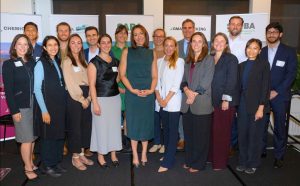
The GMA team was out in force for Green Markets Day 25 at New York Climate Week.
Upcoming Events
Sustainable Aviation Futures North America 2025 | October 14-16, 2025 | Houston
Andre de Fontaine will moderate a panel of high-level SAF stakeholders as part of the plenary session, “Is There an Acceptable Price for SAF? Price Discovery and Demand Signals.” Click here for more information.
Ammonia Energy Association Annual Conference | October 20-22, 2025 | Houston
Ash Khetpal will speak on the panel “Accelerating Adoption through Demand Aggregation and Financing Mechanisms.” Click here for more information.
VERGE hosted at Trellis Impact 2025 | October 28-30, 2025 | San Jose
GMA representatives will take part in multiple panels throughout the conference. Click here for more information.
AFCC Global Biobased Economy Conference & Exhibit | November 16-18, 2025 | Washington, DC
Andre de Fontaine will speak on the panel “Demystifying the Biggest Black Box in SAF: Monetizing Scope 3 Emissions.” Click here for more information.
Related News & Resources
06.17.25
GMA Newsletter – Summer 2025
See below for the online version of GMA’s Summer 2025 newsletter. To receive future editions directly to your inbox, sign up through the form at the bottom of our homepage or email pr@gmacenter.org to be added to our mailing list.
A message from Kim

Kim Carnahan, GMA CEO
As summer begins, I’m reflecting on GMA’s first full year. It’s safe to say we came out swinging – we’ve launched new programs, grown existing initiatives, set and met ambitious milestones, and expanded our staff from 4 to 24 (!!!) to support this important work. The slideshow video linked above summarizes the highlights – please check it out!
As we look ahead to year two, our momentum continues to accelerate. I’m relieved (seriously) to share that GMA has officially been granted 501(c)3 status, bolstering our ability to fulfill our mission effectively. At the midway point of a tumultuous 2025, we’re also encouraged by strong signals from SBTi that it sees the crucial role indirect mitigation plays in overcoming barriers to addressing value chain emissions.
We’re excited to engage in the expert working group they set up to support their Corporate Net-Zero Standard revision process, as well as similar expert groups under the GHG Protocol revision process. Standard setting can be grueling work but it’s critical to create the right incentives and guardrails for climate action.
To support these efforts, we’re also digging in and sharing our deep technical expertise on the complex mechanics of market-based value chain decarbonization through our GMA Insights series (keep scrolling to find links to our latest publications below and really nerd out).
We are confident that the book and claim systems we design with our partners will meet any guardrails SBTi may put in place, and we are doubling down on our joint procurement efforts to ensure companies have avenues to meet their ambitious SBTs. We are currently reviewing bids from our first GMA Trucking pilot procurement and have been blown away by the number and quality of the bids, as well as the enthusiasm and commitment of the carriers. There are some truly game-changing companies in the mix. If you’re not a member of GMA Trucking yet and are interested in decarbonizing your on-road freight, please get in touch! There is still time to join this first-of-kind procurement.
While I couldn’t be prouder of our accomplishments in year one, we recognize it’s still an uphill battle. Luckily, I love running hills! See you all soon, hopefully in real life. Until then, keep up the good fight.
Program Updates
Aviation
Our work with the Sustainable Aviation Buyers Alliance (SABA) reached important milestones, including the launch of two procurement tracks designed to encourage near and long-term investment into sustainable aviation fuel (SAF). SABA’s next-generation SAF procurement is aimed at helping move a next-generation SAF plant to final investment decision, while SAFc Connect is a first-of-its-kind platform to connect buyers with high integrity SAFc volumes that are available now. Notable updates within the recently published revision of SABA’s Sustainability Framework for SAF include the addition of SABA-eligible SAF registries and how fuels can meet the “SABA Advanced” criteria.
Trucking
The GMA Trucking pilot RFP response period closed at the end of April and the evaluation and shortlisting process will culminate with winner selection later this summer. Due to larger than anticipated bid volumes, GMA Trucking is opening up additional purchase opportunities for zero emission trucking service attributes. Email trucking@gmacenter.org to learn more.
Cement & Concrete
Alongside program partner RMI, we continue our work on book and claim system design, with subgroups of the Working Group exploring key design elements such as accounting and baselining in greater depth. Most recently, the Working Group aligned on a multi-functional unit system that would allow for investment in low-carbon clinker, cement or concrete solutions within a common framework and registry. The demand aggregation phase of our work is planned for launch in early fall with the formation of a buyers alliance focused on low-carbon cement and concrete. Email concrete@gmacenter.org to learn more.
Chemicals
Chemicals program design continues under the new leadership of Andrew Alcorta, who joined the GMA team in May. Watch this video narrated by team member Ash Khetpal to learn more about the program’s focus and intent, which in the near term will support the launch of an early stage pilot procurement for low emission plastics and fertilizers.
Sound interesting? Reach out to chemicals@gmacenter.org to explore participation in our soon to launch, early stage pilot!
AIM Platform
The AIM Platform Association Test pilot came to a successful conclusion, and feedback from diverse stakeholders will inform updates currently underway. The Association Test is intended to aid corporates in identifying which decarbonization investments can be credibly associated with their value chains. Next in the AIM Standard and Guidance development process is the release of the draft Quality, Reporting, and Accounting (QAR) Requirements. A pilot and stakeholder comment period for the QAR will launch later this summer and will be followed by a revision process. Together, the Association Test and QAR Requirements will make up the full Standard and Guidance, which will be considered by the AIM Standard Governing Committee for approval and publication in Q4 2025.
Maritime
The Zero Emission Maritime Buyers Alliance (ZEMBA) and Katalist recently published an open letter with 13 signatories in reaction to SBTi’s recent revision of the Corporate Net-Zero Standard and Guidance. The letter focuses on the importance of indirect mitigation efforts in facilitating the clean energy transition for maritime, following the themes established in the group’s engagement with SBTi’s public consultation period. The RFP response period for ZEMBA’s e-fuel-focused second tender closed in April with results expected to be announced by end of 2025.
In the News
- SABA’s SAFc Connect was featured in Trellis: $30 million spend expected at new sustainable aviation platform
- Energy Institute | New Energy World covered the release of SABA’s next-gen RFP: US scales up SAF with major developments
- Our cement & concrete work in partnership with RMI was highlighted in recent announcements about Microsoft’s collaboration with Sublime to decarbonize its construction operations.
#ICYMI
- Don’t miss our latest GMA Insights:
- Watch our newest explainer video focused on book and claim for zero emission trucking and our work in strategic partnership with Smart Freight Centre.
- Listen to the SAF Investor podcast for a conversation with Andre de Fontaine discussing SABA and SABA’s 2025 procurements.
- Learn more about pathways to sustainable flight – SABA’s May webinar is viewable on demand.
Upcoming Events
California Global Hydrogen Energy Transition Summit
June 30-July 1 | Sacramento, CA
Edmond Yi is participating in the session, “H2 Certification – Standardizing Green-e and International Certification of Clean/Renewable H2”
GMA is a Supporting Sponsor of this event.
Argus North Americas Biofuels, LCFS & Carbon Markets Summit
September 15-17 | Monterey, CA
Edmond Yi is an invited speaker for this event.
Climate Week NYC 2025
September 21-28, 2025 | NYC
GMA representatives will be participating in a diverse agenda of convenings and discussions. Stay tuned for details on the week’s events, including the second annual Green Markets Day.
SAF North America Congress 2025
October 14-16, 2025 | Houston
GMA will be joined by SABA stakeholders for sessions focused on corporate action in the SAF market.
VERGE hosted at Trellis Impact 2025
October 28-30, 2025 | San Jose
GMA representatives will participate in multiple panels throughout the conference. Stay tuned for more!
Related News & Resources
06.03.25
GMA Insights | Why System Boundaries Matter: Exploring Various Market-based Approaches to Deep Value Chain Decarbonization
INTRODUCTION
Welcome back to GMA Insights, a series where we explore concepts related to high-integrity market-based value chain decarbonization. In the first installment of the series, we introduced the concept of chain of custody models and explained “book and claim” – the model used most often by GMA – in greater detail.
But why do different chain of custody models exist? Is one “better” than another? In short, which model is “best” will depend on the situation, and on the goals of the company applying the model. Each model follows a unique methodology and has its own set of rules. Some are focused on detailed tracking of physical products within a system. Others focus more on tracking the characteristics inherent in a set of products or materials, whether or not these characteristics keep their 1:1 attachment to physical products within that system.
Today, we’ll do a deeper dive into two different chain of custody models: book and claim and mass balance. We’ll explain how each of them works and the rules that must be followed within each model. Given that companies can – and do – use both of these models to track the impact of their decarbonization efforts, we’ll explore why one might be preferable to another, depending on which goals an organization is trying to achieve.
So let’s get to it, starting with some fundamentals about both the book and claim and mass balance models.
MASS BALANCE CHAIN OF CUSTODY MODEL
A mass balance chain of custody model allows for physical mixing of materials with specified characteristics with other materials that do not have those characteristics. Despite this physical mixing, in a mass balance model the materials with specified characteristics are tracked as they move through a process or distribution system. The total amount of materials that are documented entering the process or system must match (taking into account process or system losses) the amount of materials that are documented coming out of the process or system.
For example, in a fuel distribution network a low emission fuel may be mixed with a fossil fuel that does not have a low emission profile. If a mass balance model is employed, at each phase in the fuel distribution network, the amount of low emission fuel and the amount of fossil fuel is tracked and documented. That is, the distribution network managers would know that, of X gallons of fuel in a storage facility in the network, Y gallons are theoretically low emission fuel and Z gallons are theoretically fossil fuel. The number of low emission fuel attributes assigned to fuel withdrawn from the fuel distribution network must match the number of gallons of low emission fuel that was added to the network. See Figure 1.
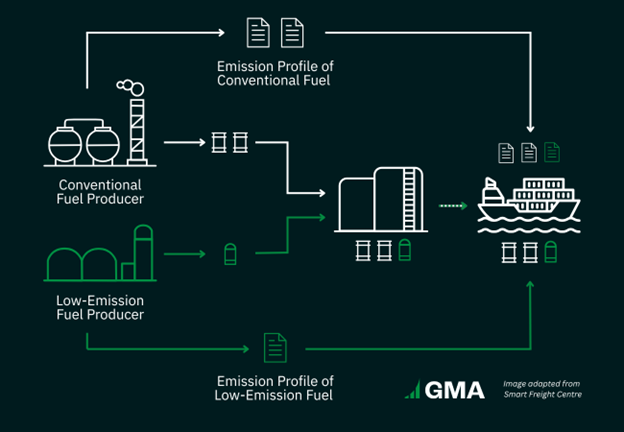
Figure 1: A mass balance chain of custody model.
BOOK AND CLAIM CHAIN OF CUSTODY MODEL
A book and claim chain of custody model also allows for physical mixing of materials with specified characteristics with other materials that do not contain those characteristics. In a book and claim model, though, the amount of materials with specified characteristics does not need to be tracked and documented at each step of the process or distribution system. Instead, the characteristics of the inputs are completely decoupled from the physical materials at or before the point of mixing. These characteristics are then tracked separately from the flow of the physical material. The materials’ characteristics are recorded and transferred in a documentation system (e.g., a registry) to ensure the integrity of accounting for these characteristics.
Applying these ideas to our example from above, a low emission fuel may still be mixed with a fossil fuel that does not have a low emission profile. But under the book and claim model, the low emission fuel’s emission attributes are completely separated from the fuel before or at the point of mixing. Once the low emission fuel and fossil fuels are mixed, the combined physical fuel is treated as if it had no low emission characteristics. The attributes of the low emission fuel are tracked and transacted independent of the physical fuel product. See Figure 2.
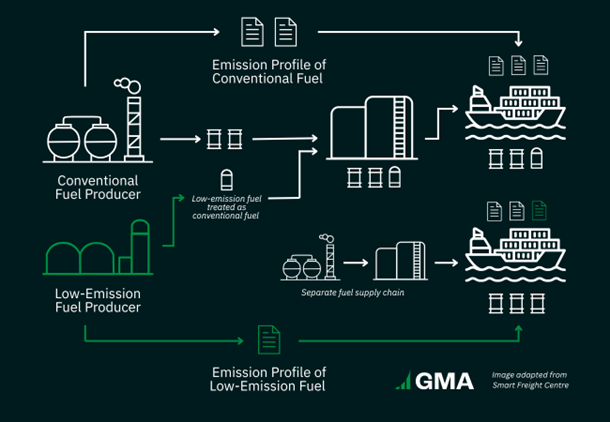
Figure 2: A book and claim chain of custody model.
Program spotlight: The Sustainable Aviation Buyers’ Alliance (SABA), a program that GMA runs in partnership with Environmental Defense Fund and RMI, relies on the book and claim model. Sustainable aviation fuel (SAF) is mixed with conventional jet fuel, with the physical mix of SAF and conventional jet fuel distributed and sold as though it were all conventional jet fuel. The low emission attributes of the SAF are completely separated from the physical SAF and transacted by means of SAF certificates in the SAFc registry.
THE IMPORTANCE OF SYSTEM BOUNDARIES
A chain of custody model’s boundary, in general terms, establishes where a company draws the line to ensure that products and characteristics going into a system (e.g. a manufacturing or refining process) match those emerging at the end. It may be surprising to see how much this decision can impact how companies can assign characteristics to their products.
Let’s explore this idea by imagining a bustling metropolis that’s home to many companies that specialize in baking wheat into delicious loaves of bread.
Company 1: Mass Balance with a Bakery Level System Boundary
Company 1 operates two bakeries: Bakery A and Bakery B.
Bakery A receives both conventional wheat and organic wheat from its wheat suppliers. The conventional wheat and organic wheat are mixed together at the bakery and made into bread.
Bakery B does not use any organic wheat to make bread.
The company applies a mass balance chain of custody model to attribute wheat characteristics to loaves of bread, and sets the model boundary at the bakery level. See Figure 3 below.
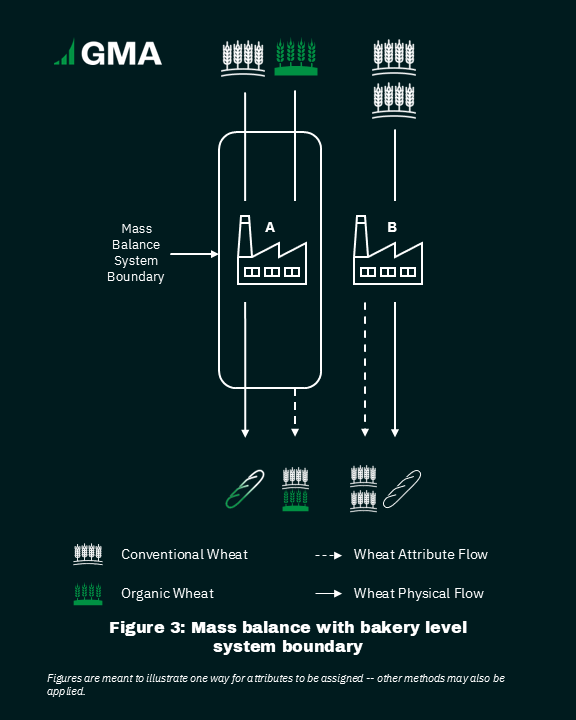
While Company 1 cannot be sure that every single loaf of bread baked at Bakery A contains organic wheat, the company does know that over a certain period of time, the wheat in the loaves of bread (in totality) baked at Bakery A was 50% organic wheat.
In this example, the system boundary (i.e., Bakery A) matches the boundary for material (i.e., wheat) flows. A buyer sourcing all of the bread from Bakery A would receive, over the period of time during which Bakery A conducted its mass balance[1], bread that physically contained 50% organic wheat.
Company 2: Mass Balance with a Company Level System Boundary
Company 2 also operates two bakeries: Bakery C and Bakery D. The inputs for the two bakeries are the same as they were in the previous example, but the system boundary is drawn in a different place.
Bakery C receives 50% conventional wheat and 50% organic wheat from its wheat suppliers. The conventional wheat and organic wheat are mixed together at the bakery and made into bread.
Bakery D does not use any organic wheat to make bread.
The company applies a mass balance chain of custody model to attributing wheat characteristics to loaves of bread, and sets the model boundary at the company level. See Figure 4 as follows.
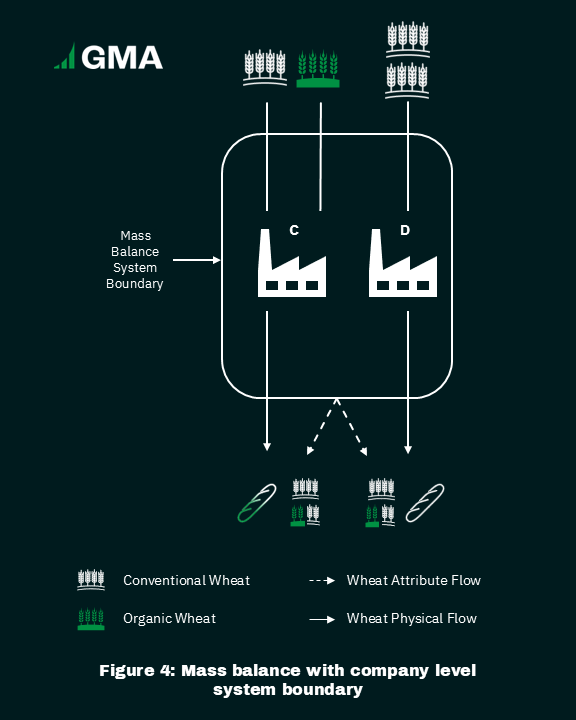
Unlike Company 1, Company 2 has set its mass balance system boundary at the company level. As such, Company 2 may attribute the characteristic of “organic wheat” to bread that has no chance of physically containing organic wheat (i.e., bread from Bakery D).
In this example, the system boundary (i.e., the company) does not match the boundary for material (i.e., wheat) flows. The amount of organic wheat attributed to the bread that buyers are purchasing is no longer linked to the amount of organic wheat that is physically in the bread that they receive.
Companies 3 and 4: Book and Claim with a Sector Level System Boundary
Our next two companies each operate one bakery: Company 3 operates Bakery E, and Company 4 operates Bakery F. For the purposes of this example, together these two companies make up the bread sector.
Bakery E receives both conventional wheat and organic wheat from its wheat suppliers. The conventional wheat and organic wheat are mixed together at the bakery and made into bread.
Bakery F does not use any organic wheat. See Figure 5, below.
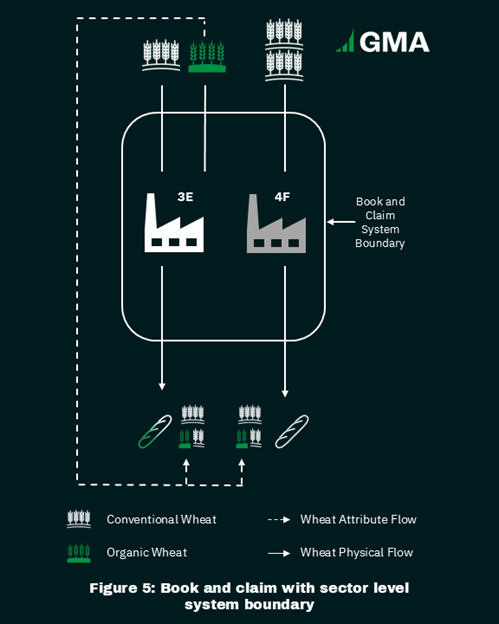
Company 3 applies a book and claim chain of custody model to attributing wheat characteristics to loaves of bread. Although some organic wheat is in the bread from Bakery E, Company 3 does not trace this wheat. Instead, Company 3 separates the organic attributes from the organic wheat before that organic wheat is mixed with conventional wheat at Bakery E. Company 3 then sells the attributes of that organic wheat to both companies buying bread from its own bakery – Bakery E – as well as to companies buying bread from a different company – Company 4 – which makes bread at Bakery F.
Now, take a look back at Figure 4 and compare it to Figure 5. Even though Company 2 applied a mass balance model and Company 3 applied a book and claim model, in both cases organic wheat characteristics are attributed to loaves of bread that have no chance of physically containing any organic wheat.
CONCLUSION
So is one chain of custody model “better” than another? Does one do a more accurate job of tracking and measuring special characteristics of physical products and giving customers a way to buy materials that “have” those characteristics? Is one model better than another at helping companies achieve their decarbonization goals?
Well, it depends. As we saw in the bakery examples above, the system boundary can have just as big an influence as the chain of custody model on the link – or lack of a link – between the characteristics and the physical composition of a batch of products.
What does this mean for decarbonizing heavy industry? Well, if you buy steel that has been attributed low emission characteristics through a mass balance model, that doesn’t necessarily mean that you will physically receive any low emission steel. The physical steel you receive might be low emission steel… but it also might not be. It depends.
Because the mass balance model maintains a closer tie between physical products and their special characteristics, some people think that the mass balance model is inherently more accurate than book and claim. As we see it, the value of an approach lies in its ability to achieve objectives. If a company’s objective is to support the decarbonization of its physical steel suppliers (meaning, at minimum, it knows who they are and that they are likely to remain the same), then a mass balance approach with a company-wide system boundary will work fine.
If a company has any other objective – for example, if its supply chain isn’t as straightforward as the examples above, then the book and claim model becomes indispensable.
Some may also think that mass balance approaches are inherently more credible than book and claim. The issue of credibility in chain of custody systems will be explored in a future edition of GMA Insights.
[1] Provided that there is not crediting of attributes across mass balancing periods (i.e., the amount of time during which the mass balance is calculated). If Company 1 credited organic wheat attributes across mass balancing periods, there is the possibility that no loaves of bread from one period would contain organic wheat, and that those loaves of bread could be attributed the characteristics of organic wheat from a previous period. For more details on crediting across balancing period, see ISO Standard 22095.
Related News & Resources
04.29.25
Insights from the AIM Platform on Deep Value Chain Analysis
Today we’re excited to feature the thought leadership of the AIM Platform with a repost of their latest exploration of deep value chain analysis. This approach draws upon a number of methods to allow companies visibility deep into their value chains – beyond the products they directly purchase – to better understand the GHG emissions associated with their suppliers and those suppliers’ suppliers and identify common emission sources. The resulting insights can help companies prioritize and scale corporate decarbonization investments where they can have the greatest beneficial impact.
The AIM Platform is an initiative developed in collaboration with GMA, C2ES and Gold Standard, with a mission to unlock vast new sums of private climate finance by bringing civil society and the private sector together to remove roadblocks to value chain mitigation and ignite sectoral transition. We encourage you to learn more on the AIM Platform website and engage with their ongoing work developing the AIM Standard and Guidance which is targeted for release in late 2025.
Summary
Scope 3 emissions represent a significant percentage of many companies’ greenhouse gas inventories. But using traditional methods to calculate scope 3 does not actually give companies insight into the biggest impacts in their supply chain. Deep Value Chain Analysis can help companies identify and quantify emissions sources that were previously hidden deep within their supply chains. Using these insights, companies can “match” their scope 3 emissions with effective interventions that can be implemented today, leveraging their purchasing power for maximum impact.
Introduction
Scope 3 emissions represent a significant percentage of many companies’ greenhouse gas inventories. As a result, companies spend a lot of time and effort quantifying these emissions with the goal of figuring out effective ways to reduce them. For many companies, identifying how to reduce scope 3 emissions is a critical part of their overall greenhouse gas reduction strategy.
Unfortunately, when a company uses traditional methods for calculating its scope 3 impact, the resulting data may not actually help them identify the largest drivers of their scope 3 emissions. Nested within a company’s scope 3 numbers are many layers (or tiers) of supply chain activities. This means that although a company might have calculated a perfectly “accurate” scope 3 inventory, that data tells them very little about how they can mitigate those emissions.
Luckily, methods do exist that help companies “see” the critical emission sources that are hidden within their scope 3 data. Identifying and quantifying these emissions sources means companies can match them with impactful interventions. We refer to these methods, collectively, as Deep Value Chain Analysis.
What is Deep Value Chain Analysis?
Deep Value Chain Analysis, sometimes referred to as horizontal LCA analysis, uses input-output data to estimate the quantity of emissions from various upstream materials and processes that are required to produce the products and services that a company purchases. Input-output tables are developed by government agencies for economic assessment and indicators, and environmentally-extended input-output (EEIO) data are commonly used to calculate parts of company scope 3 inventories.
Rather than relying on emission factor data that adds up all emissions that go into producing a given product and then uses that information to assign a single emission factor to that product, Deep Value Chain Analysis identifies the upstream processes (electricity generation, product transportation, different manufacturing processes, etc.) that went into making that product. This analysis is then repeated for products and services across a company’s value chain. Value chain totals for each type of intermediary emissions are then aggregated. This allows the company to identify which processes show up most frequently across its value chain and prioritize mitigation efforts that lower emissions for these specific processes. This allows companies to prioritize decarbonization opportunities that address the biggest drivers of emissions across their value chain, which maximizes the impact of their decarbonization work.
Figure 1. Emission drivers visible through Deep Value Chain Analysis
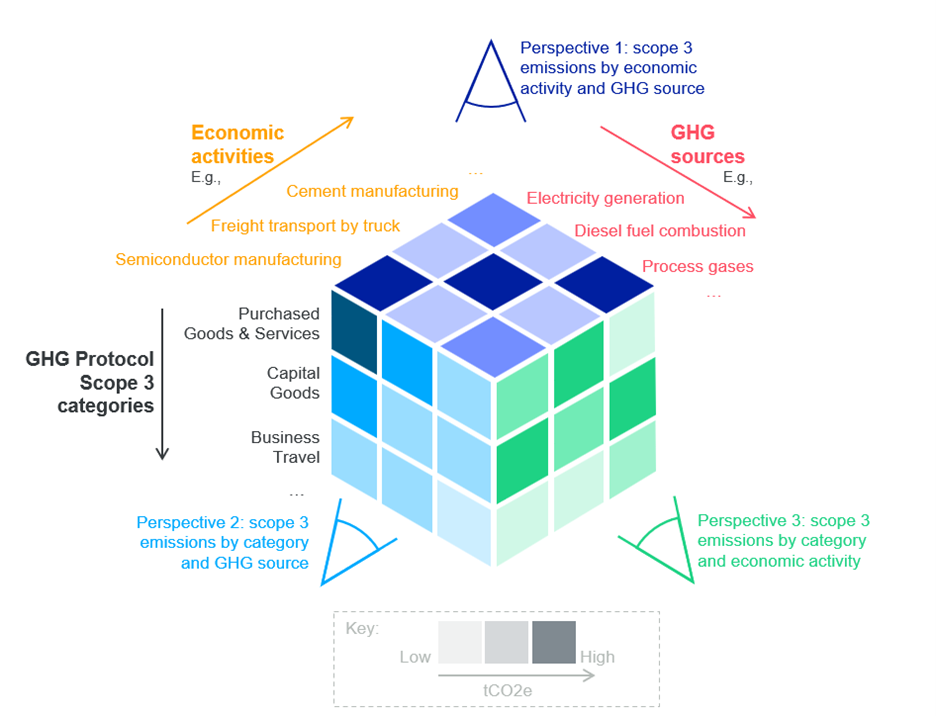
Image source: A Systematic Approach to Identifying Scope 3 Emissions (2022). Engie Impact
For example, a company might purchase a piece of electronic equipment. In order to manufacture that product, several specific economic activities – manufacturing, transport, etc. – would have taken place. Each of these activities results in GHG emissions. Once this level of detail has been identified within an organization’s supply chain, it is possible to assess the activities driving those emissions, such as electricity generation, diesel fuel combustion, industrial process emissions, etc. Once these actionable sources have been identified, it’s possible for companies to use their purchasing power to increase deployment of industrial decarbonization technologies specific to those sources. In other words, using Deep Value Chain Analysis, a vague scope 3 line item in a company’s inventory can be translated into a set of concrete emissions sources that the company can work to mitigate.
Figure 2. Breaking down electronic equipment emission drivers
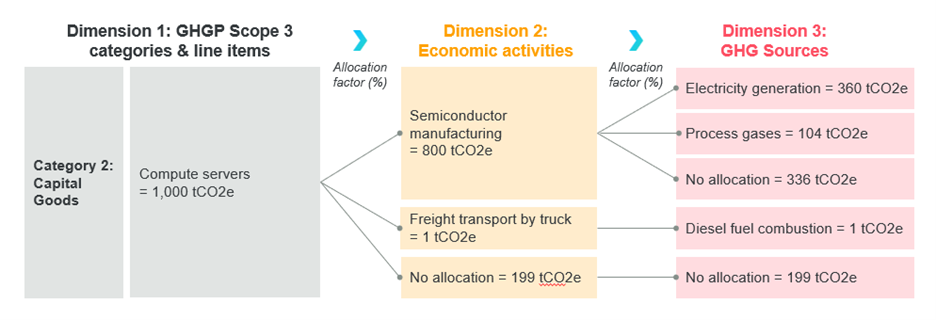
Image source: A Systematic Approach to Identifying Scope 3 Emissions (2022). Engie Impact
Benefits of Deep Value Chain Analysis
Companies, researchers, and solutions providers are starting to deploy Deep Value Chain Analysis as a way to develop scope 3 reduction strategies that have a measurable impact on specific emissions sources within companies’ supply chains.
For example, Meta worked with Engie Impact to develop a framework that translates scope 3 data into detailed greenhouse gas emission sources that can be addressed through investment in specific emission reduction projects. This framework has allowed Meta to work with value chain partners to leverage effective, direct emissions reduction strategies traditionally only possible when addressing scope 1 and scope 2 emissions.
Deep Value Chain Analysis in the AIM Platform Association Test
The draft AIM Platform Association Test recommends that companies use Deep Value Chain Analysis methods in two related ways:
- 1.To identify products they may not purchase directly but which are produced deep within their value chains, and
- 2.To aggregate their demand for decarbonization solutions across like products.
Leveraging Deep Value Chain Analysis in these ways will yield detailed information about the specific economic activities and related emissions sources that underpin each company’s value chain. These insights will allow companies to prioritize their participation and investment in buyer alliances such as those GMA and partners manage for chemicals, trucking, and cement & concrete, secure in the knowledge that their actions mitigate emissions sources foundational to their own scope 3 inventory emissions.
Next Steps
Today, more than 20 companies are testing Deep Value Chain Analysis and other methods to identify inventory emission sources, with the ultimate goal of matching these sources with impactful value chain interventions. Early results point to Deep Value Chain Analysis – and the detailed data it reveals – as an important unlock for significantly more effective corporate scope 3 mitigation at scale.
____________
Interested in trying out Deep Value Chain Analysis yourself? Check out these resources:
Related News & Resources
02.25.25
Introducing the GMA Insights Informational Series | Chain of Custody Models
by Dan Smith
Introducing GMA Insights
We are excited to launch GMA Insights, an informational series that will delve into important topics surrounding market-based approaches to value chain decarbonization. GMA’s mission to activate new markets for low-carbon fuels and materials is clear, but complex in practice. As we develop and operationalize robust approaches and systems to achieve this mission, many of the considerations informing our work warrant deeper explanation.
GMA Insights will be a forum to explore those topics. Our aim is to bring clarity and transparency to the principles, tools, and techniques that we apply to activating new markets.
GMA works on the leading edge of value chain decarbonization, which means that we are often in uncharted territory. Some concepts that we explore through GMA Insights may be evolving even as we discuss them. We welcome reflections from the climate community on these topics. If you have thoughts about an insights article, or ideas for a topic that you want us to explore, please reach out at info@gmacenter.org.
Chain of Custody Models
Our first GMA Insights topic will address a fundamental set of tools that GMA applies to our decarbonization programs: chain of custody models. A chain of custody model is defined as an approach to tracking and documenting inputs and outputs of materials through a process or distribution network[1].
Chain of custody models are applied to products that people use and consume every day. Have you bought a piece of fruit that is labeled USDA Organic? A chain of custody model and requirements were applied to maintain appropriate separation of that fruit from non-organic fruit. Have you seen the MSC label on fish or other seafood? Same thing. Have you noticed the FSC Certified stamp on a greeting card or cardboard box? The wood that went into those paper products was tracked – you guessed it – according to a chain of custody model.
There are five general chain of custody models:
- Identity preserved
- Segregated
- Controlled blend
- Mass balance
- Book and claim
Book and Claim Models
Most of the programs that GMA and our partners manage rely on the book and claim model. In a book and claim model, the characteristics (within GMA’s work, the low greenhouse gas emission profile) of a product or service are separated from the product or service itself. These characteristics are assigned to Environmental Attribute Certificates (EACs), which are “booked” in a tracking system such as a registry. The physical product or service itself is then treated as though it were a normal product or service without its low emission characteristics.
A company that is committed to reducing its value chain emissions for the product or service associated with the EAC could buy and “claim,” EACs representing low emission products and services. Purchasing EACs enables the company to support decarbonized products and services, even if the company could not buy the decarbonized products or services in its physical supply chain. See Figure 1. (We will explore additional facets of book and claim and its benefits in a later entry.)
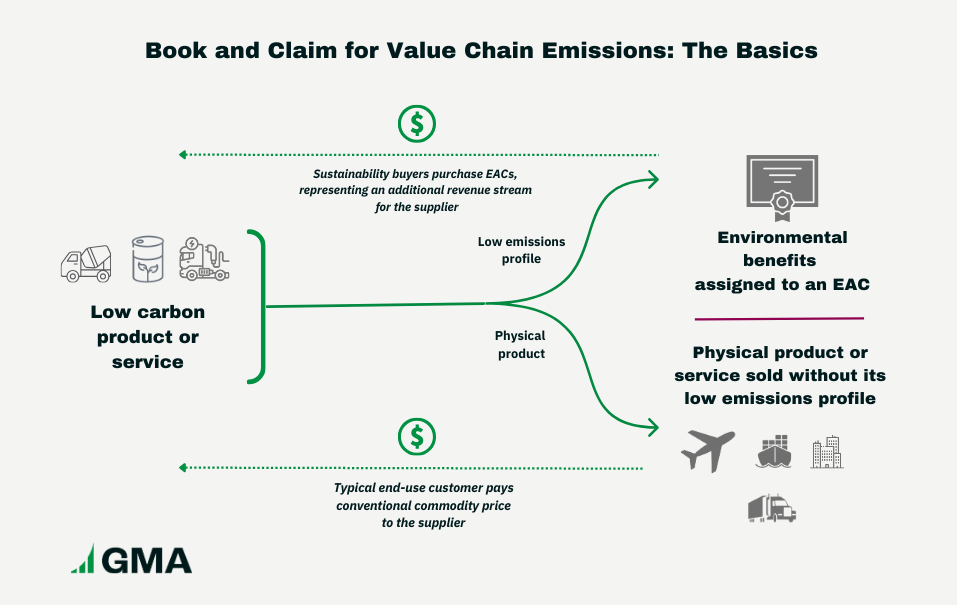 Figure 1
Making Informed Decisions
For organizations considering the use of book and claim systems to decarbonize their value chains, there are many factors to be aware of when assessing whether a system is robust and transparent. That makes it important for organizations to educate themselves about chain of custody models, their benefits, and their limitations.
A core part of GMA’s work is to develop high integrity book and claim systems that support our decarbonization programs. We’ve learned a lot about chains of custody through this work and are happy to share from our experience. The GMA Insights series offers a way for us to explain features of book and claim and other chain of custody models and the implications of their use, with an aim to foster transparency and informed decision-making by organizations purchasing products based on the models.
The next GMA Insight, in which we take a close look at key differences and similarities between book and claim and mass balance models, and the importance of system boundaries for those models, will be published in coming weeks.
[1] Readers interested in detailed definitions of chain of custody models can review ISO Standard 22095:2020, and keep an eye out for the forthcoming ISO Standards 13662 and 13659. We’ve also found National Institute of Standards and Technology’s Publication 1500-206 to be a helpful primer on chain of custody models.
Related News & Resources
07.31.24
Center for Green Market Activation Shares Insights on SBTi’s Recent Technical Outputs
By GMA
On July 30, the Science Based Targets Initiative (SBTi) published four technical outputs as part of its process to revise the SBTi Corporate Net Zero Standard. The Center for Green Market Activation and the Zero Emission Maritime Buyers Alliance co-published the following early takeaways:
- 1. These outputs start SBTi, the world’s largest validator of corporate climate goals, down a promising path towards providing companies with additional tools through which they can demonstrate progress towards ambitious Scope 3 goals.
2. Among other options, SBTi is exploring the role of environmental attribute certificates (EACs) – instruments that represent and communicate the environmental and/or climate-related attributes of commodities, activities, or projects – in addressing value chain emissions. The consideration of EACs differed from traditional carbon credits, which they stated could not be counted as emission reductions toward science-based targets.
3. While SBTi said that more work is needed before firm guidance can be given, they are particularly focused on exploring EACs derived from chain of custody models like book and claim systems. Book and claim systems separate environmental attributes from physical commodities, making it easier to connect customers willing to pay a premium with providers of green goods and services. Both the Sustainable Aviation Buyers Alliance (SABA) and the Zero Emission Maritime Buyers Alliance (ZEMBA) utilize book and claim systems in their efforts to aggregate and operationalize demand for low and zero carbon aviation and maritime fuels.
4. SBTi emphasized that usage of such book and claim systems should come with clear guardrails and potentially be limited to sources that can demonstrably lead to net-zero aligned market transformation. These comments provide a strong signal to companies to focus their investments on the highest quality EACs.
5. The Advanced and Indirect Mitigation (AIM) Platform is called out as an example of current work underway to provide greater clarity and direction on EACs.
We look forward to working with SBTi and through the AIM Platform to bring comfort and build the evidence base for EACs usage towards climate goals.
“We welcome the latest release of technical outputs of SBTi and are grateful for the hard work that went into them,” said GMA CEO Kim Carnahan. “These outputs highlight the role that EACs could play in driving deep decarbonization of supply chains and the imperative for clear standards and guidance around their use. We couldn’t agree more. Coupling strong guardrails with new tools for value chain decarbonization could unleash urgently needed investment in clean fuels and materials. We realize we aren’t there yet, but we are excited to continue to engage with SBTi as they move forward with this essential work.”
GMA encourages all stakeholders to read SBTi’s materials and engage with them on a path toward updated Scope 3 guidance.
Related News & Resources
06.12.24
Center for Green Market Activation Announces Launch
By GMA
June 12, 2024 (Washington, DC) – Today, the Center for Green Market Activation (GMA) launched as a new non-profit dedicated to harnessing corporate net zero ambition in hard-to-decarbonize sectors and jump-starting new markets for green fuels and materials. GMA is building on models developed by the Sustainable Aviation Buyers Alliance (SABA), a joint initiative of RMI and the Environmental Defense Fund (EDF), and the Zero Emission Maritime Buyers Alliance (ZEMBA), run by the Aspen Institute. Working closely with those key partners as well as the Smart Freight Centre and many others, GMA will engage companies willing to pay a premium for decarbonized goods and services and aggregate their demand to catalyze the adoption of low-carbon technologies within the hardest to decarbonize industries. Through GMA, companies seeking to reduce their suppliers’ emissions have an accessible, high integrity pathway to direct low-carbon investment deep within their value chain where it is needed most.
“GMA is scaling a proven model for raising critical capital in service of deep decarbonization in high emitting sectors, including aviation, trucking, concrete, and chemicals,” said Kim Carnahan, CEO of the Center for Green Market Activation. “Other organizations have successfully driven companies to set ambitious climate targets. GMA’s focus is turning those targets into bankable contracts.”
A US-based nonprofit organization, GMA received inaugural funding from the Bezos Earth Fund, and its programs are supported by grants from several other organizations. It focuses on high emitting sectors of the economy where decarbonization is particularly challenging due to the current high cost and limited availability of alternatives, and where the current pace of change is far from sufficient to reach climate goals. These critical, carbon-intensive sectors will require deployment of new technologies and significant capital to decarbonize, as well as strong demand signals to encourage commercial scale production. GMA’s programs are specifically designed to enable scalability at speed.
“The GMA team has been essential to ZEMBA’s success, from their technical expertise on alternative fuels and book-and-claim to their vision for widespread impact,” said Ingrid Irigoyen, CEO of ZEMBA and Senior Director, Ocean and Climate for the Aspen Institute. “We are eager to continue our collaboration and build on our great work together so far.”
GMA is an organization that enables broad cross-sector innovation, financing, and climate action by member companies through engagement with multiple sector-specific programs under a single umbrella. It leverages common infrastructure and the GMA team’s unique experience partnering with leading environmental non-profits and standard-setting organizations to design and stand up systems that channel funding towards high-quality, game-changing green technologies. Through participation in collective procurement programs for physical goods or environmental attribute certificates (EACs), members can address their Scope 3 emissions while benefiting from the quality assurance and economies of scale offered by GMA. GMA also supports suppliers of decarbonized goods and services by aggregating demand that represents a new, secure revenue stream.
“RMI has found that strong aggregated demand signals are critical to shifting and shaping the market for much needed low carbon solutions within the transportation and heavy industries sectors,” said Bryan Fisher, Managing Director of RMI. “The radical collaboration that we’ve been facilitating through demand platforms like SABA is critical to spark the investment needed for new technology and infrastructure deployment in these yet-to-decarbonize sectors. We look forward to deepening our work with GMA to further activate and organize demand.”
The GMA team has served as the Secretariat of SABA since its inception in 2021 and as strategic and technical advisors to the ZEMBA team throughout the process of designing its first tender. In addition to maintaining those roles, GMA will run programs for heavy duty trucking, cement and concrete, and chemicals, with plans to expand to other sectors in the future. A collective procurement for zero emission trucking is expected to be issued later this year. GMA ensures that all procurement it supports meets rigorous environmental standards, including third party verification.
“To decarbonize today’s economy – especially in challenging sectors such as aviation and maritime shipping – we need to rapidly ramp up funding for solutions with the greatest environmental integrity,” said Angela Churie Kallhauge, Executive Vice President for Impact at EDF. “Organizations like GMA, working with trusted partners like EDF, are instrumental to shaping the markets for green fuels, safeguarding against greenwashing, and ensuring that new technologies genuinely benefit both people and the planet.”
In addition to CEO Kim Carnahan, GMA’s leadership team includes Ellen Palmer as Chief Finance & Operations Officer, Andre de Fontaine as Senior Director of Programs, and Kari Pederson as Chief of Staff and Senior Advisor.
“To spur new green markets, we need a new breed of climate action focused on deployment,” said Christoph Wolff, CEO of Smart Freight Centre. “Leveraging the Smart Freight Centre’s normative accounting framework and close partnership with global shippers active in decarbonizing their logistics, we are excited to partner with GMA to jointly aggregate shipper demand for the environmental attributes of zero-emission trucks and therefore accelerate the deployment of zero-emission trucks.”
GMA’s work will leverage the efforts of the Advanced and Indirect Mitigation (AIM) Platform, a partnership with C2ES and Gold Standard focused on developing a standard and guidance for accounting, claiming, and reporting the impacts of value chain interventions towards corporate climate targets. The AIM Platform’s draft criteria is currently out for public comment and can be accessed at AIMPlatform.org.
Companies interested in becoming members or joining any of GMA’s sector initiatives are encouraged to visit www.gmacenter.org or email info@gmacenter.org.
About Center for Green Market Activation
The Center for Green Market Activation (GMA) is a US-based, globally focused non-profit. Through innovative book and claim systems, new and creative procurement approaches, and demand aggregating buyers’ alliances, GMA catalyzes and scales the uptake of low-carbon goods and services within carbon intensive industries such as aviation, maritime, trucking, cement and concrete, and chemicals. With collective decades of experience in environmental markets and alternative fuels and materials, GMA works to standardize new, green markets and forges mutually beneficial partnerships between climate-focused companies, suppliers, and mission-aligned non-profit organizations to channel funding to critical climate technologies in pursuit of accelerated sectoral decarbonization. For more information, please visit gmacenter.org.
Media inquiries should be directed to pr@gmacenter.org.
Related News & Resources
06.01.24
GMA Intro Brochure
This Center for Green Market Activation (GMA) introductory brochure provides an overview of GMA’s market-based approach to value chain emission reductions in sectors like aviation, maritime, and heavy-duty trucking.
Related News & Resources