11.02.26
Green Markets Day 2026 | Opening the Floodgates: Standards and Market Infrastructure that Unlock Action
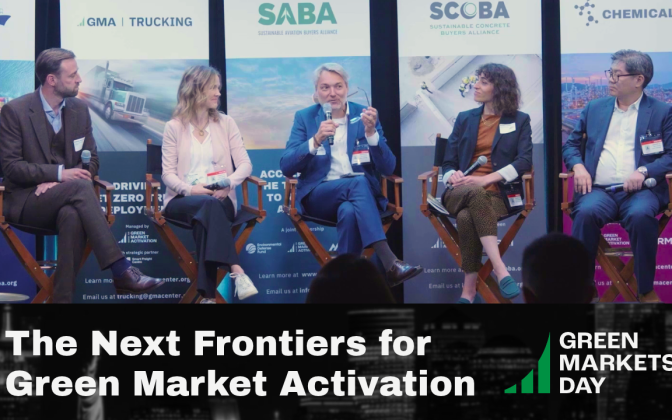
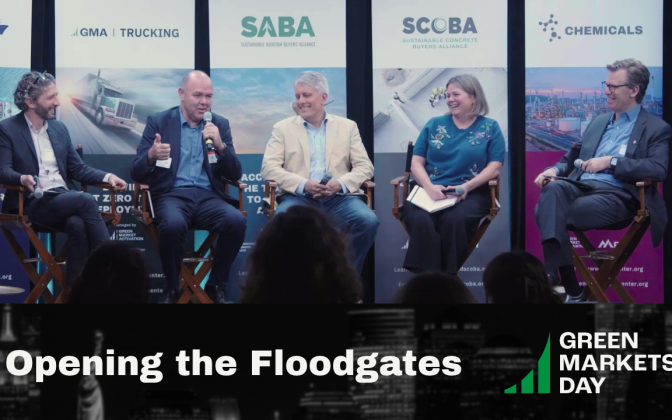
Moderator Jim Giles, Vice President and Editor-at-Large at Trellis Group, was joined by David Kennedy, CEO of SBTi; Jim Andrew, Executive Vice President and Chief Sustainability Officer at PepsiCo; Laura Draucker, Standards Director at GMA and the AIM Platform; and Tim Juliani, Director of US Corporate Climate Engagement at WWF. The panelists discussed version 2 of SBTi’s Corporate Net-Zero Standard and its recognition of market instruments, how PepsiCo has already put the new rules into practice in its reporting, the role of the AIM Platform’s guidance, and what is still needed (governance, standardization and registries) to keep market instruments credible as they scale.
See below for a full transcript.
TRANSCRIPT
JIM GILES:
Fantastic, so happy to be here. My name is Jim Giles. I’m an editor at large at Trellis Group. We have a fantastic panel. I think you can all, I don’t need to do the intro, so I hope you know who all these wonderful people are.
And I just think this is a great moment to be having this conversation because the last two years, probably more than that, have seen, they’ve been a really intense period of activity around the standards and the frameworks that shape corporate action on climate. We’ve had a major update to SBTi’s net zero standard we’re going to be hearing about. We’ve had some really interesting work around supply chain and environmental attributes certificates we’re also going to be hearing about. We’ve had some work that’s kind of outside of the system a little bit. We’ve had some groups that are kind of, I would say, pushing the incumbent standards to move faster. And I was at an event early yesterday morning where we heard from, I don’t know, I think it’s a kind of small but, you know, vocal minority of people who are calling for much bigger reform. And all of this is good. This is really good, healthy, exciting debate. And it’s worth remembering that all this debate is channeled into an effort to not create better, yes, to create better rules. But the point of better rules is not to have the rules be better. It’s to unlock real action and to tackle climate change more rapidly. And so excited to hear more about those efforts.
And David, let’s start with you. When I talked about an intense period of activity, I would say the SBTi’s recent update is kind of really core at the heart of that. Tell us, just pick out a few of the, I mean, there’s so much in V2. Just pick out a few things for this audience you think are most significant.
DAVID KENNEDY:
Okay, so hello, everybody. Thank you, Jim. We’ve got corporate net zero standard version two. We published that in the summer.
Let me just anchor it in something that’s not new. So our mission, and remind you, SBTi is there to support the corporate transition to net zero by 2050 or sooner. That is what makes us science-based. That has not changed. I think another thing that’s not changed are the people, anecdotally, think it may have changed is companies continue to engage with the corporate net zero transition. So we are about to reach 12,000 companies that have targets validated by SBTi. That’s 40% of global market capitalization, 30% of the global greenhouse gas footprint. We’ve got submissions and new commitments at record levels that sustains even in challenging geopolitical circumstances. So companies continue to engage. Why is it? Because it makes good business sense. Companies have got transition risk. We have a framework for managing transition risk. That’s what corporate net zero standard is.
I’ll pick four innovations in it. So we had a long process. We engaged with thousands of companies. We had expert working groups. We piloted. That’s how we got to corporate net zero standard version two. There is a focus on supporting incentivizing action, as you say, Jim, but for innovation. So one, target setting options and there’s a whole range of target setting options that work for different corporate contexts, different sectors, different geographies. But the common theme is they represent what companies can and should do to manage transition risk in a science based way.
Second and highly relevant to today is how do you meet targets? So, of course, focus on business transformation, reducing your physical carbon footprint. But there are limits to what you can do and you can make great contributions through the use of market instruments. And it’s always been the case that you could use Scope 2 market instruments. But we’ve extended that now to biogas, SAF, commodity certificates. And these things count towards targets. A lot of people say great that you’ve got your implementation hierarchy. But do these market instruments actually count? The answer is yes. There wouldn’t be much point in having them if they didn’t count. They do. We need to set out a bit more about how they will count and how to account for them, which we can talk about in a minute.
Third innovation is a recognition of dependencies. So in the real world, companies cannot unilaterally in certain respects. But there are external factors which are beyond the control of companies. And so we want, as part of the submission process and the progress reporting, an explicit focus on dependencies. So economic, infrastructure, supply chain, finance, examples of dependencies. And then we have the best efforts approach to targets, which is basically where dependencies are fulfilled, you are expected to act. Where they’re not fulfilled, they may become barriers, those dependencies. And then you should identify and seek to address those barriers. But it may cause a gap in the near term between performance and targets.
Last thing I would highlight as an innovation is ongoing emissions responsibility. So there’s always been a question, I think we’ve settled it now, what is the role of high integrity credits within a broader strategy? Is it legitimate? Can we address the integrity concerns? And we have been very clear, you cannot substitute effort reducing your carbon footprint, including the use of market instruments. You cannot substitute that for credits because you need to transform your business, your systems that you operate in. But we do need a lot of removals. We need 8 gigatons plus in the second half of the century. Business can contribute to that. It’s very valuable. It is a great part of a holistic strategy. A lot of companies are interested in it and we will recognize it through ongoing emissions responsibility.
So some fundamental innovations, again, all aligned with that focus on supporting incentives and incentivizing action towards net zero.
JIM GILES:
Thanks, David. So we talked about the rules unlocking new action. And I was surprised. I kind of figured like the rules are in place. Now I’m going to have a look. I’m going to start reading sustainability reports. Wait to see when they get implemented. I did not expect to see them implemented or used so quickly. So Jim, PepsiCo’s most recent sustainability report came out last month. And it includes kind of new cool things that you did because of these new rules. Tell us about that.
JIM ANDREW:
Yeah, we– I think David put it very well. It’s about how do you drive action? How do you incent action? How do you make the things that we’re doing be able to be recognized? And, you know, I’ve always said if we can’t count it, it’s philanthropy. And then it ends up over in the foundation. So how do we get in? I think that some of the advances have really been very powerful around. So we wanted to report using 2.0. And so we did that. And then we worked very hard to be as transparent as possible. And that’s always been one of the hallmarks of what we’ve tried to do at PepsiCo is be clear on where there is a physical inventory and talk about that. And then also talk. Talk about where we’re using market instruments, making sure that they’re high integrity. And that’s really that’s a major effort because there’s a lot of people that we have to get aligned internally. Right. That’s that’s finance. That’s legal. That’s sustainability for sure. These aren’t just accounting decisions and ultimately they impact action and they impact investment.
And so as we looked at where the reporting was going and some of the changes, you know, that was all in our calculus as to how do we drive action? And, you know, I think the critical next steps are how do we get clarity around projects and market instruments? And what can companies say about them? Because I think companies are very concerned about doing things, being able to count them. Or at least understand. And then what can they say about them with credibility and transparency? So we worked very closely with all the folks internally as well as our external providers to be able to take the latest, be able to use them, talk about them, be transparent.
And I think it’s a journey. You know, I think it’s something we’re all going to learn on. SBTi, as David said, has been very open to engagement, to feedback, to discussion. I think David would be the first to say we don’t have everything figured out. And, you know, we’re a big FLAG. We’re a big land user. So FLAG’s very important to us. And I know that that’s an area that’s ongoing. So we tried to incorporate and we left ourselves very open to what’s going to come. But we wanted to support and use, you know, the latest thinking to be able to convey transparently where we are. And importantly, what are some of the challenges?
JIM GILES:
And for those who are not familiar of your work, just go into a bit more detail there. You mentioned deploying these market instruments. What were they? What commodities are involved? What kind of impact did it have?
JIM ANDREW:
Yeah. So we, I mean, we’ve used a number of different ones, both obviously around Scope 2. But we’re also, you know, low-carbon fertilizer is an area that we’re very active in and working around. Renewable natural gas. You know, and the high BTU versus low, you know, medium BTU and, you know, understanding those things. And again, what we tried to do was here’s what we’re doing. Here’s our physical. Here’s using the hierarchy that David described. Here’s where we sit on each one to be able to be transparent. You know, again, I think different people are going to look at these differently. And it’s going to be interesting to see where we are in a couple of years because I think we’re all going to learn more together.
JIM GILES:
Great. Thank you. Tim, let me just bring you in. I think you have a really interesting position because you get to peer inside lots of companies through the partnership work that you do at WWF. So you’re hearing from people like Jim but across different sectors about what’s missing and what they need from these standards. To what extent is the recent evolution really unlocking the kind of ambition that’s there within companies? And what else do we need to see?
TIM JULIANI:
Yeah. So thanks. Yeah. We work. And I’m on the climate team at WWF US. And I run what’s called our Climate Business Network. And we have two dozen companies, mostly Fortune 500s, that are grappling with all these issues, setting, resetting science-based targets. That resetting process is kind of a gift that keeps on giving, right? And the – but it’s changed quite a bit over time.
So when we helped co-found SBTi back in 2015, that was a different moment than today. And at that point, companies, I think, saw a pathway to setting SBTs for the first time because the Scope 2 protocol came in at that same time. And that allowed the use of market instruments for Scope 2. At that time, the Scope – you know, with V1 of SBTi, you had the ability to set Scope 1 and Scope 2 targets together. And that ability to use market instruments, I think, really catalyzed and allowed companies to see a pathway for how to do this. And I think now in V2, while Scope 1 and Scope 2 are separated, the expanded use of market instruments is doing that same thing, right?
And, you know, what we’re doing – you know, we work one-on-one and together with the companies, thinking about not only SBTi but the entire sort of standards infrastructure that is allowing this to happen. I’m on the Actions and Market Instruments technical working group. My colleague Tim Letts is on Scope 3. He’s also engaging around ISO. So how do we create the incentives through all these for corporates to act? And how do we do it in this time where there’s still uncertainty, you know? GHGP is not going to be completed until 2028. SBTi, you know, is going first. But, you know, we’re very encouraged that we’re, you know, continuing to see that action happen on the ground. We’re seeing companies like McDonald’s and Walmart and others, you know, stick with SBTi, which I think is a fantastic signal.
JIM GILES:
Yeah, great. Thank you. So, and that brings us kind of nicely onto how things might change in the future. So SBTi update, as I said, one of the really big developments. But, Laura, you’ve been involved in something called the AIM Platform, which I think has come up with a ton of interesting ideas that we think will influence standards in the future. Tell us about that work and how you see that evolving.
LAURA DRAUCKER:
Yeah, thanks, Jim. I actually want to pull on something you said earlier about how SBTi version 2 just came out, and it seemed like right away companies were ready to report market instruments. And that is because of the work of GMA and our partners and many of you in this room who have been willing to step out ahead and invest in these solutions, put money into the decarb that we need, not knowing if they would count, right? Not really knowing how we would report them, but knowing that it was the best use of your money to drive what needs to happen in your value chain.
So the AIM Platform was born out of that, recognizing that one of the barriers for companies to really make those investments, to grow that demand that we need to grow, was the lack of clarity in the standard space. So the AIM Platform partnered up or GMA partnered up with C2ES and Gold Standard to develop the AIM Platform. We published our standard in April. And really put very simply, it’s a tool to implement the new target implementation hierarchy under Version 2. Version 2 has about three pages of quality criteria. We have about 120 pages of guidance to help you do that. And we’re continually working, meeting often with the SBTi technical team to work through some of these. What does this stuff actually mean? And how do we make sure we have it available to companies who they have confidence to implement?
And we just this morning had a great meeting with a handful of companies and we asked them to all say what win did they have this year and what challenge did they have this year related to market instruments. And everybody’s win was we’re reporting now. We’re making progress. We’re getting buy-in. And everybody’s challenge was and there’s still uncertainty. And those two things can be true at the same time. And I think we have to kind of live in that. But I’ve just been really excited with the reception to the AIM Platform and, of course, all the work that’s happening. I mean, we’re so much farther ahead than we were even last year at this time.
JIM GILES:
And just the uncertainty is a good point. We’re going to come to that. But I just want you to try and bring it to life for the audience. So it works. It works exactly as you hoped three or five years from now. What’s different? Like what are all the people out there doing that’s different as a result of this work?
LAURA DRAUCKER:
That’s a great question. I mean, I think we want to see money in decarb solutions. We want to see decarb solutions scaling in geographies and regions that they currently aren’t available in, which is the reason why companies have to go to market-based instruments, frankly, right? We don’t want to be – I have enjoyed all the panels I’ve been doing on standards over the last two years, but I’d like to not be doing those all the time. I think we’d want to have some certainty so that people are just doing the work with no excuses. And hopefully, you know, I think if you look at the implementation hierarchy, right, direct action is still what we want to see companies do. But for many sectors, many geographies, that’s not possible yet. And so this is an unlock to make that possible in the future.
JIM GILES:
Great. Thank you. Okay, let’s talk about uncertainties and risks, because a lot of this work, as I see it, is designed to introduce the kind of flexibility that companies need to move faster, which is great. There’s always a risk if you loosen the rules that you loosen too much and things start to go wrong. I mean, SBTi made what I think internally was seen as kind of a small change. This is prior to the V2 release. A bunch of people jumped on and said, well, hold on a minute. Like, I’m actually not sure this new pathway is 1.5 degree aligned, which, of course, is at the heart of that particular pathway. David, maybe you can tell us about that particular incident. But more broadly, just tell us how you kind of manage that balance and make sure that you’re actually driving real action and not allowing free riding and other problems to come into play.
DAVID KENNEDY:
So that is a great question. And science based is our USP is our superpower, and we can never depart from being science based. I think the subtext is, well, you know, maybe there’s a choice. You can be science based or you can have something that works with commercial objectives, but you can’t do both. And maybe market instruments, because they’re not physically deliverable, are somehow cheating. But I think that is not correct at all. So in a carbon constrained world, you can be science based and have things that work. In a long term, in a corporate context and fit with commercial objectives, market instruments make great contributions to system transformation, which is what we’re about.
Let’s be clear what the science says. So for a given climate objective, you can derive a climate budget or a carbon budget, sorry, using a climate model, and you can turn that into a global pathway. Science doesn’t say all companies should follow that pathway, reducing their physical footprint in accordance with it. That is our job now. It is to translate that global pathway into a set of net zero approaches, which together are consistent with that pathway. So that’s what we ask ourselves. Have we got a set of approaches which are consistent with net zero? And that takes you into business transformation and system transformation.
And on the particular aspect of market instruments, I should say what you get out of that translation is you can decarbonize at different rates in different sectors according to what the opportunities, what the technologies are. And so some of the energy-intense, emissions-intense sectors with technologies that are not well-developed obviously will decarbonize a bit further out in time. You decarbonize power. It’s a pretty consistent finding. You do that soon because we’ve got great opportunities to do that. Heat is somewhere in between if you’re talking about low temperature, medium temperature heating and residential business, whatever. So you get different pathways for reduction and that is an innovation because we have one pathway really in the first phase of SBTi.
But the market instruments in particular can make a great contribution to system transformation. They can manage transition risk for companies at the same time. So for me, that is absolutely science-based. We can trace from that objective to the global trajectory to the net zero milestone to individual approaches to market instruments. And that is something we spend a lot of time making sure that we can do that tracing.
JIM GILES:
And I’d love to know more about what the risks are that you considered. And Laura, you know, you’re involved in the development of these rules in different roles. So maybe this is one for you. But, you know, when you figure out how to set these rules, what are the things that you’re worried about? What are the things we like? We’ve got to set them in this way so this doesn’t this unhelpful behavior doesn’t take place.
LAURA DRAUCKER:
Yeah, I mean, it really is in the standard development space. It can be easy to get into a rhythm where you’re thinking, how do I set the rules so no bad action can happen? And the challenge with that, which is what we all want. Right. But the challenge with that is that often that makes the rules so complex that good action also doesn’t happen. And so in some ways we have to. This sounds a little Kumbaya. We have to work together, right? We have to be willing to open things up, allow for innovation. But we need to we need the other people in the ecosystem, the NGO watchdogs, the others to be keeping track to say, OK, wait a minute. That might be going a little bit in the wrong direction.
There’s been a lot of talk now that we sort of opened up the opportunity for more market based instruments. And bilateral agreements to count and SBTi that there are going to be bad actors and that’s inevitable. So what kind of governance do we need around market instruments and environmental attributes certificates? So the AIM Platform is planning to to pull together a task force to really help think through. Like, let’s start now with what recommendations do we need for the governance of this to make sure it’s practical, credibly implemented. And so when that inevitable bad actor comes, we can quickly say, no, that is not in line with best practice. That’s not in line with SBTi criteria.
JIM GILES:
Just just let us understand what the like what what does a bad actor look like in this space so we can understand how you’re designing the rules to counter it?
LAURA DRAUCKER:
Yeah, I mean, I think the the fear of market instruments, particularly in scope three is and Tim alluded to this and maybe can speak more to it, is that, you know, the market mechanism in Scope 2 were critically important and in some geographies are not the best option anymore. In Europe, using unbundled RECs is not the best option anymore. And we’ve gone probably too long and letting that be an option. And so how do we avoid that same trajectory for market mechanisms in Scope 3 or Scope 1? How do we make sure that we are kind of using them as much as we can and driving as much solution development as we can now. And then when it becomes that solutions are cost-parative or regulation has come into play, then maybe we don’t need market instruments for that piece anymore. And so I think we just need to learn from both the voluntary carbon market and the REC space around when’s the right time to pull back and how do we set the right governance?
JIM ANDREW:
Jim, Jim, if I could just jump in. I would agree. You know, 100% with what Laura said. From our perspective, and I know many other companies, a big risk is actually that market mechanisms lose credibility because we all think that they’re very important tools. We support high integrity. We support credibility. Yes, they have to be priced appropriately. Yes, they have to be available. And we’ve talked a little bit about that. A lot of places are not even available, right? So that’s where the hierarchy comes in.
But at least from PepsiCo’s standpoint, losing credibility, not only as a company, which we care a great deal about, obviously, but as a tool, as a set of tools, would be a catastrophe. Because you’d have a very valuable set of tools that I think all of us agree have a place, but then would lose the ability to be used. And that would be worse for the planet as well as driving progress.
So I would say a risk, and again, that’s one of the reasons we’re active and work with everybody on stage, is to make sure that that credibility does exist. Is it a balance? Does there need to be guardrails? Does there need to be actions for bad actors? Yes. Credibility is central to any of these things to actually work.
TIM JULIANI:
Yeah. I’ll jump in and say, I think, again, going back to 2015. The system did create the ability to use unbundled RECs, and at the same time, WWF and others combined to create what was then the Renewable Energy Buyers Alliance, now the Corporate Energy Buyers Alliance, saying, okay, we have the REC as the instrument, but how do we do this with the most impact? Right? So you had NGOs come together with companies and say, this is how we do it with impact.
I think that same thing is going to happen now, right? This is a voluntary ecosystem, and I think the world needs to constantly remember that this is a voluntary ecosystem that we’re building, right? It is, at best, a second-best solution to this problem. And that, you know, getting the incentives right for companies to do things that they do not have to do, you know, is very important. And I’ve always been a pragmatist, and, you know, you’re trying, as you said, to strike that balance between quality, integrity, but also the ability to implement.
JIM GILES:
Great. Great. Time is flying by. It’s amazing. We’ve got less than 10 minutes left, and I want to make sure we kind of spend some time looking at what’s coming up.
So, Jim, I’m going to start with you. I can’t remember the exact numbers. I think the market instruments that you disclosed, you saw in your report, kind of tens, hundreds of thousands of tons. If, you know, in future years, you’ll be using similar instruments in connection with millions of tons, maybe, of reductions or removals, what would it take to get there? Like, what’s missing from the current landscape that you want to see to give you the confidence to do, to make more use of these market instruments?
JIM ANDREW:
Yeah, how much we’ll use when depends on a whole lot of things around system change. So, you know, I think one of the things that needs to happen to drive things forward is greater standardization, right? Greater standardization across the market, because that allows things to scale. That standardizes, addresses a lot of the credibility issues that we’re talking about. It addresses the cost issues. It addresses the credibility and availability issues. So I think standardization is going to be a really, really important part, because companies need to understand, you know, what are they actually buying, and if every single one requires due diligence, requires independent verification, requires all those things, right?
I’ve often said, every dollar I spend on reporting, and I say this as a company that’s, as you know, Jim, very transparent, every dollar we spend on reporting is a dollar we don’t spend on doing. Now, we need to report, but, you know, I want to report, I want to get the maximum, well, every dollar we’re going to spend on verification, on due diligence, on all that is, again, dollars we don’t spend actually doing.
So companies need to know what they’re doing, what they’re buying, what they can talk about, what it counts. And I think that’s where, you know, things like interoperable registries, where various ways to drive verification, you know, more consistent contract– reducing transaction costs, standardizing, is going to be a big, big lever to drive forward. Where the appropriate levers– levels are, I think it’s going to be, you know, subject of the next panel we’re going to have at some point.
LAURA DRAUCKER:
Yeah, oh, can I just jump in real quick and say yes, 100%, registries are critical for building that trust, scaling impact, saving costs, knowing that what you’re buying for is what you get, knowing that the quality criteria you need to meet SBTi is there. So I think, as Kim said, we’ll be talking more about that later, about a registry we’ve been working on. But also, you know, we can’t– we couldn’t say you have to use a registry right now when registries aren’t available. So both SBTi and AIM Platform recognize that in the short term you need other systems of record. As we build these things, we’re definitely building the plane as we fly it, but that’s what the moment needs.
DAVID KENNEDY:
Yeah, what we can add to this as well, and to help the market development: so we have put out the corporate net zero standard. I don’t want to say it’s a high-level framework in the sense it’s a hundred pages long, but it needs the next level of detail. So in the next several months we will put out guidance and we will put out guidance one on–
JIM GILES:
Everyone’s so excited about reading that, you can see.
DAVID KENNEDY:
Read it if you can’t sleep. So yeah, we’ll put out a guidance document on certificates which will cover energy certificates, biogas, SAF, and commodity certificates, and it will interpret the requirements, and it will say, you know, what these actually mean in practice and how will you know that you have met the requirements in practice as well. So that’s one thing. Second, we’ll put out an interim accounting guidance. So we have said you have to account for market instruments separately. That raises a question: what do we mean by separately when there isn’t a greenhouse gas protocol framework?
We will put that out in the next couple of months. It will build on the market-based approach that we have for Scope 2, and it will be consistent with direction of travel for the greenhouse gas protocol.
I think the third thing we need to do is to start to elaborate the claims framework. So as Jim says, if you’re going to invest in market instruments, what can you claim? I think you can’t claim I have reduced my physical carbon footprint because that’s not true. I think companies do not get excited about being able to claim I have made a sector contribution. So can we find something a bit more sexy than a sector contribution that reflects what you’re actually doing, which is contributing to system transformation, mitigation action, and that is something we’ll want to engage with business on to find the right way of describing that.
JIM GILES:
Great. Thank you. So let’s be quick. There’s just a couple of things I want to make sure we get in. Laura, quickly tell us about, because Jim, you said more standardization. I think part of the answer to that is the AMI working group, so Laura, quickly tell us about that.
LAURA DRAUCKER:
Yeah. Actually, I’m going to turn to Tim, because Tim is on the AMI working group.
TIM JULIANI:
I mean, being part of AMI for the last, what is it now, three years, two and a half years, two years-ish, has been great. And it’s, yeah, there’s laughter over there, yeah. And you know, and so is being on the TWG of GHGP, it is amazing how you can get this many smart people in the same space, and it takes a while to agree. And that shows just how complex this is. And you know, this will not be easy over the next couple of years. But that’s why we’re all doing, you know, we’re all in it together. And that companies like PepsiCo are acting. Things are happening on the ground. And we are making some progress, right? You know, we hear a lot about that we’re blowing past 1.5, but we’ve also knocked off the most extreme scenarios in the IPCC, which is good news. So we have to celebrate where we can as well.
JIM GILES:
Great. Two minutes left. So one final question to everyone is kind of a two-part question, actually. What’s missing? You know, we talked, we’ve got some visions here about how these market instruments could scale to have really meaningful impact. What needs to happen in the first, the next couple of years for that to become true? And critically, how can all these people help you? What do you want the people in the audience to go do after this session that will help realize that future?
LAURA DRAUCKER:
Well, I’ll go first. I think if you’re a company in the room and you haven’t dipped your toe in market-based instruments, please do. If you have and you’re afraid of how to report them, say PepsiCo did it. We can do it too. And send that to your auditors and your legal team.
DAVID KENNEDY:
So I think we’ve got the nascent demand. We’ve got the nascent supply. We need to be able to bring those together. We have a first cut now of the rules within the SBTi framework. We need the next level. We’re not going to reinvent the wheel, by the way. So there’s been great work done by GMA and the AIM Platform and various others. So I think if we get those rules, if we get them clear, if everybody knows, if we’ve got the infrastructure then to support bringing that demand and supply together, we can really develop these markets and transform systems.
TIM JULIANI:
And I’d say if you’re not already setting a target with SBTi, do that. Look into the AIM Platform to see how to act in Scope 3. Learn from PepsiCo and others who are doing this on the ground. And if all of that still confuses you, come work with WWF.
JIM ANDREW:
I guess I agree with everything that was said. The only other thing I would say is ask questions, right, because no one knows all the answers. We’re all learning together and having the chance to ask questions both informs the person getting asked the question as well as, you know, you may even get the answer, but if not you’re going to get some people working together to figure it out. So ask the questions is the way I think you can help the whole effort move forward.
JIM GILES:
Great. David, Tim, Laura, Jim, thank you so much. I hope that gave you some sense of the kind of excitement and the potential and it’s going to be super exciting to see how all this work evolves over the next few years.
Related News & Resources