11.02.26
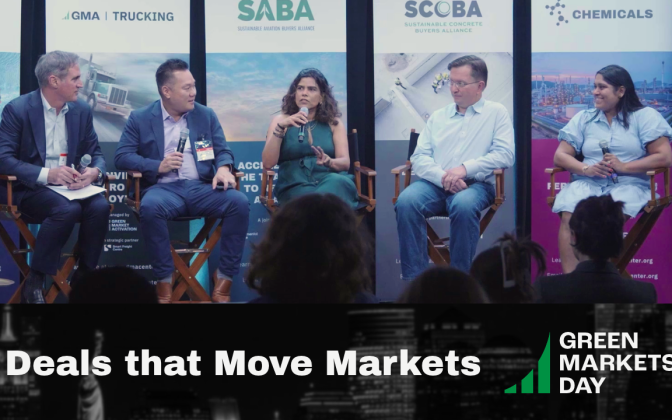
Green Markets Day 2026 | Panel: Deals That Move Markets
Moderated by Andre de Fontaine, Managing Director at GMA, this panel featured Ayesha Choudhury, Chief Commercial Officer at Infinium; Albert Luu, Chief Financial Officer at Fortera; Vrushali Gaud, Global Operations Director at Google; and Andreas Marschner, VP of Global Engineering, Maintenance & Sustainability (GEMS) and Worldwide Operations Sustainability (WWOS) at Amazon. The session opened with the announcement of Fortera as the winner of the Sustainable Concrete Buyers Alliance’s (SCoBA) first RFP for low-carbon cement and concrete attributes, along with news that the first contracts in SABA’s next-gen SAF deal with Infinium have been signed. Panelists then discussed what makes collective procurement deals bankable, how buyers get them approved internally, and what it will take to do more and bigger deals.
See below for a full transcript.
TRANSCRIPT
ANDRE DE FONTAINE:
Thank you, Ingrid. That was a really cool video. And thank you to everybody for being here. It’s great to see such a packed house. And I’m really thrilled to be moderating this panel on deals that move markets because it really gets to the core of the kind of work that we do at GMA along with our partners.
We’re going to spend the next 40 minutes or so trying to understand how collective procurement can drive new technology deployment. Specifically, what needs to be true to really make these procurements work and drive the impact that we are seeking to achieve. You know, for us, at a high level, we think about these kind of major building blocks for these deals of being innovative technology, corporate climate leadership, and then market mechanisms to connect those two. And those are the building blocks. But, of course, a lot more needs to happen from there. And so I think that’s what we’re going to talk about together as a panel is to get into the details a little bit more.
You know, fortunately for us, we’ve got a lot of really great proof points to pull from over the last year. Kim mentioned some of these in her opening remarks. And I think even better, the folks that we have on the panel were involved in most, if not all, of those innovative deals. And so we’ve got a lot of expertise on the panel and some really great perspectives to hear from today.
So let me just share a few highlights before we go into the panel. Kim mentioned some of these, but earlier this year, the Sustainable Aviation Buyers Alliance that we run with RMI and EDF announced the winner of its next-gen RFP. So this was looking at ultra-low-carbon, highly scalable, novel SAF technologies, the point being to try to get enough corporate offtake to help get the plant to final investment decision. And so we announced that Infinium, which is represented on the panel today, was the winner of that RFP. And then today we made a really great announcement that the first batch of contracts associated with that deal have been fully signed. And so that’s about 200,000 tons of CO2 reductions represented by the SAF certificates that are being transacted through this deal. And it includes companies like McKinsey, Google, Bain, and AVEVA, and there’s more on their way. Some have chosen to remain unnamed. Others are still working through the final contracting process. I think the volumes are really impressive, but even better are the structure and the term length of these contracts. Up to 10 years, that’s a real breakthrough for this sector to get corporate offtake of that duration. And then also, these contracts are bankable. Ayesha is going to talk more about what that means during her remarks, but we worked very closely with Infinium to make sure that these contracts met the needs of their financers so that we could help get this plant to FID.
Along with Aviation, as many of you know, we’re very active in trucking as well. Last year on a panel just like this one, we announced Nevoya was the winner of our first ever trucking RFP. And from there, the project has moved along really well. All the contracts are signed, which is great. And we also announced that Google had entered the deal after the first announcement was made, increasing the total volumes from 40 to 60 new trucks on a route in Texas connecting Dallas to Houston.
And so at GMA, we also care a lot about the materials. So not just airplanes and fancy new trucks, but also cement and concrete, which is often an overlooked sector. You literally walk all over it every single day. But it is a very important sector for us because it’s a major emitter, 8% or more of global greenhouse gas emissions. And it’s also a sector that we think is really ripe for innovation, also stimulated by the kind of market mechanisms that we do here at GMA along with our partners. And so that’s why we, together with RMI a couple of years ago, launched a new effort to develop a book and claim system for cement and concrete. That kicked off an effort where we brought together an expert working group to really develop the rules of the roads for how book and claim could work for this sector. We published a framework to help guide that work. And then a year later, again, at a panel just like this one, we announced the launch of the Sustainable Concrete Buyers Alliance, or SCoBA. SCoBA is a buyers alliance that brings together buyers who are seeking low-carbon cement and concrete attributes.
And I’m very pleased today to announce the culmination of a lot of that hard work. Drum roll, please. I have a clicker. For the culmination of a lot of that hard work, we are announcing today the winner of our first RFP for low-carbon cement and concrete attributes, and that winner is… Fortera. So we have Albert Luu from Fortera with us today, who’s going to share a little bit of his perspective on this process. I’ll just say a few words.
Fortera was selected through a very rigorous evaluation process. We were looking for a project that helped advance the goals of getting a new technology to commercialization. Since submission of its proposal, Fortera has continued to demonstrate momentum in this space. They have announced an agreement with the Mississippi Lime Company for the first full-scale commercial development of its ReAct cement product. ReAct uses industrial CO2 as a feedstock for its product, converts that into cement through a proprietary ReCarb process. It demonstrates compatibility with a broad range of construction applications, and it also meets all the established industry performance standards, which is really important. And I think important for us, for the purposes of today, is that it can achieve emissions reductions of two-thirds or more relative to conventional cement products. So very, very exciting. And ultimately, this facility is expected to produce more than 300,000 tons of low-carbon cement per year.
We will be announcing more details associated with this deal in the coming months as contracts are signed, but ultimately we’re targeting, with the participating buyers, offtake agreements of three to five years, and for volumes that will make up a meaningful portion of the plant’s total output. So very, very exciting. A groundbreaking new deal.
And Albert, we’d love to hear a little bit more from you before we open it up to the rest of the panel. If you can tell us a little bit more about your product and your technology, and then describe, you know, the importance of why you decided to participate in this procurement opportunity and what you hope to get out of it in terms of impacts on your company.
ALBERT LUU:
Yeah. Hi, everyone. Albert Luu. Excited to be here. Honored to be accepting this award for Fortera. You know, it’s… When you’re developing a new technology, at the end of the day, you have to get capital providers comfortable with the asset class. So what we do is we are developing production capacity and technology for next-generation cement. It’s cement that outperforms traditional cement. It’s more durable, higher performance, better reliability, and better for the environment. But for capital providers, at the end of the day, they still need to make a capital investment to fund the capex associated with this.
I’m relatively new in this role, and one of the things I’ve learned about cement is that there isn’t long-term offtake in the traditional markets. And when you think about project financing, most of the investors there look for what they call durable, predictable cash flows. And so this award, working with GMA and SCoBA, allows us to, in some ways, create a financing mechanism to bring capital providers into this space. The ability to really separate the environmental attributes from the physical product, I think, is a clever, creative way to lock in cash flows. It borrows a lot of the concepts that have come from renewable energy, where you separate the electrons from the RECs. In a similar way, this allows us to contract a portion of the project, be able to show capital providers that there is a market, there’s interested buyers, while you continue to test out the product, allow for more time for that, and then really work in the traditional space where a lot of the buyers of cement are not thinking multi-year offtake agreements.
ANDRE DE FONTAINE:
Okay. Well, thank you so much for that, Albert. Well, rounding out the panel, we have Ayesha from Infinium, we have Andreas from Amazon, and we have Vrushali from Google. So we have a really great representation of innovative producers, but also folks that represent the corporate demand that really drives these deals forward. And so, Andreas, maybe I’d like to start with you just to balance a little bit of what we heard from the producer. Why, from Amazon’s perspective, do you participate in collective procurements? What are you able to get out of these that goes beyond what you might be able to do on your own?
ANDREAS MARSCHNER:
Well, it has been covered already before in the previous panel, but also in some of the opening remarks. Also, at the size we are operating, getting to the right demand signals is insufficient on our basis. And so, pooling the demand, especially to get nascent technology a boost and allowing for a meaningful risk profile is the critical piece. And that’s why we joined several of the initiatives that are all shown here from the first day. Because we believe that we need to get the signal that the demand is there. It’s not just a single demand, but it’s a group demand and there’s willingness to invest and go that innovation journey because that is what is de-risking the topic on the technology side.
We are always in this chicken or egg dilemma. And well, if there is no demand, then there is no supply. And this is a way to overcome that part, at least in the early days. It’s not necessarily sufficient for the long term, but it is really providing this initial impetus and that’s why we are very convinced that this is the way to go, in particular, where we’re talking about new technology. Product development is never a straight line. And so we need to take the risks and distribute them accordingly.
ANDRE DE FONTAINE:
Yep. Well, thanks for that, Andreas. I think we would agree, you know, almost all demand is good demand, but there is still, I think, ways of structuring demand that can be more impactful than others. And Ayesha, I wonder if you could comment a little bit. I mentioned the bankability aspect in the opening. Can you talk a little bit more about what that means and what are some of the steps that we took together to make sure that the contracts were signed for the SABA members actually do meet the needs of your financiers?
AYESHA CHOUDHURY:
Absolutely. First, thanks for having me, Andre, and GMA. I appreciate the opportunity to be here. First, let me explain what Infinium is in 30 seconds. We are a power-to-liquid SAF producer. What it means is that we make sustainable aviation fuel from renewable power and waste CO2. It’s a different pathway, which is a more novel technology than the other pathways that exist for SAF today, but it has the ability to scale because our feedstocks are fundamentally sun, air, and water. So that’s Infinium in a nutshell.
We talk all day about commercial– er, technological innovation, right? This is a novel technology, and this is something that needs to come down the cost curve. But to Andre’s point, a lot of the work that we’ve done together with GMA and SABA, with American Airlines, our partner in this deal, and all of the Scope 3 buyers is really what I would call the commercial innovation part of things. It’s not just the technology alone that’s going to get these projects off the ground to FID and get built and continue to scale the industry. It has to come from commercial innovation, too.
And so, you know, we always talk about bankability and bankable demand and bankable contracts. What does that really mean? I’m actually a former banker. So I think before I was at Infinium, I was a banker for a long time. So maybe if I can tell it to, you know, to boil it down very simply, it’s duration, the tenor of the contracts, it’s volume certainty and price certainty and predictability on that, right? Those are the obvious things. And the less obvious things are other types of risk sharing and allocation, particularly when it’s a novel technology. What happens if the plant is delayed? What happens if it doesn’t produce with the uptime that you expect? All of that stuff goes into the contract, too.
And so a lot of the work that we did with, first, the SABA team, and then with all the Scope 3 buyers that, like Google, that joined in on this procurement was really the negotiation and standardization, I would say, because it’s sort of the same contract across all of the many buyers that we had. And that was a great innovation and a material step in bringing these projects towards a final investment decision. Because even if the technology is de-risked, the commercial side has to be materially de-risked, too.
ANDRE DE FONTAINE:
Great. And, Vrushali, coming from the buyers’ perspective, you know, when we think about these deals that we’re approaching you with, it’s multi-year bankable for technologies that are not yet commercial and on a time scale where you’re committing to purchase something that doesn’t exist yet. So this is a tall ask, and I wonder if you can comment a little bit on, you know, the process internally to get these kinds of deals approved. What do you need to demonstrate? Or what are the types of challenges you need to overcome to get these approved internally?
VRUSHALI GAUD:
Thank you. Can you guys hear me? I think I’m echoing a little bit. So just bear with me. So first of all, congratulations. What a fantastic day to be here when we had the SABA deal go through this morning. It was announced, and it has Infinium in it. American Airlines, we are very, very proud to be a supporter of that. And it’s a good example of some of the things you mentioned, right? It’s the technology innovation, but it’s also the commercial innovation, and also the standards innovation, because how do we make book and claim, and how do we claim for this and track it? So it’s a good stepping stone all around.
Going back to your question, I think there are two sides of this, but I say it from a Google perspective, or any company that has the privilege of making investments, of having the foresight and the support internally to make investments that are long-term in nature and also have a sizable impact. So I think that, you know, initially that is an impetus we have. I acknowledge that and it’s a privileged position to be in.
Having said that, any deal has the same constraints. It is: is the technology proven? Then is the price point the right that you want? So is it cost-effective? Because eventually you want this to be scaled and scaled such that Google can do it in volume but everybody else can do it in volume. And the third part is your time, the horizon to get to that scale. And, I think if you look at all of those three attributes, it makes a case for two things.
One, there has to be people who are the first movers. And I think Amazon and Microsoft and Googles of the world can be the first movers, which is a great advantage that we have and sort of put our investments in the pilots. And then make the deals in a collaborative way. I think that’s where the power of the collaboration comes in because individually you cannot get– you cannot prove the technology through the scale and in the time frame you want. And for all of those three rubrics is I think what the activation to an alliance comes in.
ANDRE DE FONTAINE:
Thank you. That’s a really great perspective. And maybe to switch gears a little bit, I’d love to know, I mean, these were first of a kind deals. We want to do more and bigger deals as we go. Maybe I’ll start with Ayesha. What do you need to see in order to take this even bigger? Is it regulations? Is it more voluntary demand? Is it greater standardization around the market measures? Or is it some combination of all three?
AYESHA CHOUDHURY:
It’s all of the above and then some. These are hard problems, right? We have a very hard problem to solve. And I think one of the things that I’m very proud to be a part of is very collaborative effort to figure out how to get there. A lot of the work that we’ve done out of this procurement is going to be useful for the next projects and the next projects. I would say that we spent– we invested a lot of time and energy, and I give the SABA team a lot of credit for investing so much time and energy in working on a bankable contract template that is going to be critical and useful for many more projects to come until this market becomes much larger with much more market depth that you don’t have to have these types of procurements anymore. Unfortunately, or fortunately, or unfortunately, you need it all, and this has been a really important step forward.
ANDRE DE FONTAINE:
Maybe I’ll pose the same question to Albert, but you’re not allowed to say the same thing. So you can’t just say it’s all, or if it’s all, can you give me some kind of rank order or priority?
ALBERT LUU:
I’ll try. I think we’re starting off in the journey where we’re relatively– like, when you think about building materials, earlier in this process of contracting. And so I think it’s great to hear when buyers talk about kind of investments, and because it really is an equity investment, it’s not a typical supply agreement. And so it’s how do you allocate risk and think about risk between the different parties for projects that have never been built before, and understanding that things never go as planned, and being able to kind of work through some of those things. So I think having kind of the collective minds just collaborating there, and everybody really taking the view that we’re an equity owner in this project and everybody needs to kind of share in the risk for this project to move forward.
The other area I think about is, listen to Ayesha talk about all the T’s and C’s around this. I’m sure every buyer has things that are going to be unique to them, but for us, we’re starting this journey, so the more we can do to lower soft costs, standardize contracts, standardize terms where the risks are going to be the same between all the buyers, it will allow us to go to capital providers, the law firms that have to review all these agreements in a way where we can be much more efficient and they can see an industry that really will scale from, you know, for us, first few plants are going to be hundreds of millions to multiples of hundreds of millions and then multiple plants. So a lot of, I think, what work has been done in other sectors just needs to be done for cement and concrete.
And then, you know, it’s easy enough to say, but just more buyers. I spent a lot of time talking to capital providers and they always talk about, it’s great that you have a couple of buyers, but that doesn’t really show a market. You need a lot more depth and I think some of the early buyers, the bigger organizations who can kind of create signals for other players in their space to follow on, I think that’s another mechanism that will be helpful.
ANDRE DE FONTAINE:
Yeah. Okay. Thank you, Albert. Maybe turning it over to the buyers, one thing I’m curious about, you know, you’ll see from the posters, GMA with its partners is active in a number of different sectors and you guys have purchased attributes in all, I think, of these programs or close to it. Do you take the same approach to each sector when you consider the opportunities and you consider the purchasing opportunity, or does it vary by sector or technology type? And Andreas, maybe I’ll start with you.
ANDREAS MARSCHNER:
It’s a yes and a no. So the yes is related to, of course, we have learned with the first of these type of agreements. What we have never done before because it is all about aligning interests and acknowledging what are the constraints of each party and then really looking what is now the joint solution space. And I think this is what GMA did fantastic in the past with all of these things because it was all providing that environment and this joint commitment to drive change and figuring out how to actually get there.
The no part is it is, of course, a very different story if you are talking about fuel or if you talk about low-carbon cement solutions. So we also then need to recognize what is the hard problem to solve. And there is just very different elements in play and that is where the things are different.
I remember when my team was looking for getting the direct supply of low-carbon concrete to a site we were building. And it was impossible to find it in a meaningful environment. That’s why also the entire book and claim mechanisms are so important to help getting things off the ground. Because in areas where you would say, well, that should be solvable. It’s just in the regions where you might actually have a project or you have a sizable demand. You might not get the supply at a meaningful cost. And getting these things right is very different throughout the applications we have been talking about.
ANDRE DE FONTAINE:
Great. And Vrushali, same question to you. I mean, how do you think about this? Is it a standard approach or does it vary by sector?
VRUSHALI GAUD:
I think I’m going to just build on what he said. It depends. We, we, it’s my favorite. It’s the one thing I learned in business school. Just say it depends for everything and you can get out through it.
But we, so we do have internal thresholds. A lot of the companies have a dollar per ton threshold or a dollar per megawatt hour. Depending on what you’re looking at, right? And below a certain threshold, it’s easy. Because that’s just, you know, it’s scaled in projects. It’s, it’s scaled interventions. And those kind of go, go for the flow. Beyond that, and that’s where some of these newer things come in. It, it’s sort of in, we bucket it under what is predominantly important for our business. Right?
So certain interventions are critical for us. Data center construction. So green construction is, is an important piece to it. Green steel, looking at different ways within the construction materials. So that I think is, is something we like double down on a little bit more. And that again links very well with the location. So certain locations, we just did a deal in super excited about zero emissions steel in Stegra in, in Europe. And that’s very close to sort of the European data center location. So there is an inbuilt demand. We know it will be sustained. So we have a much better playbook on that in certain regions. And so it’s a combination of the price point. But also the operational need. And I think if you justify the operational need, it’ll most of us in sustainability know then it’ll stick around. It’ll be sustained and not just be a one time deal.
And the other side, something like SAF, you know, it’s not predominantly our business. We are not an airline company, but a lot of our employees travel. It’s part of our footprint. So we have to decide on scale where and how much we invest. So I think in that it’s some of these first of a kind alliances that are helpful, probably not as much as we do in some of the other spaces. So it’s a combination across all of that.
ANDRE DE FONTAINE:
Okay. Great point. And I actually think we do have some time for questions from the audience. So if folks want to raise their hand. Any questions? And as you guys consider questions, I will ask a quick round robin. If folks can, you know, you heard there’s some continuity in the announcements we make at Green Markets Day. So fast forward a year from now, what would you hope to be able to say about the project or deals you’re working on now? And Albert, I’ll start with you.
ALBERT LUU:
Yeah, hopefully a year by now. We will have contracted many of these offtake agreements. And then I think the other area, too, is, you know, I was having lunch with our CEO and an investor, and one of the things I’m learning about cement is that because it goes– because it’s a material beyond just contracts, like product validation is a big thing as well. And so looking at the coalition to, like, are there ways to share data so that we don’t go through the same testing with everyone, just so that we make this a more efficient process? So what are ways that we can just streamline product validation and offtake over the next year?
ANDRE DE FONTAINE:
Yep, that’s great. And Albert, on your first point, if you find that the contracting is taking more than a year, let’s definitely talk about that. That should not be the outcome. But let’s go down the road. Vrushali, what would you say a year from now? What would you like to be saying?
VRUSHALI GAUD:
I think two things. One is incentives. So you have to make it, you have to give incentives to even folks like Google, right? Like, how, you know, making and paying the higher premium, are there contractual benefits? Are there first offtake benefits? So you have to incentivize. And then how do you incentivize others to come? As much as I love my company and, you know, seeing its name everywhere, it doesn’t mean much if we are just, if we are the whole market. You want to see others, others come in.
ANDRE DE FONTAINE:
Absolutely. Andreas?
ANDREAS MARSCHNER:
Making real progress in the hard to abate environment we have here and getting more momentum established by aligning the risk profiles better than what is already the case. In some of the areas we talked about, I think we are still chasing our tail a bit because if you go in the transportation sector, you have several things that need to work well together. And only if all of these conditions, you have a truck that has the sufficient range, you have the charging available when you actually need it, and the grid provides capacity when you need it, if these things don’t play together, you are never able to scale. And that is the part where we need to partner with the different players involved to allow for a much faster scaling in that domain.
ANDRE DE FONTAINE:
Ayesha?
AYESHA CHOUDHURY:
My hot take is much more selfish. I just hope that our project hits a final investment decision a year from now. We’ve made a lot of significant progress on the development of this project, including this very important procurement, and so I hope a year from now we can talk about how we, you know, are going to go to the, you know, ribbon-cutting or, you know, shoveling party.
ANDRE DE FONTAINE:
That would be amazing. Do we have any questions from the audience?
SAMAN BAGHESTANI:
Hi. I’m Saman, co-founder and CEO of S3 Markets. We work on industrial commodity certificates. My question for the group is, and particularly for Google and Amazon, you know, it seems like a lot of companies like yours repeat the same diligence on the same set of companies. To what extent do you think that diligence is a public good that perhaps could bring down costs and let other organizations who just can’t, they don’t have the same budgets as you do, access that same sort of diligence?
VRUSHALI GAUD:
I can, so that’s a great question. And we just, through the Elemental group, we formed a data center innovation initiative which has Meta on it and Amazon on it. And I think that’s a great example because part of what Elemental is trying to do is sort of, you know, express due diligence on things, so right, like so you already have a list of startups they work with or technologies that they’ve progressed in and they become the central repository of sharing information across. And there are times when, look, as much as we like open sourcing things, you also have to be careful around where you’re driving the market, creating the market and shaping it and like all sorts of regulations around it. But having a central entity that does that, and that’s exactly the initiative we have from DSI. And same, I think, I would say about the SABA and the SCoBA deal.
ANDREAS MARSCHNER:
I can only plus one on that, because the regulatory framework provides clear boundaries on what can and what cannot be done, and that is there for a good reason. And that’s why intermediaries who then potentially help with these topics can also help address it. And then, of course, bearing my colleagues in finance, there’s also then always the question in terms of what is the right financial modeling and what are the right inputs. And if that then differs, then you might still have certain aspects that need to be covered independently.
ANDRE DE FONTAINE:
Okay. Just scanning to see if there’s any more questions. I have a couple more that I can keep posing. Maybe I’ll go back to Ayesha, because you mentioned that you hope a year from now to be able to say that the plant has gotten to FID. So what is the next priority post this voluntary deal, what are you focused on to help get to FID?
AYESHA CHOUDHURY:
So project development, there’s, in project finance, there’s often what you call three legs of the stool. That’s the common parlance. So the first pillar, leg of the stool is your offtake. The next second one, no particular order, is capital, right? Both debt and equity. And then the third leg of the stool is called technology, construction, EPC, right? And you’re all kind of doing, you’re kind of doing all three of these at once, right? But obviously if you only have one, then you have no stool, right? So I think that that’s sort of the traditional way of thinking about project development.
What I think is really different about what we’re doing in more novel markets and novel technologies is it’s a whole lot less of a stool and a lot more of a tent. You are pushing the poles together enough in such a way, and you’re getting them to land exactly in the right place. So I would say that, I don’t know, I only have two arms, but like here, like right now we’re really just, we have all of the pieces, we have all the legs of the stool, I guess, but what we’re trying to do is bring the stool, the legs together into more of a tent. That’s what we’re really doing. And so we have all the basics in place. But now it’s getting them tighter.
ANDRE DE FONTAINE:
Yeah. And then, Albert, maybe a similar question for you. What’s the immediate next priority for your process?
ALBERT LUU:
So for us, a couple of weeks ago, as you mentioned earlier, we announced a 300,000 ton plant with MLC. We are working on FEED on that, and we should complete FEED by end of this year, working through permitting. Once we complete FEED, what that unlocks is detailed engineering. Long lead, all working towards that FID concept.
The great thing about FID to me is that you can’t fake it. Like, there are so many things that get announced that you kind of go, is it really going to happen? But at the end of the day, FID is one of those you cannot fake because you have to have all the pieces together and ultimately third party capital to say this has been de-risked to move forward. So we’re working towards that. We expect this plant to be operational in 2028 and take FID sometime next year.
ANDRE DE FONTAINE:
Okay. Great. And then maybe a question, a similar question for both Andreas and for Vrushali. How do you manage the tension around some of the technology types that you might be investing in? When we look across these different sectors, whether it’s trucking or cement and concrete or aviation fuel, there is the kind of like forward-looking ultra-low carbon solutions that tend to come at a higher premium. And may not be available in much quantity today versus potentially cheaper carbon abatement opportunities in those same sectors that are more widely available. How do you manage the tension between investment in one that might deliver a lower cost today, but could be less scalable in the future? Andreas, maybe I’ll start with you.
ANDREAS MARSCHNER:
Our philosophy has always been being willing to fail fast because we want to learn fast. And that means really acknowledging that we are in a product development journey, and it is absolutely natural that things will go wrong and will not work out and not seeing this as a defect, but as part of the learning journey to get to this scalable solution faster and making sure that this is really a joint learning with our partners. And that’s why we are investing in different, very recent technologies, or we are building partnerships and how to explore those. To then really provide, also, the business environment to test these things instead of being solely dependent on the lab type of environment. Because what we typically see is the real business life typically provides different challenges than what you can actually really see in the lab.
ANDRE DE FONTAINE:
And Vrushali, same question to you.
VRUSHALI GAUD:
I think, you know, for us, you have to, there’s two portions of this. One is you have to have the right expertise in whether it’s in-house or whether you have partnerships. Because a lot of the things we’re looking at are, they are scientific in nature. There’s innovation. There’s, you know, there’s like why one versus the other. And it would be obnoxious to say we know it all. So I think relying on those who have expertise and have guidance on that, I think that helps us get that first view.
And then the second thing, you know, I think we don’t have the fail fast one, but we have a very strong theory of change that we walk ourselves through. So is the theory of change as to the fastest, quickest or the most credible or the most impactful? Right. Each one is. You can justify that. And there’s different ways to go about it. But we have a theory of change where we have different facets on those three dials. And then that helps us decide which technology is more credible and then also meets the scale and time that you want.
ANDRE DE FONTAINE:
Great. And then maybe we have time for just one last question. Vrushali, I’ll stick with you because you mentioned something that Google looks for is that you don’t want to be alone on these deals. And so what are some things– I think that’s the question all of us are wrestling with is how do we bring more demand into these markets? Do you have any ideas of how to bring more companies into this?
VRUSHALI GAUD:
Most companies work at the intersection of cost. So what does it cost me and what benefit do I get? And I think you have to work on both those incentives. So find a way to bring the cost down, which is I think what we’re all sort of talking about. That’s one. And then the incentive either is a compliance or a regulation or a demand signal or a consumer signal, something on that side. So I think both of those are critical to get more companies in.
ANDRE DE FONTAINE:
Terrific. Well, thank you. I just want to close by doing two things. One is congratulating Albert and Fortera, congratulating Ayesha and Infinium, and then thanking Vrushali and Google and thanking Andreas and Amazon for providing the demand that makes a lot of these things happen. And if all of you could join me in giving a warm round of applause for these panelists.
Related News & Resources