11.02.26
Green Markets Day 2026 | Welcome and State of the Market
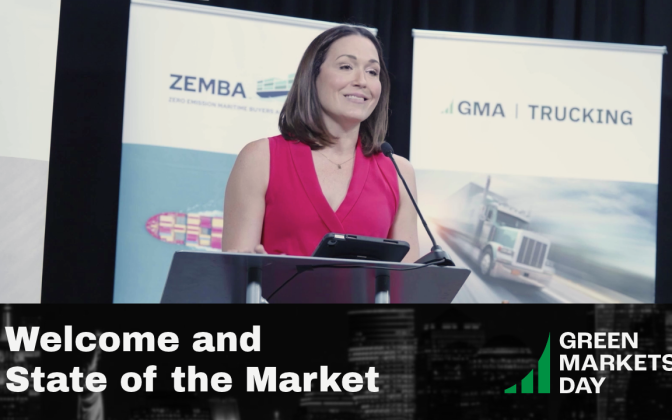
Kim Carnahan, CEO of the Center for Green Market Activation (GMA), opened the third annual Green Markets Day with a look at the state of the market. She reviewed a year of progress across GMA’s programs: the first-ever collective procurement for low-carbon cement, a pilot procurement for low-emissions ethylene, SABA’s first bankable 10-year contracts for an e-SAF facility, an expanded zero-emission trucking deal, the launch of the Green Ammonia Buyers Alliance, and ZEMBA joining the GMA family. She urged companies still on the sidelines to start buying now, because demand, not waiting, is what brings costs down.
See below for a full transcript.
TRANSCRIPT
KIM CARNAHAN:
Hello and welcome to the third annual Green Markets Day. I’m Kim Carnahan, I’m the CEO of the Center for Green Markets—Green Market Activation, excuse me, or GMA, as we like to call ourselves. I want to start off by thanking Amazon for providing us this amazing space and the food and… so much logistical help. They’ve been one of our strongest supporters since… well before GMA existed and we were just running the Sustainable Aviation Buyers Alliance, so really grateful for them.
Also really grateful for the GMA team and the teams at Smart Freight Centre and RMI who have done a lot of help… who’ve done a lot of work to help us pull together this agenda for today. In particular to GMA’s communications manager, Alison Greene, who’s been amazing, and Kari Pederson, who is absolutely the orchestrator of this whole thing. She’s our Chief Strategy Officer, and her job description does not come anywhere close to including running this event, and she does it magically. So… really huge thank you to Kari. I don’t see her anymore. She’s hiding somewhere.
And thank you, of course, all of you for showing up today. I know there’s a lot going on in this city. So we’re really grateful that you’re choosing to spend a little bit of today with us.
I want to start by asking a question. It might seem a little bit controversial. How do you eat an elephant? Anybody know? One bite at a time. That’s right. That’s right. That’s been my personal maxim for my entire adult life. I do not condone eating elephants. Do not go write a blog post about this, please. Um… So please, when I say eating an elephant, imagine this guy. This is a very real photo of me getting ready to eat an adorable, I mean, really, it’s adorable, isn’t it? Elephant pancake. So we’re going to talk about pancakes today.
The point is… when the challenge seems enormous, the only way to tackle it is, of course, piece by piece.
And for many of us working on corporate decarbonization over the past year, it has really been focused on standards. Which is a big one. Maybe even the trunk of the elephant? I’m pretty happy with where that work is landing. The AIM Platform published its standard and guidance earlier this year, giving companies a tool to use right now when accounting for, reporting and claiming market-based approaches towards target implementation. SBTi, even more importantly, gave companies the bright green light to use market-based approaches towards target implementation, and the GHG Protocol, through its Actions and Market Instruments white paper, signaled that it will provide a structured avenue for reporting market-based approaches in its revised Corporate Standard.
So the direction of travel is clear and standards cannot be the excuse anymore. But remember, we’re talking about an elephant here. Elephant pancake, excuse me.
Standards may have been the trunk, but demand is really the belly. I am very proud of the work, very, very proud of the work that GMA and our partners have done to kick off the process of activating demand in some pretty tricky sectors. Over the last 12 months, we have managed the first-ever collective procurement for low-carbon cement, with sufficient demand to support a first-of-a-kind commercial-scale facility. We’re announcing the winner of that procurement process this afternoon, so please stay tuned.
We have launched our High Value Chemicals program and are currently running a pilot procurement process for low-emissions ethylene, a building block for most plastics. We executed the Sustainable Aviation Buyers Alliance, SABA’s, most ambitious SAF procurement to date, securing our first-ever truly bankable 10-year-long contracts for a future e-SAF facility, helping to get that facility to FID. We scaled our first zero-emission trucking procurement by over 50% after the deal closed. By over 50%! Thank you, Google. And partnered with the Smart Freight Centre to chart the program’s much more ambitious next phase.
We launched the Green Ammonia Buyers Alliance, or GABA (please don’t say gabba, people), with RMI and 3Degrees, with the remit of tapping corporates’ demand for low-emission fertilizer.
And finally, definitely not least, we were thrilled to bring the Zero Emission Maritime Buyers Alliance, ZEMBA, formally into the GMA family of programs. ZEMBA is now expanding its ambition to additional zero-emission technologies, including battery electric vessels, which we think is pretty cool.
And that’s quite a lot. We’ve done all of this in the face of some pretty incredible headwinds. Hostile conditions, you might even say. But that makes me feel like we’re onto something and we really cannot slow down.
But I have to level with you. Our members are not all buying yet. And beyond that, there are a lot of companies who are still on the sidelines waiting to engage.
What are the companies waiting for exactly? This is what I spend my time thinking about. It’s mostly for costs to come down. And I understand decarbonization of hard to abate sectors is expensive, especially when we’re just getting started as we are in many of these programs.
The thing is, waiting doesn’t bring down costs. Demand does. And waiting will not create more competitive markets for decarbonized products, but signing contracts today will. We desperately need more companies to grab a fork and start eating that elephant. Pancake.
So my question to all of you is: can we work together to get this done?
For companies in the room, help us get your major customers and suppliers in the game. This year, GMA will be developing new tools to help companies share costs and co-claim with other players in their value chain. This reduces the cost burden immediately. We can also reduce cost in the near term simply by bringing more buyers into the fold, helping to bend that cost curve down.
And by scaling up. How can you help there? We have seen great success when several peers in a sector jump into a procurement together, from pharma to entertainment to apparel. Because the first question that’s… or one of the first questions that the C-suite often asks is whether their competitors are also procuring. So let’s make the answer yes, yes, yes, yes, yes, yes.
Another option: do you have colleagues in another region that also has a decarbonization mandate, a separate one from you? GMA is expanding focus abroad over the next 12 months in search of more demand. That’s our primary goal. We will be spending a lot of time in the APAC region in particular. You’ll hear more about that today. Please introduce us to your colleagues there.
And beyond increasing the number of buyers and the size of buys, we also want to make sure that there isn’t a cost penalty for being a first mover. For first-of-a-kind projects, the per-unit cost can be… painful. So GMA is working with suppliers and experimenting with new deal structures that make it the smart move to participate in that first deal rather than waiting for the second one. If participating in the first deal guarantees you access to a much lower cost second deal, would that interest companies to jump in sooner? Maybe even just for a tiny buy. Dip your toe in. If this sounds interesting and you have an interest in concrete or ethylene, come talk to us immediately.
Now, even if you’ve secured a budget and are ready to buy, we know that decarbonizing supply chains is still too complicated. Way too complicated. And that’s why just this morning, GMA, RMI and the Mærsk Mc-Kinney Møller Center announced a new joint initiative to develop a unified book and claim registry across transport and heavy industry. Our goal is to make markets… accessing these markets simpler and easier for companies to participate in at scale. RMI CEO Jon Creyts will be here later today, and we’ll share much more about this effort.
As I come to a close, I want to take a second to talk about policy. People are always asking me why GMA doesn’t do policy. I always say, to be clear, I would do cartwheels across this stage if we could see more climate regulation, but my entire career tells me that waiting for policy is insane. We just don’t know when it’s going to happen. When it does, we’ll be ready to act right alongside it.
But instead of waiting, we ask that you flip the script with us, and create proof points for future regulation, because the stories of game-changing innovation that we can manifest together are the stuff that gives policymakers goosebumps. Seeing these technologies in action, seeing these products heading out the door, can convince them that not only is it possible, but that they have the power to create the future that we also desperately need.
And to be able to tell those stories, we have to keep making our way through the pancake.
Related News & Resources