11.02.26
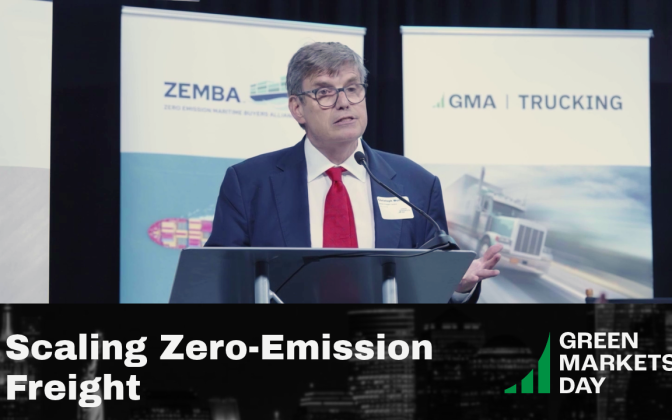
Green Markets Day 2026 | Executive Keynote
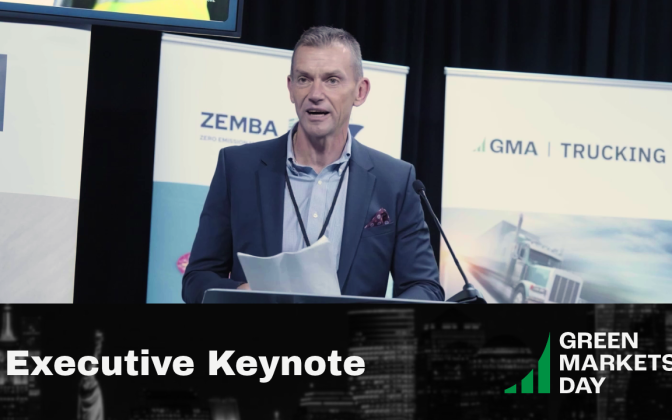
In the executive keynote, Robert Kowalik, Vice President of Worldwide Environment at Amazon, described how Amazon approaches decarbonization across its many businesses, from network design and fleet electrification to supplier engagement through the Amazon Sustainability Exchange. He made the case that procurement, and especially collective procurement, is a fundamental tool for turning corporate ambition into real investment, and that credible standards, accounting and registries are what give buyers and suppliers the confidence to scale.
See below for a full transcript.
TRANSCRIPT
KIM CARNAHAN:
I’m excited to invite our Amazon keynote speaker to the stage. Please join me in welcoming Amazon’s Vice President of Worldwide Environment, Robert Kowalik.
ROBERT KOWALIK:
Well, good afternoon. Good afternoon. Thank you for being here. And I’m so excited to be here. I know what I’m going to have for breakfast tomorrow. It’s going to be a pancake. It’s going to be shaped. I’m hungry. Like, this is a fantastic, fantastic photo. Very appealing.
Well, I’ve been with Amazon for 10 years. I used to run a lot of our operations and two and a half years kind of leading our environmental team at Amazon. So anything related to water, carbon, biodiversity, all of our work in in waste and sustainable selection. Prior to that, I’ve spent 20 years in the energy sector pretty much all over the world, including kind of early days of renewable energies in China, even and and some of the early projects in Europe and in the United States.
Now that I learned so much about — you learned so much about me, I just wanted to ask you two questions. One, how many of you are here for the first time? I’m attending Climate Week in New York? Oh, welcome. Welcome. There’s a pretty that’s great. Great. Welcome. So excited for you to be here.
Do you know how many Climate Weeks happened in New York? Anybody knows? The first one was 2009. I googled it and this is number 18. Is there anybody in the room that attended all 18? I thought so. I thought it would be difficult but well, well, thank you. Thank you for being here.
I’ll get kind of to my content but first wanted to really thank GMA and and RMI for and many partners who came here and brought this community together. All the corporate leaders in the room, all the suppliers, policymakers, investors, innovators, nonprofits and everyone that’s kind of contributing to accelerate the transition to green economy. I want to obviously acknowledge all of those wonderful partners. We are working with including SABA, ZEMBA, Trucking and SCoBA. We’ve been actively engaging.
So again, it’s an honor to be here and I will kind of build on what Kim mentioned. We are living through an extremely, extremely different period of growth and change like unlike anything we’ve seen in the recent memory. So the regulations are obviously shifting and changing. The climate impacts are harder to ignore and they’re extremely visible, but also technology and AI is reshaping every single industry and our personal lives. And at the same time, while all of this is happening, we kind of tend to call it the headwinds or kind of challenges, with the choices we’re going to make in the next few years will kind of help us to define what was going to happen in the next decades and generations to come. What I want to mention — there are a light —
We recognize that at Amazon, the journey will never be linear. And can we talk a lot about that including what our CEO, Andy Jassy, mentioned in his recent shareholder letter like we know the path will never be perfectly mapped. It will continue to involve in changing conditions and uneven infrastructure, evolving technologies. There will be a lot of economic considerations and the next move will never be immediately clear, but that uncertainty is not a reason to slow down. It is a reason to operate with a much sharper focus and continue to build on what we can control and on our controllables.
Today, sharper focus means thinking and acting beyond individual commitments towards the practical mechanisms that will enable conditions to scale. Whether it’s credible demand, whether it’s capable suppliers, whether it’s investments, consistent and transparent reporting, measurements, collaboration across all these different value chains.
As sectors — today, across all the sectors, we’re actually seeing the real progress. Companies are making procurement commitments, suppliers are investing in lower carbon emission technologies and many of the new projects are actually getting developed. Accounting standards are also advancing. We’re very happy for that and thank you for influencing those wherever we can. And the solutions that sometimes existed as pilots are getting scaled very actively and we’re scaling a lot of them across Amazon too.
But the transition remains very difficult, especially in the sectors that are hardest to abate that many of those buyer coalitions are representing. One thing is to identify the lower carbon fuel material or technology and another thing is to make sure that it’s actually available in the right geography at scale with the required performance and the cost that companies can accept. And it has a credible way of accounting for it in the emission impact. And this is why building conditions for scale matters.
So the challenge is not only to create lower carbon solutions, but it is also to create conditions in which companies can confidently invest, suppliers can invest, and capital can flow towards those.
I will start first with our approach on Amazon and how we look at that. To understand our approach, it’s actually best to start with actually a picture of our company.
So, you know, we’re a pretty large company. We operate across retail, dot-com. We operate across logistics, obviously one of the largest logistics network in the world. We’re a cloud computing company with a lot of generative AI as well across our AWS. We’re a grocery operator through Whole Foods Market, physical stores, but we also have an online fulfillment of grocery. We own the lineup of devices. Probably many of you are familiar with Echo, with Kindle, with Fire TV. We’re a media company. We own Amazon Studios, we own MGM Studios, and the next James Bond movie you’re going to see. I don’t know who James Bond is going to be, but I’m very excited about the next one coming out of MGM Studios. We own self-driving cars through a company called Zoox that operates across multiple cities in the United States. We are kind of investing in hanging satellites in the air for low broadband internet through our project, Leo. We own the pharmacy business and many other businesses.
So what I’m saying is that all of those businesses are complex and they have a very different operating model. They have a very different set of suppliers at our scale and they have a very distinct emission profile and path to decarbonization.
As you can imagine, powering up data center is very, very different than optimizing delivery routes for our vehicles in last-mile delivery. Same with using packaging or it’s very different from low-carbon construction materials and supporting sustainable agriculture requires different tools than, for example, SAF or electronic components that go to our data center or our devices. And the complexity will continue to be the reality, but again, it does not remove the need for action and progress. It makes shared tools, clear accountability and common standards and cross-functional collaboration of this group and events like this and coalitions like this even more important.
How do we organize an Amazon around that? Like, probably like many of you, we have central team. We’re kind of, myself, sit in a lot of kind of central team that can actually add the most value centrally, whether it’s our company-wide standards, science, reporting, alignment with the standards and our offset procurement on behalf of the company. And then at the same time, we also have the deep technical expertise that sits very close to the business in whatever they can control and the closest to the emission source that they potentially generate.
For example, our operations team will work on transportation, on fuels. And I know a lot, many of you attended downstairs a couple of workshops today or packaging. Our procurement team will stay close to engagement with our suppliers. Our AWS team, or Amazon Web Services, our data centers, will work very closely with things like energy, electronic components, and infrastructure. And then our grocery team will work across the food systems and agricultural supply chains.
So I’m sure this distributed model is very similar to many of you, especially in a corporate world. And the question is actually not whether the work is complex. It’s complex for us. We recognize that. But it is up to us to design the right mechanisms to move through that complexity faster and to deliver.
A great example for us is the transportation network. This is our critical core bread and butter of our business, obviously. And it’s a network that serves our customers. The most important network, one of the most important networks in our company. And where customers are expecting selection, speed, convenience, and reliability, our role is to meet all of those expectations and continue to raise the bar. But at the same time, we also have to continue to think about how we think about products moving through our network and how we reduce emissions of products moving through our network.
To start, this starts with a network design. We’ve designed our network in a way that we position inventory closer to customers. And then we can improve by, through that we can improve speed, efficiency, and also reduce the emissions. And this kind of shows 39% reduction of our emissions. I’m very proud of that. Per package that we ship in the last, I want to say seven years since 2019 when we launched this program, every package that gets to a customer is about 39% less emissions that are embedded as a result of that.
We combine that with electrification of our fleet and then deployment of micro-mobility hubs. That’s an exciting solution that probably many of you have seen at downtown Manhattan here this week where you see a lot of pushcarts and e-carts and kind of e-cargo bar, e-bikes and cargo bikes kind of moving through the city. So all of that helps us to improve customer experience, speed, cost, but also at the same time reduce emissions.
We also have a goal to have 100,000 electric vehicles on the road by 2030. We set that goal. We didn’t know exactly how to achieve that. And we kind of collaborated with, again, with policymakers, with finance, with the finance world. When we set this goal, we didn’t know how to achieve that. But we set this very ambitious goal back in 2019, and we’re halfway there. We have 52,000 electric vehicles on the road today. We have over 50,000 chargers to support that infrastructure.
And it could only happen by leveraging our scale and all the relationships and working through the different coalitions as well. That kind of combined with micromobility solutions and some of the other hard things help us to kind of, again, continue to reduce those emissions in our deliveries.
What I want to say also that the fleet electrification charging infrastructure, all the carbon fuels and supporting services ecosystem do not scale because the single company announced the target. Obviously, it scales when demand becomes visible, as Kim mentioned. It’s sustained, it’s credible enough for all these vehicle manufacturers, fuel producers, infrastructure providers to actually build capacity to support that.
And this is what procurement can do. We really tap into our procurement teams at Amazon. It’s not just a back office function. But in the transition to a low-carbon economy, this is the fundamental powerful tool to translate our individual ambitions into the demand and actual investments.
And when companies act collectively, like we do through many of the coalitions and partners we work with, it gives suppliers and developers signals that the demand is actually worth serving. And it helps suppliers to invest in new production capacity. And project developers to reach kind of their financial goals. And investors see enough demands to back up that kind of emerging technology.
And that’s why I think collective procurement models that, throughout this event, you’ll hear a lot about, are so critical because they turn these fragmented investments into signals that suppliers, investors, and everybody else can act on.
And the same is true for supply chain at Amazon. Our suppliers, as you can imagine, span across a variety of industries, geographies, and their decarbonization pathways different. And we cannot meet our climate objectives at Amazon without making progress across what we call Scope 3 emissions and that entire ecosystem.
That supplier engagement also cannot stop asking companies to just disclose their emissions or set a target. The measurement will obviously matter. Transparency will matter. And targets will matter. But the ultimate objective is action, progress, whether it’s improving energy efficiency, whether it’s using lower carbon energy, whether it’s changing process, adapting cleaner materials or fuels, or investing in technologies that will help to kind of long-term decarbonization.
Supplier commitment is only meaningful, again, when it translates into real measurable action. And that is why we also want to help our suppliers to build credible, practical ways to decarbonize.
We not only encourage our suppliers to set credible emission targets, but we also support them with measurement and tech reporting. We share a lot of tools, a lot of playbooks, a lot of examples, and we also help suppliers to identify actionable emission sources that are the closest and the most relevant to their business. And through that effort, we launched that program about two years ago within our supply chain with our top strategic suppliers. Sixty-two percent of them have shared their decarbonization plans with us, and we see many of them are making a lot of encouraging year-over-year progress.
We also Amazon Sustainability Exchange. It’s part of that effort. We launched the exchange. It’s a website that you can kind of check. It provides a lot of practical decarbonization resources that can help any company, but especially those in our value chain, to take immediate climate action.
It includes guidance and resources that are spanning across carbon, energy, water, waste, and other sustainability disciplines like biodiversity and sustainable selection. And it doesn’t only come from Amazon. It comes from more than 160 other organizations, leading organizations that kind of partnered up with us and shared their content.
The exchange is also where we use our scale and expertise to provide those actionable solutions to our suppliers to help them kind of move faster.
And earlier this year, we also launched three pathways to help suppliers to procure carbon-free energy on exchange. For many suppliers, especially those operating across regions without a dedicated procurement team or where clean energy is not as easily accessible or it’s very expensive, we helped them to kind of get the jumpstart there.
So through Sustainability Exchange, what you will see, Amazon offers not only playbooks and online courses, but we’re also providing access to RECs, or renewable energy certificates, power purchase agreements, and also on-site solar in the facilities throughout the U.S.
We also shared our own playbooks that we used on Amazon that contributed to us investing in over 700 renewable energy and carbon-free energy projects in the last few years. As you can imagine, 700 projects makes, that’s a significant scaling again through other organizations and through signaling that supply chain, but they generate 42 gigawatts of electricity. We kind of own the largest portfolio of renewable energy generation in the world today across the corporations, which kind of, we are very proud of that.
And this recognizes a very, very important reality that suppliers have different starting points. Some of them might be ready to reduce demand inside on-site solar or leverage the other PPAs. For others, it might be too early, too expensive, or they operate in the networks where those options are not yet available. And for those companies, we can obviously use RECs wherever we can. It’s a practical way, not ideal, but practical.
And the same principles will apply to hard-to-abate sectors. Sure, if I got it right. Hard-to-abate sectors. So, like, for example, lower carbon fuels or materials the company wants to buy will not physically be available in the volume, location, and geography that will allow the buyer to procure them directly. But that’s why we’re kind of scaling our insetting and book and claim work at Amazon to kind of challenge that.
And I’m sure many of you know what insets are. It can help kind of direct the investments toward climate solutions related to our value chain where physical access is not economically feasible. And that provides a lot of physical access to fuels and to some of the other agricultural or building materials or agriculture.
And again, the credible inset book and claim mechanism can direct the demand, but also a lot of things have to be true for this to happen. It has to be used with rigor, with transparency, credible accounting, and this mechanism can only channel the demand towards lower-carbon solutions today where the physical investments and the physical infrastructure does not exist.
So, for example, through Sustainability Exchange, our website, as well, qualified companies to Amazon can already procure from us, not only carbon credits or offsets, but also can use lower-carbon insets, especially in the transportation space for aviation, for ocean shipment, and for on-road use.
And again, the point is not that the certificate itself, or credit, or accounting replaces the direct decarbonization. It doesn’t, but it helps to scale and provide access to everybody else. And I’m really proud of that.
And that kind of leads me directly to the question about this event and what this event is asking. I’m really tall here, so… What infrastructure is needed to kind of turn that action into scale?
First, companies need confidence that what they are buying is good. They need confidence that the underlying data and quality can be trusted. They need confidence that the claims are credible, are tracked, and consistently accounted for. And suppliers, project developments, will need confidence that the buyer demand will be durable enough to justify investments.
And that is why standards, accounting and guidance, registries and tracking systems really matter. They’re just not technical topics, but they are actually have very practical commercial consequences. The good infrastructure will help to lower the friction and do what’s right.
And again, no one can do this alone. No company can do this alone. No government, no investor, no suppliers. We need very strong forms of collaboration across suppliers and buyers, producers, between suppliers and technical experts, innovators, and between the companies, policy makers and organizations that help to kind of solve the rules, infrastructure, and measurement.
That is why GMA is just so important. It creates this connective tissue that helps everyone move from individual ambition to shared progress.
Again, the core principle of all of that will remain consistent. When buyers act together, they will have a confidence to invest and that will give also investors confidence to invest in money and to build.
So as we begin today, in the next couple of hours, I just wanted to leave you really with three thoughts and kind of call to action.
First, action creates learning. We wouldn’t have achieved what we have achieved with our electrification, with renewable energy, with vehicles, with fuels, if we were kind of waiting for the perfect moment to take action. We take action. We really, and bias for action is one of our leadership principles at Amazon. We do not wait to resolve every single question, although we try, but we need to act responsibly and learn through implementation. If we fail, we fail quickly. We learn and we move forward. And we build stronger mechanisms and rigors and continuously improve. And that kind of shows in some of those outputs.
We also continue to leverage our demand as a leadership tool. Corporate purchasing decisions can do more than reduce individual companies’ footprint. They can create demand signals. That enables suppliers, investors, innovators to kind of gain confidence to invest in those solutions.
And then collaboration will not be optional. This transition will be built through collaborations. And we’ll move faster when we move together.
We are really committed, as you can see, through our results and helping to scale a lot of that work, to be part of that work. We want to continue to use our operations, our technology, our supply chain, and our relationships to kind of move this forward and make it very practical.
Thank you for being here. This was a lot of content. I know I speak fast, but very excited to welcome you to the next session. And thank you for being here.
Related News & Resources