11.02.26
Green Markets Day 2026 | Closing Remarks
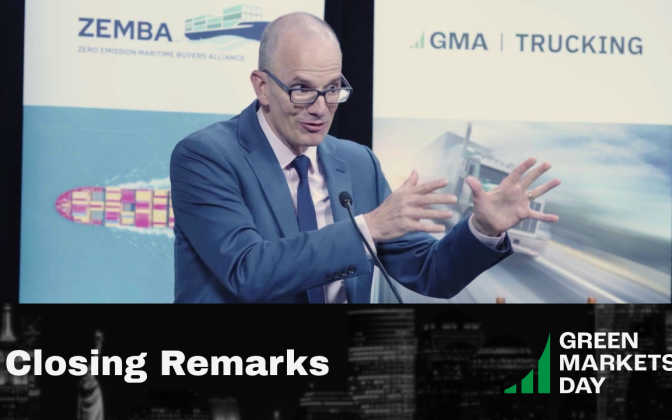
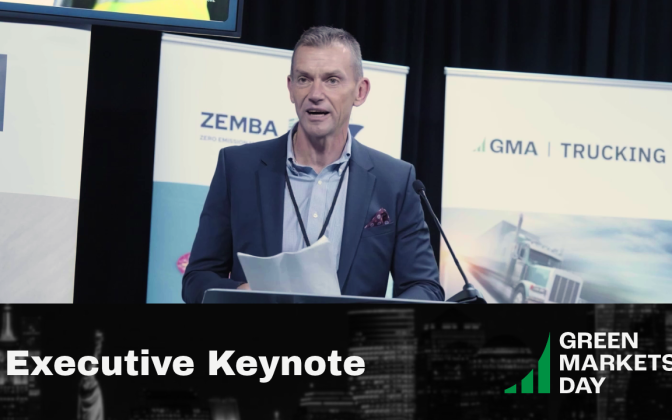
Jon Creyts, CEO of RMI, closed the third annual Green Markets Day by reflecting on the day’s announcements as evidence of a functioning ecosystem for new green markets, from new buyers alliances and members to expansion into new regions and new book and claim frameworks. He highlighted the umbrella registry system being developed to connect heavy industry and transport, and challenged attendees to take one concrete action after Climate Week to help move these markets faster.
See below for a full transcript.
TRANSCRIPT
JON CREYTS:
Terrific. Good afternoon. Hello, everyone. For those of you who don’t know me, I’m Jon Creyts. I’m the CEO of RMI. You’ve already heard from some of my colleagues today about our work transforming global energy systems through market-driven solutions like the ones that you’ve explored here today. And I’m honored to be here with you for the closeout of Green Markets Day.
First, a huge, huge thank you to our host, Amazon, who has been a partner accelerating the market for green fuels and materials since day one, right? And I think we all know that not only do they help bring us together, but they help provide the confidence to make some of those early deals happen through their decarbonization support and through their commitments. Today simply wouldn’t have been possible without them, without you, so thank you to all the Amazon folks here.
An immense gratitude as well to our convening partners in GMA and to the Smart Freight Centre for making the third annual, and this is amazing, it’s the third year we’ve done this, the third annual Green Markets Day a reality. So thank you as well to all the speakers and to you all as attendees, because there are no shortage of things and places you could be right now, and we are just grateful that you’re here at this moment.
Now I wasn’t able to be with you all for the full afternoon, but I did get a chance to debrief with my team here, and what strikes me today, based on their feedback, is that this wasn’t a collection of isolated announcements. We’re starting to develop a functioning, thriving ecosystem, right, to drive these new markets together. You know, today’s theme was about turning progress to scale, and I think it’s clear from what you’ve heard today that we’re well on our way.
We’re seeing buyers initiatives grow, from launching in new sectors like the Green Ammonia Buyers Alliance, and for those involved with that, it’s amazing. Congratulations on that. We’re welcoming new members to longer-term stalwarts like ZEMBA, as well as expanding into new regions through the GMA’s partnership with Green Fuel Forward. So there’s lots of opportunity here, lots of expansion, growth, and we’re seeing increasingly this global opportunity.
We’re also seeing demand for members to drive changes in commodity production and transportation, whether it’s fulfilling the need for lower emissions concrete and cement, while cutting 70% of emissions compared to conventional cement through SCoBA, by helping a next-generation sustainable aviation fuel facility reach FID through SABA, or putting new fully electric trucks on our roads through GMA trucking.
So lots of reasons for us to feel good about the progress we’re making, and we’re building the systems that help make sure all this progress can be tracked and verified, which is super important by companies so that the claims that we all make through the new book and claim framework that’s been established for steel, that really complements existing frameworks and gives us the confidence that we need to move forward with investability here.
So there’s a clear arc that we’ve heard across all these different activities today that standards and market infrastructure create trust, that aggregated demand creates a credible signal, that contracts turn that signal into momentum and into investment, and investment brings new supply into the market. And once we know that all that machinery works, we can adapt it across sectors and geographies. And that’s how a market goes from promising to self-reinforcing. And we’re all part of that cycle right now.
So with that, it’s worth zooming out for a moment here, because we all are in the nuts and bolts on a day-to-day basis. And just to recognize that the clean energy transition has crossed a significant threshold here. Last year, we had nearly 700 gigawatts of renewable capacity that were added globally, more than any other year, accounting for more than 85% of new power capacity, right? This year, the world’s on track to invest over $2.2 trillion in the energy transition. Again, a full trillion more than is going into the old energy economy. So this is no longer a story about whether an energy transition will happen. It is happening, right?
The challenge now is extending that momentum into the harder parts of the economy, the next parts of the economy, the fuels, the materials, freight, industrial systems that are really represented in this room here.
So we’ve moved beyond theory, right, at this point. A little over five years ago, when we launched the Sustainable Aviation Buyers Alliance, we had a theory, right, about how we could drive investment into the leading-edge technologies in one of the hardest sectors to abate. What started as committed action in a group of about 10 buyers, right, has grown by leaps and bounds in the past five years and is now embodied and represented in this room.
The most exciting part is it’s not any longer just a story about SABA. We’re seeing the model become repeatable, right? Again, we see it in shipping and trucking and cement and concrete and steel and chemicals and fertilizer now. That’s amazing, right, and that’s part of how we’re all working together through our institutions to drive broader change. Think. Do. Scale. Right? That’s our mantra here.
So, the demand that we’re demonstrating across sectors gives suppliers something enormously valuable, the confidence to invest, to modernize a plant, to scale a new product or to build that next facility, and today’s conversations have all really demonstrated once again that demand aggregation, collective procurement, book and claim systems, and other market-based approaches are really increasingly the way to produce tangible results.
So, the next step really is about how do we make this repeatable, how do we make this easier for you all, right? And as these demand initiatives have grown, we’ve really got to work on that standards, on the accounting, on the registries, on the other market, making infrastructure that can provide you all with greater clarity on, and really the confidence to act.
So we’ve seen great success in things like the SAFc Registry, and I will say we are on the brink of a million tons here right now. Literally during happy hour today, somebody could seal a million tons, so make that a motive here. What’s that? World Energy is in the room. You could do it, Adam and team. You could do it.
And the Katalist Registry for Shipping, which is helping companies address the emissions associated with maritime. This is a sector that moves 80% of the world’s freight. Again, we’re seeing opportunities there.
The challenge ahead isn’t simply developing more models, but it’s taking what is working and making it easier and making it replicable. So, that’s about how we expand it to multiple sectors, and in particular, we’re excited about the umbrella registry system right now that you’ve heard mentioned today. It’s designed to help build connectivity and confidence and create simplicity and help drive to scale. And so, think about that and let’s all feed in and make sure that it’s a success in itself. It’s really a next generation nonprofit platform. And it’s going to bring together heavy industry and the transport sectors into one ecosystem that allows, again, that ease and that replicability that’s so essential.
So instead of spending time keeping track of holdings or figuring out, you know, kind of requirements, you’re going to, through what is arguably heroic efforts by many of you, we’re going to make that easier and take your time and put it where higher value can be used in finding those next transactions rather than authenticating what you’ve already done. I hope everyone in this room can be a part of the journey as we build that to scale.
So with that, I know I stand between you and happy hour. You’re just going to literally go out those doors and go downstairs and there will be drinks and you’ll be able to continue the ecosystem formation in a informal environment that’s so essential to all the work that we’re doing to accelerate at scale.
But I do want to leave you with a final thought, right? And that’s for each of us, we’re going to be in a lot of meetings here this week. We’re going to have a lot of opportunities, but I want you to take one, one action here post, post-climate week that proves that this is all worthwhile in the end.
And if you’re, if you’re a buyer, right, where can your demand become more powerful by joining with others? Maybe SABA, right? We can get over a million, but maybe other places. If you’re a supplier, what signal would you, would give you the confidence to invest, right? And if you’re an investor or market builder, what friction can you remove that’s going to make that next transaction easier? Take that as a request, as an obligation, right, of having been here and invested your time. Let’s all take that forth into action.
The momentum is real. The machinery is in place. We now just need to get it moving faster. Thank you for all the amazing work you do. In this amazing community, let’s all continue to spin that machinery faster, do more deals, and drive more change at scale. Thank you all.
Related News & Resources