
February 23-25, 2027
GreenBiz 27
GMA will have a robust presence at GreenBiz 27, with multiple GMA thought leaders featuring on the program. Details to come!
Location
San Diego, CA
Related News & Resources


11.03.26
Green Markets Day 2026 | Session Recordings Now Available
Green Markets Day 2026: Markets in Motion — Turning Progress into Scale
The transition to a low-carbon economy depends on turning ambition into action. Now in its third year, Green Markets Day has become a flagship gathering during New York Climate Week, bringing together corporate leaders, suppliers, policymakers, investors, and nonprofit partners to explore how markets can accelerate the deployment of low-emissions fuels, materials, technologies, and infrastructure. Hosted by the Center for Green Market Activation in partnership with RMI and Smart Freight Centre on September 22, 2026, this year’s program examined how corporate demand is accelerating decarbonization of value chains across hard-to-abate sectors. Explore the session recordings and transcripts below by clicking the links in the session titles.
Session Recordings
Welcome & State of the Market
Kim Carnahan, CEO, Center for Green Market Activation (GMA)
Executive Keynote
Robert Kowalik, VP of Worldwide Environment, Amazon
Panel Session: Opening the Floodgates: Standards and Market Infrastructure that Unlock Action
Jim Giles, Vice President, Trellis Group (moderator)
David Kennedy, CEO, SBTi
Jim Andrew, Executive Vice President, Chief Sustainability Officer, PepsiCo
Laura Draucker, Standards Director, GMA & AIM Platform
Tim Juliani, Director of US Corporate Climate Engagement, WWF
Spotlight Remarks: ZEMBA’s Market-Making Momentum
Ingrid Irigoyen, Managing Director, GMA
Panel Session: Deals That Move Markets
Andre de Fontaine, Managing Director, GMA (moderator)
Ayesha Choudhury, Chief Commercial Officer, Infinium
Albert Luu, Chief Financial Officer, Fortera
Vrushali Gaud, Global Operations Director, Google
Andreas Marschner, VP of Global Engineering, Maintenance & Sustainability (GEMS) and Worldwide Operations Sustainability (WWOS), Amazon
Spotlight Remarks: From Demand to Deployment, Scaling Zero-Emission Freight
Christoph Wolff, CEO, Smart Freight Centre
Spotlight Announcement: Expanding Sustainable Aviation Fuel Markets in Asia
Frederick Teo, CEO, GenZero
Seow Hui Tan, CEO, SAFCo
Kim Carnahan, CEO, GMA
Panel Session: The Next Frontiers for Green Market Activation: New Technologies, New Sectors, New Regions
Andrew Alcorta, Senior Director, GMA (moderator)
Philippe Vedrenne, CEO, 3Degrees
Frederick Teo, CEO, GenZero
Rachel Lichte, Interim CEO, Good Food Institute
Devon Lake, Head of Net Zero Strategy, Meta
Spotlight Announcement: Scaling the Market for Low Emission Steel
Thomas Koch Blank, Managing Director, RMI
Closing Remarks
Jon Creyts, CEO, RMI
Related News & Resources
11.02.26
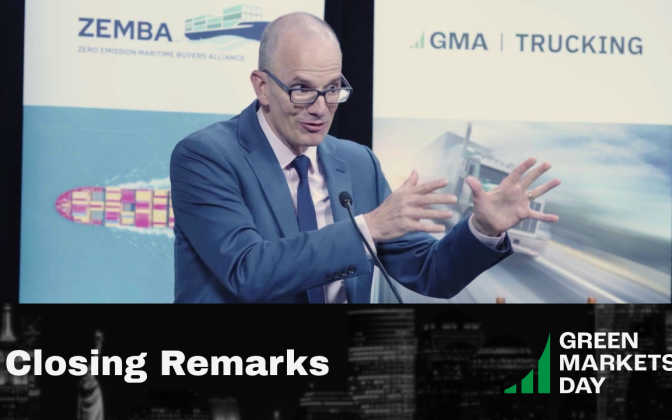
Green Markets Day 2026 | Closing Remarks
Jon Creyts, CEO of RMI, closed the third annual Green Markets Day by reflecting on the day’s announcements as evidence of a functioning ecosystem for new green markets, from new buyers alliances and members to expansion into new regions and new book and claim frameworks. He highlighted the umbrella registry system being developed to connect heavy industry and transport, and challenged attendees to take one concrete action after Climate Week to help move these markets faster.
See below for a full transcript.
TRANSCRIPT
JON CREYTS:
Terrific. Good afternoon. Hello, everyone. For those of you who don’t know me, I’m Jon Creyts. I’m the CEO of RMI. You’ve already heard from some of my colleagues today about our work transforming global energy systems through market-driven solutions like the ones that you’ve explored here today. And I’m honored to be here with you for the closeout of Green Markets Day.
First, a huge, huge thank you to our host, Amazon, who has been a partner accelerating the market for green fuels and materials since day one, right? And I think we all know that not only do they help bring us together, but they help provide the confidence to make some of those early deals happen through their decarbonization support and through their commitments. Today simply wouldn’t have been possible without them, without you, so thank you to all the Amazon folks here.
An immense gratitude as well to our convening partners in GMA and to the Smart Freight Centre for making the third annual, and this is amazing, it’s the third year we’ve done this, the third annual Green Markets Day a reality. So thank you as well to all the speakers and to you all as attendees, because there are no shortage of things and places you could be right now, and we are just grateful that you’re here at this moment.
Now I wasn’t able to be with you all for the full afternoon, but I did get a chance to debrief with my team here, and what strikes me today, based on their feedback, is that this wasn’t a collection of isolated announcements. We’re starting to develop a functioning, thriving ecosystem, right, to drive these new markets together. You know, today’s theme was about turning progress to scale, and I think it’s clear from what you’ve heard today that we’re well on our way.
We’re seeing buyers initiatives grow, from launching in new sectors like the Green Ammonia Buyers Alliance, and for those involved with that, it’s amazing. Congratulations on that. We’re welcoming new members to longer-term stalwarts like ZEMBA, as well as expanding into new regions through the GMA’s partnership with Green Fuel Forward. So there’s lots of opportunity here, lots of expansion, growth, and we’re seeing increasingly this global opportunity.
We’re also seeing demand for members to drive changes in commodity production and transportation, whether it’s fulfilling the need for lower emissions concrete and cement, while cutting 70% of emissions compared to conventional cement through SCoBA, by helping a next-generation sustainable aviation fuel facility reach FID through SABA, or putting new fully electric trucks on our roads through GMA trucking.
So lots of reasons for us to feel good about the progress we’re making, and we’re building the systems that help make sure all this progress can be tracked and verified, which is super important by companies so that the claims that we all make through the new book and claim framework that’s been established for steel, that really complements existing frameworks and gives us the confidence that we need to move forward with investability here.
So there’s a clear arc that we’ve heard across all these different activities today that standards and market infrastructure create trust, that aggregated demand creates a credible signal, that contracts turn that signal into momentum and into investment, and investment brings new supply into the market. And once we know that all that machinery works, we can adapt it across sectors and geographies. And that’s how a market goes from promising to self-reinforcing. And we’re all part of that cycle right now.
So with that, it’s worth zooming out for a moment here, because we all are in the nuts and bolts on a day-to-day basis. And just to recognize that the clean energy transition has crossed a significant threshold here. Last year, we had nearly 700 gigawatts of renewable capacity that were added globally, more than any other year, accounting for more than 85% of new power capacity, right? This year, the world’s on track to invest over $2.2 trillion in the energy transition. Again, a full trillion more than is going into the old energy economy. So this is no longer a story about whether an energy transition will happen. It is happening, right?
The challenge now is extending that momentum into the harder parts of the economy, the next parts of the economy, the fuels, the materials, freight, industrial systems that are really represented in this room here.
So we’ve moved beyond theory, right, at this point. A little over five years ago, when we launched the Sustainable Aviation Buyers Alliance, we had a theory, right, about how we could drive investment into the leading-edge technologies in one of the hardest sectors to abate. What started as committed action in a group of about 10 buyers, right, has grown by leaps and bounds in the past five years and is now embodied and represented in this room.
The most exciting part is it’s not any longer just a story about SABA. We’re seeing the model become repeatable, right? Again, we see it in shipping and trucking and cement and concrete and steel and chemicals and fertilizer now. That’s amazing, right, and that’s part of how we’re all working together through our institutions to drive broader change. Think. Do. Scale. Right? That’s our mantra here.
So, the demand that we’re demonstrating across sectors gives suppliers something enormously valuable, the confidence to invest, to modernize a plant, to scale a new product or to build that next facility, and today’s conversations have all really demonstrated once again that demand aggregation, collective procurement, book and claim systems, and other market-based approaches are really increasingly the way to produce tangible results.
So, the next step really is about how do we make this repeatable, how do we make this easier for you all, right? And as these demand initiatives have grown, we’ve really got to work on that standards, on the accounting, on the registries, on the other market, making infrastructure that can provide you all with greater clarity on, and really the confidence to act.
So we’ve seen great success in things like the SAFc Registry, and I will say we are on the brink of a million tons here right now. Literally during happy hour today, somebody could seal a million tons, so make that a motive here. What’s that? World Energy is in the room. You could do it, Adam and team. You could do it.
And the Katalist Registry for Shipping, which is helping companies address the emissions associated with maritime. This is a sector that moves 80% of the world’s freight. Again, we’re seeing opportunities there.
The challenge ahead isn’t simply developing more models, but it’s taking what is working and making it easier and making it replicable. So, that’s about how we expand it to multiple sectors, and in particular, we’re excited about the umbrella registry system right now that you’ve heard mentioned today. It’s designed to help build connectivity and confidence and create simplicity and help drive to scale. And so, think about that and let’s all feed in and make sure that it’s a success in itself. It’s really a next generation nonprofit platform. And it’s going to bring together heavy industry and the transport sectors into one ecosystem that allows, again, that ease and that replicability that’s so essential.
So instead of spending time keeping track of holdings or figuring out, you know, kind of requirements, you’re going to, through what is arguably heroic efforts by many of you, we’re going to make that easier and take your time and put it where higher value can be used in finding those next transactions rather than authenticating what you’ve already done. I hope everyone in this room can be a part of the journey as we build that to scale.
So with that, I know I stand between you and happy hour. You’re just going to literally go out those doors and go downstairs and there will be drinks and you’ll be able to continue the ecosystem formation in a informal environment that’s so essential to all the work that we’re doing to accelerate at scale.
But I do want to leave you with a final thought, right? And that’s for each of us, we’re going to be in a lot of meetings here this week. We’re going to have a lot of opportunities, but I want you to take one, one action here post, post-climate week that proves that this is all worthwhile in the end.
And if you’re, if you’re a buyer, right, where can your demand become more powerful by joining with others? Maybe SABA, right? We can get over a million, but maybe other places. If you’re a supplier, what signal would you, would give you the confidence to invest, right? And if you’re an investor or market builder, what friction can you remove that’s going to make that next transaction easier? Take that as a request, as an obligation, right, of having been here and invested your time. Let’s all take that forth into action.
The momentum is real. The machinery is in place. We now just need to get it moving faster. Thank you for all the amazing work you do. In this amazing community, let’s all continue to spin that machinery faster, do more deals, and drive more change at scale. Thank you all.
Related News & Resources
11.02.26
Green Markets Day 2026 | Panel: The Next Frontiers for Green Market Activation: New Technologies, New Sectors, New Regions
Moderated by Andrew Alcorta, Senior Director at GMA, this panel featured Philippe Vedrenne, CEO of 3Degrees; Frederick Teo, CEO of GenZero; Rachel Lichte, Interim CEO of the Good Food Institute; and Devon Lake, Head of Net Zero Strategy at Meta. The panelists explored where demand aggregation and market mechanisms should go next, from new sectors such as metals, plastics, low-carbon fertilizer, green ammonia and alternative proteins to new regions, especially the Asia Pacific. They also discussed the standards and market infrastructure needed to work across geographies, and shared what success could look like five years from now.
See below for a full transcript.
TRANSCRIPT
ANDREW ALCORTA:
So, first of all, thank you to the panelists and we’ll do introductions in just a moment. But I just want to start with some reflections and perhaps some framing for this conversation about new frontiers for demand aggregation and market mechanisms.
Every Green Markets Day, I find myself kind of looking around the room and seeing all the various folks that I know from past lives and that I know from some of the work that we’re doing within various GMA initiatives. And it is hard not to be blown away by the amount of good work that is happening in this space, even in spite of some real headwinds that I know many of us are feeling at the moment.
And so I think it’s important to start by recognizing that there is real progress happening here and that deploying things like demand aggregation, deploying market mechanisms and book and claim is allowing us to really create wins in a number of sectors that have been very challenging to move forward for quite some time.
And if I think back to the deals that move markets panel earlier in the day, I think it is a reflection of the fact that we are seeing real projects move forward that either would have taken much longer or might not have been able to move forward absent these mechanisms.
And it’s a good opportunity to step back and really take stock of the fact that we have something that is working, right? And we need more of it and we need more of it faster, but we have found something that really is moving the needle and not only allowing projects to move forward to FID, but ultimately is going to put steel in the ground for low-carbon projects that we can point to as a demonstration that this is possible.
And so I think it’s against that backdrop that it’s important to really ask the question, where else can and should we be applying these mechanisms? And that’s what we’re going to explore on the panel today and we want to take that from two lenses.
The first is what other sectors might be ripe for demand aggregation, for market mechanisms to really be applied and to accelerate progress beyond what we’re seeing? And the second is what new geographies can we bring these mechanisms to or scale these mechanisms in more aggressively and how can we do that effectively?
On the first one, as we think about additional sectors, there are two places that I just want to pause on and frame out. I think it’s important to step back and look at the entire emissions stack that we’re trying to solve for.
25% of emissions come from industrial production. Cement and concrete, steel, copper, aluminum, a lot of things that we take for granted and don’t think about, but that are responsible for this structure that we’re in today, are responsible for the phones and laptops that we are doing business on every day. And it is a sector where, despite the fact that we all know there is a huge impact and a huge challenge that we need to tackle, very little progress has been made to date in many of these sectors. And we have seen some announcements here and there about low-carbon production, but they are still the exception and not the norm. And I think understanding how we can be applying some of these mechanisms to industrial commodities and to industrial production is a question that we really need to seriously ask here, particularly when a lot of the market failures that we have successfully addressed in some of the transportation sectors are also present in industrial commodities. And I think we could bring some of the same solutions to bear.
Another sector that we need to look at here is agriculture, which is another 20 to 25 percent of emissions and is another place where there are some really challenging problems. And we are beginning to move forward and get traction on some of those, but we have a very long way to go. And so thinking about how can we accelerate some of that progress is really, really critical.
If I switch and think about the geographic side for a moment, many of us live in this world and we’re trying to figure out how to get these projects across the line. But I think it’s really important to step back and remember that while many of the interactions we may be having on a day-to-day basis or with colleagues in the U.S. or North America or sometimes Europe, the projects that can really deliver here can happen all over the world. And particularly when you look at the global south, some of the energy cost fundamentals are incredibly compelling in terms of being able to bring new technologies to the market at effective costs if we can solve for the capital stack.
And at the same time, there is demand all over the world. I was looking up some stats as I was preparing for this, and it is remarkable to think, I think for many of us, that only 10% of the validated SBTi targets come from companies headquartered in North America. 35% of the targets come from companies headquartered in Asia. And so there is an enormous amount of opportunity. And if we are going to make the voluntary markets drive the change that we need to see and live up to their potential, we need not just the first wave of demand that some of the folks, including people here on the stage, are delivering, but we need to figure out who is going to follow that demand. And part of that is recruiting the next set of buyers in the markets that we’re operating in today, but part of that is also expanding the aperture and looking at new markets. And so that’s what we get to explore over the next 35 minutes or so, and I’m really excited to get into the conversation. And we’ll talk about the sector element of this, the geographic element of this, and– and I want us to really pause and talk for a few minutes about, okay, well, if we execute on that and if we do it right, what does the world look like? I think it’s easy for many of us to get caught up in the day-to-day of the work, and it’s important to step back and say, what is the vision here and what can we actually achieve if we are effective in rolling these mechanisms out? So with that, I will pause.
I would love to turn to the panel here and ask everyone on the panel to provide a very quick introduction, name, organization, perhaps a little bit of context. And I can start here briefly. My name is Andrew Alcorta. I’m a senior director at the Center for Green Market Activation. I lead our low-emissions materials work, which includes both cement and concrete, ammonia, and other high-value chemicals. And I’m very excited to be here with you all today. Devon.
DEVON LAKE:
Hi. Devon Lake. I’m the head of net zero strategy at Meta. And I think this is my third Green Markets Day. And it’s just a thrill to be here and see how many different sectors are represented. I’m really excited to talk about the new sectors that are coming. And my team leads basically all of our work, investing in market mechanisms across many of the commodities and technologies that we’re talking about here.
PHILIPPE VEDRENNE:
Hi, everyone. I’m Philippe Vedrenne, CEO of 3Degrees. 3Degrees is a global climate solutions provider. We help companies to reduce emissions on Scope 1, 2 and 3. We have been in the business now for more than 20 years. We are a B Corp. We’ve just reached the $1 billion turnover. Joined this company one year ago. I spent 25 years before in the energy space. Still new in this space, but very excited about what we try to do all together. Thank you for having me here.
RACHEL LICHTE:
Hello. Wonderful. Hi, I’m Rachel Lichte. I’m the interim CEO of the Good Food Institute, or GFI. We are a nonprofit think tank, and we focus on unlocking the resources and the knowledge to change how meat is made in order to create our vision of a thriving world fed sustainably. We just celebrated our 10-year anniversary. We have a presence here in the United States, and we have affiliates around the globe, so we’re a global network. And I’m absolutely thrilled to be talking about new opportunities for aggregating market demand.
FREDERICK TEO:
Very good. Hi, my name is Fred again. I’m CEO of GenZero. I think GenZero is probably the baby on the block here. So we are just slightly over four years old. We are a climate investment company headquartered in Singapore, wholly owned by Temasek Holdings. We invest into nature, technology, as well as climate ecosystem solutions. And we have been focusing on delivering both sustainable financial returns from our investments, as well as to deliver climate impact from our investments. Thank you.
ANDREW ALCORTA:
Wonderful. And thank you all for joining us today. Devon, I want to start with you. And, you know, as I think about the challenge that Meta is tackling here with the net zero goal, the supply chain that you all have to manage is incredibly complex, right? And it spans power, cement and concrete, steel, all sorts of metals, from products to data centers, and even food, right? And so as you are thinking about the next set of opportunities, what are you all focused on as the sectors that you really want to try to deploy market activation techniques in and move the needle in?
DEVON LAKE:
Yeah, no, that’s a great question, and it’s one that my team really loves kind of digging into. So the sectors that you mentioned, cement and concrete, steel, iron, we’re now on our third, fourth, fifth transactions in each of those sectors. And it gets easier. The AIM Platform is our bible. I say this all the time. We now have guidance, which we didn’t three years ago, in terms of what makes a quality investment of this kind. The book and claim systems are out there. We’re getting the sector guidance that docs in. So the whole process from an investment point of view is really becoming much easier. And the counterparties, the folks bringing us the projects, whether it’s through buyers alliances or directly, are also much more mature. So all that to say, you know, I have a lot of hope for where this can get to.
It’s been interesting to start to work, for example, on the trucking sector. That was one of the things that I have to do is to get my leadership excited about every new sector we go to. It’s not enough to say that deep in the bowels of my Scope 3 EEIO factors, like this emissions is there. That doesn’t, you know, that doesn’t, it’s not going to get the money moving. So instead, what we do is we really help communicate what are the sectors that we drive through our business and that our suppliers operate in, what are the solutions that those sectors need to decarbonize, how can we do investments now so that in five or ten years our suppliers can be using these solutions directly, or we can be using these solutions directly.
So one of the sectors that we’ve been spending more time in is plastics, which is what we’ve named chemicals, because chemicals didn’t capture the imagination, but plastics people can touch and feel from a data center perspective. So we actually just did our first plastics project, which was announced today with Macrocycle this morning, and we’re learning in that sector. And so I think another sector that we’re really interested in continuing to explore is, what are the other metals that we can be doing work in? Copper, aluminum, we know that these metals are relevant to us and our suppliers, and we’re still very early in terms of figuring that out.
ANDREW ALCORTA:
Wonderful. Thank you, Devon. Philippe, I want to turn to you. And I would ask that maybe you share a little bit about what 3Degrees is currently doing in regards to low-emissions fertilizer, low-emissions ammonia. And if you can say a little bit about why book and claim might be particularly important in this sector, it would be wonderful.
PHILIPPE VEDRENNE:
Yeah, this is actually one of our core topics. I mean, when we are talking about low-carbon fertilizers or fertilizers, generally speaking, what are we talking about in terms of emissions? This is a really hard spot. I mean, fertilizer industry emits roughly 1.3 gigaton of emissions on a yearly basis. I think it’s nearly a quarter of total U.S. emissions on a yearly basis, or equivalent of 300 million of vehicles powered with gasoline. So it’s really a very, very important sector in terms of emissions. And 40% of these emissions resides in the production of these fertilizers.
So end of 2023, 2024, 2025, we decided to launch the Low-Carbon Fertilizer Alliance, bringing together actually consumer brands, forward-looking companies who wanted to accelerate the decarbonization of this space. And technologies exist, actually. You can use catalytic technologies to abate nitrous oxides in nitric acid plants. You can install CCS, carbon capture and storage when you produce ammonia. And you can in the future even produce green ammonia with green power, water and air.
Now, you need investments to deploy these technologies. And these emissions happen very upstream in the value chains of these big brands. And so there is a huge and very complex supply chain that sits in between. I mean, these potential investments and this ultimate consumer brands company.
Now, that’s where actually collective action and market-based instrument comes into play. With market-based instrument, as long as you can associate your intervention or investment to, let’s say, a geographic boundary which makes sense towards your value chain, then you can overcome this problem of not being able to do direct procurement from your fertilizer industry. And so you can deploy market-based instruments collectively. And that was the other element which was important.
When you need to invest in these assets, and we mentioned that earlier in the day, I mean, no one can afford investing in a single asset. So having a collective approach, a pool of investors that can fill their actual capital through these technologies, make these technologies accessible, lower the initial ticket for each of them, and building a coalition of buyers as well, resolve a risk management issue, which is, in general, these budgets are only yearly budgets, and you want to have a steady flow of money over the years to finance not only the capex but the opex of these technologies.
So one of our first interventions was with CF Industries, which is a large fertilizer producer in the United States. We finance a catalytic-based technology to reduce emissions by 600,000 tons per annum, so that’s a significant one. We have currently 25 members in this LCFA alliance. We are going to add new projects, and the next step now is what you see on the left side, the Green Ammonia Buyers Alliance. We want to replicate what we have done with the Low-Carbon Fertilizer Alliance in the green ammonia sector. We will have exactly the same concept.
Coming from the renewable energy certificate business, actually we experienced today what we experienced 20-25 years ago, when actually through RECs we were allowing end consumers to have access to renewable power without having to manage the complexity of the supply chain and the logistics of power. So that’s where we are today, and we are still at the beginning with a lot to come, but with a good start.
ANDREW ALCORTA:
Wonderful. Thank you, Philippe. And we have been incredibly excited about the collaboration and the ability to move the Green Ammonia Buyers Alliance forward here. Rachel, let me go down to you, and I mentioned briefly in my opening that as we think about new sectors, industrial commodities is one space we need to think about, the agricultural sector is another. And there are some real tricky challenges when you start breaking down emissions from food and beverage and the agricultural supply chain more broadly, and animal proteins are at the heart of a lot of that. And so we’d love for you to share a little bit about, maybe just some context on the challenge as you see it, but also the solutions that you all are working on at the Good Food Institute.
RACHEL LICHTE:
Absolutely. So, you did speak to the overall global emissions of agriculture, but if we look at animal agriculture in particular, it’s 12% of global greenhouse gas emissions. So there is a huge percentage that we can focus on, just from animal agriculture. Animal agriculture is also incredibly inefficient. 80% of farmland is used for just 17% of the calories that are produced. And the demand is increasing. Right now, the projection is that it’s going to increase 50% by 2050. And animal agriculture is connected to some of the biggest issues that we face as a globe. So in addition to greenhouse gas emissions, we’re also looking at biodiversity loss, land use issues, water pollution, a whole slew of human health issues as well, zoonotic disease, antibiotic use resistance. There are a lot of issues that are connected to livestock and to animal agriculture.
So at GFI, we really focus on not trying to get people to change what they eat, but rather to look at how meat is made, how our protein is developed. And if we can produce those foods differently, then we have an opportunity to drastically reduce some of the negative side effects of it.
So at GFI, we focus primarily on three different types of proteins. So one of them is plant-based. Perhaps you have had it before down the street. You can get products like a Beyond Burger or Impossible that is primarily a plant-based protein. So meats that are made from plants. But we consume them, and they perform, and we experience them just like a conventional animal product. Another technology is fermentation-derived. So those are foods that are made. If you were to, you could walk in, at industrial scale, you could walk in and see huge tanks. They’re like three floors tall. They even go multiple floors through, and it looks like a big brewery. But rather than producing beer or yogurt, they’re producing proteins. And these proteins are used in really small amounts, but they provide critical functionality or performance or taste benefits to products. And then the third technology that we use or that we focus on is called cultivated meat. So these are meats made from animal cells rather than whole animals.
And across the board, we see that there is the emissions reductions are absolutely incredible. So through this and as we think about a buyer’s alliance here, we’re really focused on precision fermentation and in particular whey, so a dairy protein and eggs. And the emissions reductions potential there is significant. So with whey, we’d be reducing emissions by 77% land use. It’s less than 99% more efficient from a land use standpoint. And with egg, it’s 55%. And it continues on as we look at plant-based and cultivated as well. So huge, huge potential as far as more environmental benefits and in addition to others.
Over the past 10 years that GFI has been around, we’ve seen incredible development in this space. So 10 years ago, alternative proteins and protein diversification wasn’t really talked about a whole lot. But we have seen tremendous scientific advancement around the globe. There are three countries that have already approved cultivated meats. So in the United States, there are different restaurants and states you can go into and purchase cultivated meat right now. We have seen precision fermentation products, plant-based products make tremendous strides.
And we’ve also seen some headwinds. Over the past few years, we have seen that products were too expensive. Products did not meet the performance expectations. They didn’t taste quite right. They didn’t feel quite right. So we did not see them perform as businesses would have expected. But there is a whole set of technology that has continued to develop but is now really kind of caught in this middle where they have, there is technology that is ready to scale. There are businesses that see, that have invested in these technologies that have seen some benefit but there is a real need to scale them up more. So we’re in this kind of stalemate situation with technology that is ready to scale. Businesses that see some benefit, that see a value proposition primarily around the sustainability benefits or the price stability benefits, particularly as there is price volatility with dairy and eggs. But there is a big risk in investing.
And so as we think about opportunities to support and address this market failure, we’re very excited about what we’ve learned with GMA about the opportunity for something like a Buyers Alliance that would allow us to aggregate some of that demand and really signal that there is demand for these products in order to unlock that financing that can help scale up these technologies. So there is demand for these technologies. We’ve seen some from some of the large companies around the world, like JBS and Novonesis. There is technology that is ready to scale. There is tremendous greenhouse gas emission savings. And so we’re really excited about the potential for precision fermentation technology in particular.
ANDREW ALCORTA:
Wonderful. So, I mean, it’s really exciting to hear both the appetite to look up in upstream and supply chain and really understand what are those remaining hotspots. And a lot of what I’m hearing here is industrial commodities, right? Metals, materials, as well as ammonia into fertilizer is key opportunities in places where action is already taking place. And then, Rachel, I am hearing, you know, perhaps kind of the new frontier here as being how can we start applying demand aggregation to some of the other big problems that we know we have ahead of us in the transition.
I want to switch gears here and start moving to the second lens that we teed up at the beginning of geography. And Fred, I will start with you. And, you know, I think it’s important to start with the incredible work that GenZero is already doing on applying this model. And at least part of how I think about it is, you know, ultimately so much of what needs to happen to deploy these models is building understanding and building trust. And I think having folks that are operating in market and know the key players and can do that translation work is critical as we think about building those things. And so would love to hear how you are thinking about opportunities to apply demand aggregation and market mechanisms within the Asian context more broadly, both on the supply side, but also looking at the demand generation side of this.
FREDERICK TEO:
Sure. I think when we think about market activation, and that’s true in Asia, that will be true anywhere else. I think that I’ve got a couple of things that you probably need, especially when we’re talking about green solutions. The first is that you’ve got to be very clear about the policy and regulatory framework and environment. Whether it is about standards on what kind of new foods you will need to have, and Singapore went through that process as well, right? Or setting a sufficiently ambitious carbon price to be able to incentivize change and transformation. You’ve got to have the enabling regulatory and policy environment. Otherwise, it is also going to be very difficult for many corporates to make the case to often pay more, right, for some of these solutions. That’s one.
Two, given the current macro environment especially, it is important for us, when we’re talking about activation, to be able to connect to the audience. In other words, can we speak the language that people will understand? For many of us in this space, right, I mean, we are sometimes lost in our own alphabet soups and our own technical jargons, which only we understand. But the point of it is that when you are talking to others, you’ve got to be able to relate to them and explain things to them and have these solutions become appealing.
So, for example, all the good stuff that Rachel is talking about will not work if it doesn’t taste great, right, because food is experiential. We’ve got to find a way to tell people, look, you know, all of us love to travel, we want to see new cultures, new places, we’ve got to fly. Now, how do we do this in a way that doesn’t also make you feel bad about the impact that you are, you know, having on the planet, right? So, we’ve got to think about changing the narrative. So, both of these things actually require us to develop a little bit of an innovative framework and I will relate to some examples out in Asia on what we are trying to do.
Let’s talk about the narrative around climate and maybe shifting it from clean energy to a question around energy security and resilience. This issue around biofuels that we spoke about has actually come to the fore more recently, not because we all want to have like SAF for aviation but because you don’t want to be vulnerable to a single choke point somewhere in the Middle East. And that means that you’ve got to diversify your feedstock, you’ve got to diversify the way that you have access to fuels and that means in the near term biofuels or renewables or many other kinds of things. So, where we see an intersection between climate impact and energy resilience, that is a good place to activate.
Now, even on the food question, we work on carbon projects that are nature-based around the world. One very interesting project is in India where we talk about sustainable rice farming and that involves teaching some of the smallholder farmers practices around alternate wetting and drying. Now, why do we do it? When I visited some of the farmers in India, I asked them, you know, this practice has been around for a long, long time, why are you doing it now? And they said that that’s because over the past few years, the average rainfall in that part of India dropped by 50%. And as you know, rice farming involves continuous flooding of the rice fields. And so if you don’t have enough water, you’re going to have a real problem. So teaching them how to save water is important for their ability to continue to grow rice. But for us, it results in lower anaerobic decomposition, less methane emissions, and we can then credit it, right, and draw additional revenues. Now, so there is actually an adaptation concern here as well, right, because you are teaching them how to deal with agriculture in a much more water-constrained environment. And then there is a food resilience component to it.
But I belatedly also realized that there’s something else happening. With climate change, farmers need to adapt to very new conditions. So that means that they are sometimes switching out from food crops to cash crops. Take, for example, oil palm that uses about a third of the amount of water to produce the same amount of product. And each ton of that product, crude palm oil versus rice, is probably three times more valuable. If you are the smallholder farmer facing some of these challenges, it’s kind of like a no-brainer. But carbon revenues, for example, can then channel additional economics to the smallholder farmers to perhaps alleviate some of these negative disincentives. So this is important for us.
So in other words, change the narrative. We don’t need to always talk about climate impact. We don’t always have to talk about doing clean energy, low-impact food. Sometimes it’s about food resilience, energy resilience. We can talk about it in a language that others can understand. Secondly, we’ve got to corral each other or support each other to be able to get the correct policy frameworks to encourage action. And finally, I will also say that we’ve got to find the correct economic incentives because we have got to make sustainability sustainable. Great. Thanks.
ANDREW ALCORTA:
Thank you, Fred. Philippe, I want to turn back to you. And I know 3Degrees has operated across a range of markets and has sold market mechanisms ranging from RECs to other EACs in a number of markets. And, you know, I think as we are thinking about applying and scaling this model in new places, one of the questions is how do we need to adjust this model? Or to what extent should we be prioritizing consistency and standardization? So I’d be curious what lessons you have learned about, you know, where and how these models might need to be flexed in different policy or infrastructure or demand environments as you have operated in various geographies.
PHILIPPE VEDRENNE:
Yeah, I will share, I mean, our experience more on the REC side. I mean, we are operating nearly in 65 different EAC markets globally. And some of them are very mature. REC markets are very greeny markets. Here are very, I mean, standard liquid. Some others are much less. So we face a huge diversity in terms of market infrastructures. And when we look at these market infrastructures, four dimensions are important for us. The registries, I think we mentioned that in a previous session. The chain of custody, how we track actually the commodity. The local regulation. And I put that last, but I think it’s the most important, the accounting standard and target setting standard. And I will come back to that.
Of course, when we are talking about registries, there’s a question of cost to trade. There’s a question. I mean, registries are super important to, I mean, validate the eligible environmental assets that are registered. The claim and the environmental certificates you can issue from them and avoiding the double counting. So that’s super important. It’s important as well to make sure that, I mean, you have easy access to them. You can lower your cost to operate with them. And we’re not necessarily at the same level of, I would say, sophistication across the world. So that’s something that might be an impediment to development of a market-based mechanism.
Chain of custody. In the renewable energy certificates, we talk about book and claim, where you can completely separate the flow of the environmental certificates with a physical power. In other commodities, you talk about mass balance, which is probably a more precise system to track the environmental attributes across the value chain within blended systems. I mean, both of them are valid. I mean, one is probably easier to manage and create more fungibility. So it helps. So the book and claim system helps actually to create more scale in terms of tradability. Mass balance is probably a more challenge from that perspective. That’s the one we have typically in the biomethane sector globally. But nothing that you can’t overcome.
Then you come with the regulation. I mean, the regulation has two sides of the coin. Positive signals in terms of price and value that actually give incentives to the demand to be there and to actually buy for these environmental attributes. The other side of the coin is a regulatory uncertainty. As long as we can complain about voluntary markets because actually the demand is difficult to trigger and that’s come back to what is the correct narrative to have company making actions. We like sometimes having more regulatory, I mean, strong frameworks to incentivize these interventions. But actually on the other side, you take the risk of change of regulation and that might be as well a difficulty.
Last point I think which is important is accounting and target setting framework. I think we had a great discussion earlier with David from SBTi. Where are the markets we operate? I mean, we’re going to manage the structures of this market differently. The storytelling might be different depending on the commodity we are addressing. But we need to be consistent across geographies in terms of the way we measure and we report our interventions. And because we are still in this flux of evolving guidance, evolving regulatory frameworks in some areas in the world, it’s an impediment actually to scale up what we currently try to do.
For example, the fertilizer industry. We expect to expand that in many other geographies. In Asia, it’s probably the right place where we could have a lot of demand and a lot of projects. But applying what we did on Scope 2 and Scope 3 is not necessarily easy. And we need to take care about issues we face as well on Scope 2. I mean, it was mentioned earlier today. Additionality. When we are discussing about GO markets in Europe, there is no more additionality. The question of double counting emission factors that take into account the market-based instruments which are traded or not. The question of regional matching. I mean, how close you are between your operations and the source of your EACs. That are issues we’re going to face in the Scope 3 market developments.
We are at the beginning where we actually want to trigger these markets. So we want this investment coming from actually these high-end firms that are committed. But moving forward, we’ll see some challenges we will have to address in terms of precision, in terms of accounting, precision in terms of locationality. That we need to address with wide open eyes.
ANDREW ALCORTA:
No, it’s very helpful. And I think we want to make sure that we are learning lessons from prior market experiences and the reactions that have come there. And perhaps you can file this one under shameless plug. But I think this is where the AIM standard work can be really helpful to navigate some of those tradeoffs in the early days. And what we’re seeing is more convergence and ensuring that these nascent markets we are helping to get off the ground. But we’re doing it with a glide path that addresses all of these things is the balance that we have to strike here. Devon, I want to go to you and understand from the buyer’s perspective, what does it take to engage across markets? And what do you need to see in terms of rules and standards or from a project perspective to be able to really take a meaningful position in projects across a range of geographies?
DEVON LAKE:
Yeah, it’s a great question. And just to confirm, we’ve got three minutes. Yeah, we’re going to shorten the next bit of this. All right, I’m going to be real fast. So I would say at the highest level, it is certainly easier for us to transact in the U.S. And we’re going after solutions that don’t all exist in the U.S., right? Either because the emissions aren’t happening here, right? This is not where the copper smelting, as far as I understand it, is happening. I’m learning a lot about where the processes are and thus where the technologies are going to need to be deployed. So that’s one.
Two, this is Scope 3. We’ve got a huge portion of our Scope 3 that is based out of this country, mostly in APAC, right? So there are a number of different reasons to go beyond the U.S. market, and it gets progressively trickier because it gets less familiar, right? And so the more that we have the book and claim frameworks, the registries, the more we’re able to say, yeah, this looks familiar. We know how to go and transact here because a lot of the other pieces, to your point on the standards, we’ve got those parts, you know, figured out. We’ve got a playbook to follow.
So I would just say standardization, whether that’s the contracts, the, you know, systems that we’re using, is going to help our team because my guess is our team at Meta is probably larger than most of the teams that people in these buyers alliances is maybe paying attention to, maybe working on, and our team will struggle to go internationally if there isn’t some replicability and familiarity in the way that the markets work.
ANDREW ALCORTA:
Incredibly helpful. So being conscious of time, I want to maybe condense this last section and just go down the line and ask each of you, you know, if we were sitting here five years from now and your wildest dreams have been realized for kind of your priority in the sector, what does the world look like? And Fred, perhaps I’ll start with you.
FREDERICK TEO:
Oh, I usually think that if I’m extremely successful with my work, I don’t need to exist. So if we are highly successful at what we are doing, you won’t need to have a dedicated market activation capability because it would just be the norm. I think that it would take a lot to be able to get there. Clearly, there will need to be political will. We will need to be able to bring some of the costs down. But if I can just summarize in one thing, I think we do need to work with each other a lot more closely and be a lot more open-minded about the kind of coordination, understanding of what is actually happening out here. You know, America is a continental country. It is a big, huge country. But it is extremely important, like just what Devon was saying, to be aware of what is actually happening outside the US, what is happening in Europe, innovation that is happening in APAC, developments that are happening in Africa and South America because, you know, really a lot of the action and what needs to take place to be able to get us to net zero will be happening outside this country.
ANDREW ALCORTA:
Thank you, Fred. Rachel?
RACHEL LICHTE:
Yeah, so in thinking about the near-term future, I’m kind of wondering where we would have room on this stage for a buyer’s alliance that speaks to the precision fermentation opportunities. So another shameless plug there. And if there are any people interested, please do come and speak with us.
But I think that it’s very much aligned with what you shared, Fred, that ideally there wouldn’t be a need for an organization that is going out of its way, that we have greater protein diversification, that this is fairly unremarkable, that the way that we source proteins, the way that we are eating is much more sustainable, so is not emitting and is far more efficient. That is a longer-term future, so we are doing what we can along the way.
Near-term, looking at a buyers alliance opportunity to help aggregate that demand and scale up supply. Medium-term, diversifying even the types of proteins that can fit within that sort of aggregated demand. And then longer-term, just an unremarkable commodity market that is much more sustainable.
ANDREW ALCORTA:
Thank you. Philippe?
PHILIPPE VEDRENNE:
Yeah, I hope in five years we will be here with GMA and RMI to celebrate what we have done on the low-carbon fertilizer industry and ammonia industry. Hope that we will have more than 200 members by then, that we will have a lot of demand, not only coming from the U.S., but from Europe and from Asia, with a lot of projects everywhere in the world, meaning that will become brighter and better.
And hope as well that we will be able to stimulate demand over 10 years and 15 years, long-term commitments. Really the things which are critical. And that they will consider some as normal things to do when you want to manage your supply chain risk, when you use it as a hedge. Because actually, as you mentioned, at the end it’s a question of resilience and forward-looking. So I hope that we will be there in five years’ time.
ANDREW ALCORTA:
Wonderful. And Devon?
DEVON LAKE:
I’m going to go back to, I think someone mentioned shovel-ready projects and ribbon cuttings. I would love to see just a huge map of all of the ribbon cuttings from the plants that are actually built from these transactions because I’m learning a lot about what it takes to move from idea in the lab or startup concept, you know, shopping an idea around to investors to actually getting the project built. And I’m hopeful that the demand that we and others represent accelerates that process. And I really just am excited to see actual materials that we can consider putting in our own data centers, that we can say we help those get deployed in this other facility. That to me is where, you know, I can’t touch the carbon, so I want to touch the concrete and the cement and just know that this is actually changing things in the real world.
ANDREW ALCORTA:
Incredible. So we will check back in five years. We’ll probably do one-year checks between now and then. But thank you all so much for the time, for sharing your thoughts here. And this is where we’ll break and actually hand over to our colleagues at RMI to share some of the work that they are doing on one of the industrial commodities that we started the session talking about. So thank you all.
Related News & Resources
11.02.26
Green Markets Day 2026 | Panel: Deals That Move Markets
Moderated by Andre de Fontaine, Managing Director at GMA, this panel featured Ayesha Choudhury, Chief Commercial Officer at Infinium; Albert Luu, Chief Financial Officer at Fortera; Vrushali Gaud, Global Operations Director at Google; and Andreas Marschner, VP of Global Engineering, Maintenance & Sustainability (GEMS) and Worldwide Operations Sustainability (WWOS) at Amazon. The session opened with the announcement of Fortera as the winner of the Sustainable Concrete Buyers Alliance’s (SCoBA) first RFP for low-carbon cement and concrete attributes, along with news that the first contracts in SABA’s next-gen SAF deal with Infinium have been signed. Panelists then discussed what makes collective procurement deals bankable, how buyers get them approved internally, and what it will take to do more and bigger deals.
See below for a full transcript.
TRANSCRIPT
ANDRE DE FONTAINE:
Thank you, Ingrid. That was a really cool video. And thank you to everybody for being here. It’s great to see such a packed house. And I’m really thrilled to be moderating this panel on deals that move markets because it really gets to the core of the kind of work that we do at GMA along with our partners.
We’re going to spend the next 40 minutes or so trying to understand how collective procurement can drive new technology deployment. Specifically, what needs to be true to really make these procurements work and drive the impact that we are seeking to achieve. You know, for us, at a high level, we think about these kind of major building blocks for these deals of being innovative technology, corporate climate leadership, and then market mechanisms to connect those two. And those are the building blocks. But, of course, a lot more needs to happen from there. And so I think that’s what we’re going to talk about together as a panel is to get into the details a little bit more.
You know, fortunately for us, we’ve got a lot of really great proof points to pull from over the last year. Kim mentioned some of these in her opening remarks. And I think even better, the folks that we have on the panel were involved in most, if not all, of those innovative deals. And so we’ve got a lot of expertise on the panel and some really great perspectives to hear from today.
So let me just share a few highlights before we go into the panel. Kim mentioned some of these, but earlier this year, the Sustainable Aviation Buyers Alliance that we run with RMI and EDF announced the winner of its next-gen RFP. So this was looking at ultra-low-carbon, highly scalable, novel SAF technologies, the point being to try to get enough corporate offtake to help get the plant to final investment decision. And so we announced that Infinium, which is represented on the panel today, was the winner of that RFP. And then today we made a really great announcement that the first batch of contracts associated with that deal have been fully signed. And so that’s about 200,000 tons of CO2 reductions represented by the SAF certificates that are being transacted through this deal. And it includes companies like McKinsey, Google, Bain, and AVEVA, and there’s more on their way. Some have chosen to remain unnamed. Others are still working through the final contracting process. I think the volumes are really impressive, but even better are the structure and the term length of these contracts. Up to 10 years, that’s a real breakthrough for this sector to get corporate offtake of that duration. And then also, these contracts are bankable. Ayesha is going to talk more about what that means during her remarks, but we worked very closely with Infinium to make sure that these contracts met the needs of their financers so that we could help get this plant to FID.
Along with Aviation, as many of you know, we’re very active in trucking as well. Last year on a panel just like this one, we announced Nevoya was the winner of our first ever trucking RFP. And from there, the project has moved along really well. All the contracts are signed, which is great. And we also announced that Google had entered the deal after the first announcement was made, increasing the total volumes from 40 to 60 new trucks on a route in Texas connecting Dallas to Houston.
And so at GMA, we also care a lot about the materials. So not just airplanes and fancy new trucks, but also cement and concrete, which is often an overlooked sector. You literally walk all over it every single day. But it is a very important sector for us because it’s a major emitter, 8% or more of global greenhouse gas emissions. And it’s also a sector that we think is really ripe for innovation, also stimulated by the kind of market mechanisms that we do here at GMA along with our partners. And so that’s why we, together with RMI a couple of years ago, launched a new effort to develop a book and claim system for cement and concrete. That kicked off an effort where we brought together an expert working group to really develop the rules of the roads for how book and claim could work for this sector. We published a framework to help guide that work. And then a year later, again, at a panel just like this one, we announced the launch of the Sustainable Concrete Buyers Alliance, or SCoBA. SCoBA is a buyers alliance that brings together buyers who are seeking low-carbon cement and concrete attributes.
And I’m very pleased today to announce the culmination of a lot of that hard work. Drum roll, please. I have a clicker. For the culmination of a lot of that hard work, we are announcing today the winner of our first RFP for low-carbon cement and concrete attributes, and that winner is… Fortera. So we have Albert Luu from Fortera with us today, who’s going to share a little bit of his perspective on this process. I’ll just say a few words.
Fortera was selected through a very rigorous evaluation process. We were looking for a project that helped advance the goals of getting a new technology to commercialization. Since submission of its proposal, Fortera has continued to demonstrate momentum in this space. They have announced an agreement with the Mississippi Lime Company for the first full-scale commercial development of its ReAct cement product. ReAct uses industrial CO2 as a feedstock for its product, converts that into cement through a proprietary ReCarb process. It demonstrates compatibility with a broad range of construction applications, and it also meets all the established industry performance standards, which is really important. And I think important for us, for the purposes of today, is that it can achieve emissions reductions of two-thirds or more relative to conventional cement products. So very, very exciting. And ultimately, this facility is expected to produce more than 300,000 tons of low-carbon cement per year.
We will be announcing more details associated with this deal in the coming months as contracts are signed, but ultimately we’re targeting, with the participating buyers, offtake agreements of three to five years, and for volumes that will make up a meaningful portion of the plant’s total output. So very, very exciting. A groundbreaking new deal.
And Albert, we’d love to hear a little bit more from you before we open it up to the rest of the panel. If you can tell us a little bit more about your product and your technology, and then describe, you know, the importance of why you decided to participate in this procurement opportunity and what you hope to get out of it in terms of impacts on your company.
ALBERT LUU:
Yeah. Hi, everyone. Albert Luu. Excited to be here. Honored to be accepting this award for Fortera. You know, it’s… When you’re developing a new technology, at the end of the day, you have to get capital providers comfortable with the asset class. So what we do is we are developing production capacity and technology for next-generation cement. It’s cement that outperforms traditional cement. It’s more durable, higher performance, better reliability, and better for the environment. But for capital providers, at the end of the day, they still need to make a capital investment to fund the capex associated with this.
I’m relatively new in this role, and one of the things I’ve learned about cement is that there isn’t long-term offtake in the traditional markets. And when you think about project financing, most of the investors there look for what they call durable, predictable cash flows. And so this award, working with GMA and SCoBA, allows us to, in some ways, create a financing mechanism to bring capital providers into this space. The ability to really separate the environmental attributes from the physical product, I think, is a clever, creative way to lock in cash flows. It borrows a lot of the concepts that have come from renewable energy, where you separate the electrons from the RECs. In a similar way, this allows us to contract a portion of the project, be able to show capital providers that there is a market, there’s interested buyers, while you continue to test out the product, allow for more time for that, and then really work in the traditional space where a lot of the buyers of cement are not thinking multi-year offtake agreements.
ANDRE DE FONTAINE:
Okay. Well, thank you so much for that, Albert. Well, rounding out the panel, we have Ayesha from Infinium, we have Andreas from Amazon, and we have Vrushali from Google. So we have a really great representation of innovative producers, but also folks that represent the corporate demand that really drives these deals forward. And so, Andreas, maybe I’d like to start with you just to balance a little bit of what we heard from the producer. Why, from Amazon’s perspective, do you participate in collective procurements? What are you able to get out of these that goes beyond what you might be able to do on your own?
ANDREAS MARSCHNER:
Well, it has been covered already before in the previous panel, but also in some of the opening remarks. Also, at the size we are operating, getting to the right demand signals is insufficient on our basis. And so, pooling the demand, especially to get nascent technology a boost and allowing for a meaningful risk profile is the critical piece. And that’s why we joined several of the initiatives that are all shown here from the first day. Because we believe that we need to get the signal that the demand is there. It’s not just a single demand, but it’s a group demand and there’s willingness to invest and go that innovation journey because that is what is de-risking the topic on the technology side.
We are always in this chicken or egg dilemma. And well, if there is no demand, then there is no supply. And this is a way to overcome that part, at least in the early days. It’s not necessarily sufficient for the long term, but it is really providing this initial impetus and that’s why we are very convinced that this is the way to go, in particular, where we’re talking about new technology. Product development is never a straight line. And so we need to take the risks and distribute them accordingly.
ANDRE DE FONTAINE:
Yep. Well, thanks for that, Andreas. I think we would agree, you know, almost all demand is good demand, but there is still, I think, ways of structuring demand that can be more impactful than others. And Ayesha, I wonder if you could comment a little bit. I mentioned the bankability aspect in the opening. Can you talk a little bit more about what that means and what are some of the steps that we took together to make sure that the contracts were signed for the SABA members actually do meet the needs of your financiers?
AYESHA CHOUDHURY:
Absolutely. First, thanks for having me, Andre, and GMA. I appreciate the opportunity to be here. First, let me explain what Infinium is in 30 seconds. We are a power-to-liquid SAF producer. What it means is that we make sustainable aviation fuel from renewable power and waste CO2. It’s a different pathway, which is a more novel technology than the other pathways that exist for SAF today, but it has the ability to scale because our feedstocks are fundamentally sun, air, and water. So that’s Infinium in a nutshell.
We talk all day about commercial– er, technological innovation, right? This is a novel technology, and this is something that needs to come down the cost curve. But to Andre’s point, a lot of the work that we’ve done together with GMA and SABA, with American Airlines, our partner in this deal, and all of the Scope 3 buyers is really what I would call the commercial innovation part of things. It’s not just the technology alone that’s going to get these projects off the ground to FID and get built and continue to scale the industry. It has to come from commercial innovation, too.
And so, you know, we always talk about bankability and bankable demand and bankable contracts. What does that really mean? I’m actually a former banker. So I think before I was at Infinium, I was a banker for a long time. So maybe if I can tell it to, you know, to boil it down very simply, it’s duration, the tenor of the contracts, it’s volume certainty and price certainty and predictability on that, right? Those are the obvious things. And the less obvious things are other types of risk sharing and allocation, particularly when it’s a novel technology. What happens if the plant is delayed? What happens if it doesn’t produce with the uptime that you expect? All of that stuff goes into the contract, too.
And so a lot of the work that we did with, first, the SABA team, and then with all the Scope 3 buyers that, like Google, that joined in on this procurement was really the negotiation and standardization, I would say, because it’s sort of the same contract across all of the many buyers that we had. And that was a great innovation and a material step in bringing these projects towards a final investment decision. Because even if the technology is de-risked, the commercial side has to be materially de-risked, too.
ANDRE DE FONTAINE:
Great. And, Vrushali, coming from the buyers’ perspective, you know, when we think about these deals that we’re approaching you with, it’s multi-year bankable for technologies that are not yet commercial and on a time scale where you’re committing to purchase something that doesn’t exist yet. So this is a tall ask, and I wonder if you can comment a little bit on, you know, the process internally to get these kinds of deals approved. What do you need to demonstrate? Or what are the types of challenges you need to overcome to get these approved internally?
VRUSHALI GAUD:
Thank you. Can you guys hear me? I think I’m echoing a little bit. So just bear with me. So first of all, congratulations. What a fantastic day to be here when we had the SABA deal go through this morning. It was announced, and it has Infinium in it. American Airlines, we are very, very proud to be a supporter of that. And it’s a good example of some of the things you mentioned, right? It’s the technology innovation, but it’s also the commercial innovation, and also the standards innovation, because how do we make book and claim, and how do we claim for this and track it? So it’s a good stepping stone all around.
Going back to your question, I think there are two sides of this, but I say it from a Google perspective, or any company that has the privilege of making investments, of having the foresight and the support internally to make investments that are long-term in nature and also have a sizable impact. So I think that, you know, initially that is an impetus we have. I acknowledge that and it’s a privileged position to be in.
Having said that, any deal has the same constraints. It is: is the technology proven? Then is the price point the right that you want? So is it cost-effective? Because eventually you want this to be scaled and scaled such that Google can do it in volume but everybody else can do it in volume. And the third part is your time, the horizon to get to that scale. And, I think if you look at all of those three attributes, it makes a case for two things.
One, there has to be people who are the first movers. And I think Amazon and Microsoft and Googles of the world can be the first movers, which is a great advantage that we have and sort of put our investments in the pilots. And then make the deals in a collaborative way. I think that’s where the power of the collaboration comes in because individually you cannot get– you cannot prove the technology through the scale and in the time frame you want. And for all of those three rubrics is I think what the activation to an alliance comes in.
ANDRE DE FONTAINE:
Thank you. That’s a really great perspective. And maybe to switch gears a little bit, I’d love to know, I mean, these were first of a kind deals. We want to do more and bigger deals as we go. Maybe I’ll start with Ayesha. What do you need to see in order to take this even bigger? Is it regulations? Is it more voluntary demand? Is it greater standardization around the market measures? Or is it some combination of all three?
AYESHA CHOUDHURY:
It’s all of the above and then some. These are hard problems, right? We have a very hard problem to solve. And I think one of the things that I’m very proud to be a part of is very collaborative effort to figure out how to get there. A lot of the work that we’ve done out of this procurement is going to be useful for the next projects and the next projects. I would say that we spent– we invested a lot of time and energy, and I give the SABA team a lot of credit for investing so much time and energy in working on a bankable contract template that is going to be critical and useful for many more projects to come until this market becomes much larger with much more market depth that you don’t have to have these types of procurements anymore. Unfortunately, or fortunately, or unfortunately, you need it all, and this has been a really important step forward.
ANDRE DE FONTAINE:
Maybe I’ll pose the same question to Albert, but you’re not allowed to say the same thing. So you can’t just say it’s all, or if it’s all, can you give me some kind of rank order or priority?
ALBERT LUU:
I’ll try. I think we’re starting off in the journey where we’re relatively– like, when you think about building materials, earlier in this process of contracting. And so I think it’s great to hear when buyers talk about kind of investments, and because it really is an equity investment, it’s not a typical supply agreement. And so it’s how do you allocate risk and think about risk between the different parties for projects that have never been built before, and understanding that things never go as planned, and being able to kind of work through some of those things. So I think having kind of the collective minds just collaborating there, and everybody really taking the view that we’re an equity owner in this project and everybody needs to kind of share in the risk for this project to move forward.
The other area I think about is, listen to Ayesha talk about all the T’s and C’s around this. I’m sure every buyer has things that are going to be unique to them, but for us, we’re starting this journey, so the more we can do to lower soft costs, standardize contracts, standardize terms where the risks are going to be the same between all the buyers, it will allow us to go to capital providers, the law firms that have to review all these agreements in a way where we can be much more efficient and they can see an industry that really will scale from, you know, for us, first few plants are going to be hundreds of millions to multiples of hundreds of millions and then multiple plants. So a lot of, I think, what work has been done in other sectors just needs to be done for cement and concrete.
And then, you know, it’s easy enough to say, but just more buyers. I spent a lot of time talking to capital providers and they always talk about, it’s great that you have a couple of buyers, but that doesn’t really show a market. You need a lot more depth and I think some of the early buyers, the bigger organizations who can kind of create signals for other players in their space to follow on, I think that’s another mechanism that will be helpful.
ANDRE DE FONTAINE:
Yeah. Okay. Thank you, Albert. Maybe turning it over to the buyers, one thing I’m curious about, you know, you’ll see from the posters, GMA with its partners is active in a number of different sectors and you guys have purchased attributes in all, I think, of these programs or close to it. Do you take the same approach to each sector when you consider the opportunities and you consider the purchasing opportunity, or does it vary by sector or technology type? And Andreas, maybe I’ll start with you.
ANDREAS MARSCHNER:
It’s a yes and a no. So the yes is related to, of course, we have learned with the first of these type of agreements. What we have never done before because it is all about aligning interests and acknowledging what are the constraints of each party and then really looking what is now the joint solution space. And I think this is what GMA did fantastic in the past with all of these things because it was all providing that environment and this joint commitment to drive change and figuring out how to actually get there.
The no part is it is, of course, a very different story if you are talking about fuel or if you talk about low-carbon cement solutions. So we also then need to recognize what is the hard problem to solve. And there is just very different elements in play and that is where the things are different.
I remember when my team was looking for getting the direct supply of low-carbon concrete to a site we were building. And it was impossible to find it in a meaningful environment. That’s why also the entire book and claim mechanisms are so important to help getting things off the ground. Because in areas where you would say, well, that should be solvable. It’s just in the regions where you might actually have a project or you have a sizable demand. You might not get the supply at a meaningful cost. And getting these things right is very different throughout the applications we have been talking about.
ANDRE DE FONTAINE:
Great. And Vrushali, same question to you. I mean, how do you think about this? Is it a standard approach or does it vary by sector?
VRUSHALI GAUD:
I think I’m going to just build on what he said. It depends. We, we, it’s my favorite. It’s the one thing I learned in business school. Just say it depends for everything and you can get out through it.
But we, so we do have internal thresholds. A lot of the companies have a dollar per ton threshold or a dollar per megawatt hour. Depending on what you’re looking at, right? And below a certain threshold, it’s easy. Because that’s just, you know, it’s scaled in projects. It’s, it’s scaled interventions. And those kind of go, go for the flow. Beyond that, and that’s where some of these newer things come in. It, it’s sort of in, we bucket it under what is predominantly important for our business. Right?
So certain interventions are critical for us. Data center construction. So green construction is, is an important piece to it. Green steel, looking at different ways within the construction materials. So that I think is, is something we like double down on a little bit more. And that again links very well with the location. So certain locations, we just did a deal in super excited about zero emissions steel in Stegra in, in Europe. And that’s very close to sort of the European data center location. So there is an inbuilt demand. We know it will be sustained. So we have a much better playbook on that in certain regions. And so it’s a combination of the price point. But also the operational need. And I think if you justify the operational need, it’ll most of us in sustainability know then it’ll stick around. It’ll be sustained and not just be a one time deal.
And the other side, something like SAF, you know, it’s not predominantly our business. We are not an airline company, but a lot of our employees travel. It’s part of our footprint. So we have to decide on scale where and how much we invest. So I think in that it’s some of these first of a kind alliances that are helpful, probably not as much as we do in some of the other spaces. So it’s a combination across all of that.
ANDRE DE FONTAINE:
Okay. Great point. And I actually think we do have some time for questions from the audience. So if folks want to raise their hand. Any questions? And as you guys consider questions, I will ask a quick round robin. If folks can, you know, you heard there’s some continuity in the announcements we make at Green Markets Day. So fast forward a year from now, what would you hope to be able to say about the project or deals you’re working on now? And Albert, I’ll start with you.
ALBERT LUU:
Yeah, hopefully a year by now. We will have contracted many of these offtake agreements. And then I think the other area, too, is, you know, I was having lunch with our CEO and an investor, and one of the things I’m learning about cement is that because it goes– because it’s a material beyond just contracts, like product validation is a big thing as well. And so looking at the coalition to, like, are there ways to share data so that we don’t go through the same testing with everyone, just so that we make this a more efficient process? So what are ways that we can just streamline product validation and offtake over the next year?
ANDRE DE FONTAINE:
Yep, that’s great. And Albert, on your first point, if you find that the contracting is taking more than a year, let’s definitely talk about that. That should not be the outcome. But let’s go down the road. Vrushali, what would you say a year from now? What would you like to be saying?
VRUSHALI GAUD:
I think two things. One is incentives. So you have to make it, you have to give incentives to even folks like Google, right? Like, how, you know, making and paying the higher premium, are there contractual benefits? Are there first offtake benefits? So you have to incentivize. And then how do you incentivize others to come? As much as I love my company and, you know, seeing its name everywhere, it doesn’t mean much if we are just, if we are the whole market. You want to see others, others come in.
ANDRE DE FONTAINE:
Absolutely. Andreas?
ANDREAS MARSCHNER:
Making real progress in the hard to abate environment we have here and getting more momentum established by aligning the risk profiles better than what is already the case. In some of the areas we talked about, I think we are still chasing our tail a bit because if you go in the transportation sector, you have several things that need to work well together. And only if all of these conditions, you have a truck that has the sufficient range, you have the charging available when you actually need it, and the grid provides capacity when you need it, if these things don’t play together, you are never able to scale. And that is the part where we need to partner with the different players involved to allow for a much faster scaling in that domain.
ANDRE DE FONTAINE:
Ayesha?
AYESHA CHOUDHURY:
My hot take is much more selfish. I just hope that our project hits a final investment decision a year from now. We’ve made a lot of significant progress on the development of this project, including this very important procurement, and so I hope a year from now we can talk about how we, you know, are going to go to the, you know, ribbon-cutting or, you know, shoveling party.
ANDRE DE FONTAINE:
That would be amazing. Do we have any questions from the audience?
SAMAN BAGHESTANI:
Hi. I’m Saman, co-founder and CEO of S3 Markets. We work on industrial commodity certificates. My question for the group is, and particularly for Google and Amazon, you know, it seems like a lot of companies like yours repeat the same diligence on the same set of companies. To what extent do you think that diligence is a public good that perhaps could bring down costs and let other organizations who just can’t, they don’t have the same budgets as you do, access that same sort of diligence?
VRUSHALI GAUD:
I can, so that’s a great question. And we just, through the Elemental group, we formed a data center innovation initiative which has Meta on it and Amazon on it. And I think that’s a great example because part of what Elemental is trying to do is sort of, you know, express due diligence on things, so right, like so you already have a list of startups they work with or technologies that they’ve progressed in and they become the central repository of sharing information across. And there are times when, look, as much as we like open sourcing things, you also have to be careful around where you’re driving the market, creating the market and shaping it and like all sorts of regulations around it. But having a central entity that does that, and that’s exactly the initiative we have from DSI. And same, I think, I would say about the SABA and the SCoBA deal.
ANDREAS MARSCHNER:
I can only plus one on that, because the regulatory framework provides clear boundaries on what can and what cannot be done, and that is there for a good reason. And that’s why intermediaries who then potentially help with these topics can also help address it. And then, of course, bearing my colleagues in finance, there’s also then always the question in terms of what is the right financial modeling and what are the right inputs. And if that then differs, then you might still have certain aspects that need to be covered independently.
ANDRE DE FONTAINE:
Okay. Just scanning to see if there’s any more questions. I have a couple more that I can keep posing. Maybe I’ll go back to Ayesha, because you mentioned that you hope a year from now to be able to say that the plant has gotten to FID. So what is the next priority post this voluntary deal, what are you focused on to help get to FID?
AYESHA CHOUDHURY:
So project development, there’s, in project finance, there’s often what you call three legs of the stool. That’s the common parlance. So the first pillar, leg of the stool is your offtake. The next second one, no particular order, is capital, right? Both debt and equity. And then the third leg of the stool is called technology, construction, EPC, right? And you’re all kind of doing, you’re kind of doing all three of these at once, right? But obviously if you only have one, then you have no stool, right? So I think that that’s sort of the traditional way of thinking about project development.
What I think is really different about what we’re doing in more novel markets and novel technologies is it’s a whole lot less of a stool and a lot more of a tent. You are pushing the poles together enough in such a way, and you’re getting them to land exactly in the right place. So I would say that, I don’t know, I only have two arms, but like here, like right now we’re really just, we have all of the pieces, we have all the legs of the stool, I guess, but what we’re trying to do is bring the stool, the legs together into more of a tent. That’s what we’re really doing. And so we have all the basics in place. But now it’s getting them tighter.
ANDRE DE FONTAINE:
Yeah. And then, Albert, maybe a similar question for you. What’s the immediate next priority for your process?
ALBERT LUU:
So for us, a couple of weeks ago, as you mentioned earlier, we announced a 300,000 ton plant with MLC. We are working on FEED on that, and we should complete FEED by end of this year, working through permitting. Once we complete FEED, what that unlocks is detailed engineering. Long lead, all working towards that FID concept.
The great thing about FID to me is that you can’t fake it. Like, there are so many things that get announced that you kind of go, is it really going to happen? But at the end of the day, FID is one of those you cannot fake because you have to have all the pieces together and ultimately third party capital to say this has been de-risked to move forward. So we’re working towards that. We expect this plant to be operational in 2028 and take FID sometime next year.
ANDRE DE FONTAINE:
Okay. Great. And then maybe a question, a similar question for both Andreas and for Vrushali. How do you manage the tension around some of the technology types that you might be investing in? When we look across these different sectors, whether it’s trucking or cement and concrete or aviation fuel, there is the kind of like forward-looking ultra-low carbon solutions that tend to come at a higher premium. And may not be available in much quantity today versus potentially cheaper carbon abatement opportunities in those same sectors that are more widely available. How do you manage the tension between investment in one that might deliver a lower cost today, but could be less scalable in the future? Andreas, maybe I’ll start with you.
ANDREAS MARSCHNER:
Our philosophy has always been being willing to fail fast because we want to learn fast. And that means really acknowledging that we are in a product development journey, and it is absolutely natural that things will go wrong and will not work out and not seeing this as a defect, but as part of the learning journey to get to this scalable solution faster and making sure that this is really a joint learning with our partners. And that’s why we are investing in different, very recent technologies, or we are building partnerships and how to explore those. To then really provide, also, the business environment to test these things instead of being solely dependent on the lab type of environment. Because what we typically see is the real business life typically provides different challenges than what you can actually really see in the lab.
ANDRE DE FONTAINE:
And Vrushali, same question to you.
VRUSHALI GAUD:
I think, you know, for us, you have to, there’s two portions of this. One is you have to have the right expertise in whether it’s in-house or whether you have partnerships. Because a lot of the things we’re looking at are, they are scientific in nature. There’s innovation. There’s, you know, there’s like why one versus the other. And it would be obnoxious to say we know it all. So I think relying on those who have expertise and have guidance on that, I think that helps us get that first view.
And then the second thing, you know, I think we don’t have the fail fast one, but we have a very strong theory of change that we walk ourselves through. So is the theory of change as to the fastest, quickest or the most credible or the most impactful? Right. Each one is. You can justify that. And there’s different ways to go about it. But we have a theory of change where we have different facets on those three dials. And then that helps us decide which technology is more credible and then also meets the scale and time that you want.
ANDRE DE FONTAINE:
Great. And then maybe we have time for just one last question. Vrushali, I’ll stick with you because you mentioned something that Google looks for is that you don’t want to be alone on these deals. And so what are some things– I think that’s the question all of us are wrestling with is how do we bring more demand into these markets? Do you have any ideas of how to bring more companies into this?
VRUSHALI GAUD:
Most companies work at the intersection of cost. So what does it cost me and what benefit do I get? And I think you have to work on both those incentives. So find a way to bring the cost down, which is I think what we’re all sort of talking about. That’s one. And then the incentive either is a compliance or a regulation or a demand signal or a consumer signal, something on that side. So I think both of those are critical to get more companies in.
ANDRE DE FONTAINE:
Terrific. Well, thank you. I just want to close by doing two things. One is congratulating Albert and Fortera, congratulating Ayesha and Infinium, and then thanking Vrushali and Google and thanking Andreas and Amazon for providing the demand that makes a lot of these things happen. And if all of you could join me in giving a warm round of applause for these panelists.
Related News & Resources
11.02.26
Green Markets Day 2026 | Welcome and State of the Market
Kim Carnahan, CEO of the Center for Green Market Activation (GMA), opened the third annual Green Markets Day with a look at the state of the market. She reviewed a year of progress across GMA’s programs: the first-ever collective procurement for low-carbon cement, a pilot procurement for low-emissions ethylene, SABA’s first bankable 10-year contracts for an e-SAF facility, an expanded zero-emission trucking deal, the launch of the Green Ammonia Buyers Alliance, and ZEMBA joining the GMA family. She urged companies still on the sidelines to start buying now, because demand, not waiting, is what brings costs down.
See below for a full transcript.
TRANSCRIPT
KIM CARNAHAN:
Hello and welcome to the third annual Green Markets Day. I’m Kim Carnahan, I’m the CEO of the Center for Green Markets—Green Market Activation, excuse me, or GMA, as we like to call ourselves. I want to start off by thanking Amazon for providing us this amazing space and the food and… so much logistical help. They’ve been one of our strongest supporters since… well before GMA existed and we were just running the Sustainable Aviation Buyers Alliance, so really grateful for them.
Also really grateful for the GMA team and the teams at Smart Freight Centre and RMI who have done a lot of help… who’ve done a lot of work to help us pull together this agenda for today. In particular to GMA’s communications manager, Alison Greene, who’s been amazing, and Kari Pederson, who is absolutely the orchestrator of this whole thing. She’s our Chief Strategy Officer, and her job description does not come anywhere close to including running this event, and she does it magically. So… really huge thank you to Kari. I don’t see her anymore. She’s hiding somewhere.
And thank you, of course, all of you for showing up today. I know there’s a lot going on in this city. So we’re really grateful that you’re choosing to spend a little bit of today with us.
I want to start by asking a question. It might seem a little bit controversial. How do you eat an elephant? Anybody know? One bite at a time. That’s right. That’s right. That’s been my personal maxim for my entire adult life. I do not condone eating elephants. Do not go write a blog post about this, please. Um… So please, when I say eating an elephant, imagine this guy. This is a very real photo of me getting ready to eat an adorable, I mean, really, it’s adorable, isn’t it? Elephant pancake. So we’re going to talk about pancakes today.
The point is… when the challenge seems enormous, the only way to tackle it is, of course, piece by piece.
And for many of us working on corporate decarbonization over the past year, it has really been focused on standards. Which is a big one. Maybe even the trunk of the elephant? I’m pretty happy with where that work is landing. The AIM Platform published its standard and guidance earlier this year, giving companies a tool to use right now when accounting for, reporting and claiming market-based approaches towards target implementation. SBTi, even more importantly, gave companies the bright green light to use market-based approaches towards target implementation, and the GHG Protocol, through its Actions and Market Instruments white paper, signaled that it will provide a structured avenue for reporting market-based approaches in its revised Corporate Standard.
So the direction of travel is clear and standards cannot be the excuse anymore. But remember, we’re talking about an elephant here. Elephant pancake, excuse me.
Standards may have been the trunk, but demand is really the belly. I am very proud of the work, very, very proud of the work that GMA and our partners have done to kick off the process of activating demand in some pretty tricky sectors. Over the last 12 months, we have managed the first-ever collective procurement for low-carbon cement, with sufficient demand to support a first-of-a-kind commercial-scale facility. We’re announcing the winner of that procurement process this afternoon, so please stay tuned.
We have launched our High Value Chemicals program and are currently running a pilot procurement process for low-emissions ethylene, a building block for most plastics. We executed the Sustainable Aviation Buyers Alliance, SABA’s, most ambitious SAF procurement to date, securing our first-ever truly bankable 10-year-long contracts for a future e-SAF facility, helping to get that facility to FID. We scaled our first zero-emission trucking procurement by over 50% after the deal closed. By over 50%! Thank you, Google. And partnered with the Smart Freight Centre to chart the program’s much more ambitious next phase.
We launched the Green Ammonia Buyers Alliance, or GABA (please don’t say gabba, people), with RMI and 3Degrees, with the remit of tapping corporates’ demand for low-emission fertilizer.
And finally, definitely not least, we were thrilled to bring the Zero Emission Maritime Buyers Alliance, ZEMBA, formally into the GMA family of programs. ZEMBA is now expanding its ambition to additional zero-emission technologies, including battery electric vessels, which we think is pretty cool.
And that’s quite a lot. We’ve done all of this in the face of some pretty incredible headwinds. Hostile conditions, you might even say. But that makes me feel like we’re onto something and we really cannot slow down.
But I have to level with you. Our members are not all buying yet. And beyond that, there are a lot of companies who are still on the sidelines waiting to engage.
What are the companies waiting for exactly? This is what I spend my time thinking about. It’s mostly for costs to come down. And I understand decarbonization of hard to abate sectors is expensive, especially when we’re just getting started as we are in many of these programs.
The thing is, waiting doesn’t bring down costs. Demand does. And waiting will not create more competitive markets for decarbonized products, but signing contracts today will. We desperately need more companies to grab a fork and start eating that elephant. Pancake.
So my question to all of you is: can we work together to get this done?
For companies in the room, help us get your major customers and suppliers in the game. This year, GMA will be developing new tools to help companies share costs and co-claim with other players in their value chain. This reduces the cost burden immediately. We can also reduce cost in the near term simply by bringing more buyers into the fold, helping to bend that cost curve down.
And by scaling up. How can you help there? We have seen great success when several peers in a sector jump into a procurement together, from pharma to entertainment to apparel. Because the first question that’s… or one of the first questions that the C-suite often asks is whether their competitors are also procuring. So let’s make the answer yes, yes, yes, yes, yes, yes.
Another option: do you have colleagues in another region that also has a decarbonization mandate, a separate one from you? GMA is expanding focus abroad over the next 12 months in search of more demand. That’s our primary goal. We will be spending a lot of time in the APAC region in particular. You’ll hear more about that today. Please introduce us to your colleagues there.
And beyond increasing the number of buyers and the size of buys, we also want to make sure that there isn’t a cost penalty for being a first mover. For first-of-a-kind projects, the per-unit cost can be… painful. So GMA is working with suppliers and experimenting with new deal structures that make it the smart move to participate in that first deal rather than waiting for the second one. If participating in the first deal guarantees you access to a much lower cost second deal, would that interest companies to jump in sooner? Maybe even just for a tiny buy. Dip your toe in. If this sounds interesting and you have an interest in concrete or ethylene, come talk to us immediately.
Now, even if you’ve secured a budget and are ready to buy, we know that decarbonizing supply chains is still too complicated. Way too complicated. And that’s why just this morning, GMA, RMI and the Mærsk Mc-Kinney Møller Center announced a new joint initiative to develop a unified book and claim registry across transport and heavy industry. Our goal is to make markets… accessing these markets simpler and easier for companies to participate in at scale. RMI CEO Jon Creyts will be here later today, and we’ll share much more about this effort.
As I come to a close, I want to take a second to talk about policy. People are always asking me why GMA doesn’t do policy. I always say, to be clear, I would do cartwheels across this stage if we could see more climate regulation, but my entire career tells me that waiting for policy is insane. We just don’t know when it’s going to happen. When it does, we’ll be ready to act right alongside it.
But instead of waiting, we ask that you flip the script with us, and create proof points for future regulation, because the stories of game-changing innovation that we can manifest together are the stuff that gives policymakers goosebumps. Seeing these technologies in action, seeing these products heading out the door, can convince them that not only is it possible, but that they have the power to create the future that we also desperately need.
And to be able to tell those stories, we have to keep making our way through the pancake.
Related News & Resources
10.09.26
GMA Newsletter Fall 2026 | Post-Climate Week Edition
If you’d like to have these newsletters delivered directly to your inbox, subscribe to our mailing list through the form at the bottom of our homepage or email pr@gmacenter.org.
The energy behind GMA’s work was on full display during New York Climate Week and our third annual Green Markets Day. Across plenary sessions, workshops, and countless conversations, one message came through clearly: collective procurement and book and claim systems are creating new pathways to scale solutions, and we need more companies at the table.
Transforming hard to abate sectors requires buyers to come together to send strong, credible demand signals. As GMA CEO Kim Carnahan emphasized in her opening keynote, costs won’t fall and markets won’t mature until companies start buying.
There’s never been a better time for companies to engage. SBTi has given a clear green light for the use of market-based approaches to meet Scope 3 targets, market rules and infrastructure are developing, and GMA is introducing new membership pathways that make participation easier. And even against serious headwinds, low-carbon technology costs are dropping in some key sectors. GMA’s newly announced work with RMI and the Mærsk Mc-Kinney Møller Center for Zero Carbon Shipping to develop a unified book and claim registry system across transport and heavy industry is one example of how we’re working to make these markets easier to navigate and scale.
If you’ve been considering GMA membership or haven’t yet been ready to participate in a procurement, now is the time to get involved.
We look forward to sharing recordings of all Green Markets Day sessions in the coming weeks. In the meantime, we invite you to explore the sector updates below for highlights from Climate Week and the past quarter.
Watch highlights from GMA’s third annual Green Markets Day during New York Climate Week in the video above.
Program Updates
Aviation
On September 22, SABA announced commitments from members to purchase sustainable aviation fuel certificates (SAFc) from Infinium Energy’s planned Project Atlas eSAF facility, providing the long-term structured contracts that are catalytic to securing project financing and supporting progress towards final investment decision. By focusing this third collective procurement on next-generation fuels, SABA members are investing in SAF with fewer feedstock constraints, enabling more effective long-term decarbonization of the aviation sector. The team is currently preparing for SABA’s next collective procurement set to launch in Q4 2026. To learn more about how to get involved or to explore SABA membership, email info@flysaba.org.
Also announced on Green Markets Day, Green Fuel Forward welcomed GMA and the Singapore Sustainable Aviation Fuel Company to its Steering Committee. This collaboration will allow GMA to apply our successful demand aggregation/book and claim procurement model to Asia, ensure it complements existing global initiatives like SABA, and steer it toward real-world contracting that accelerates SAF uptake in this fast-growing aviation market.
Maritime
The Zero Emission Maritime Buyers Alliance transitioned to become a program of GMA as of September 1, and ZEMBA staff are now part of the official GMA team! Following quickly on that milestone was the incredible announcement of ZEMBA as an Earthshot Prize Finalist – read more here and watch a video highlighting ZEMBA’s work. During Green Markets Day 2026, ZEMBA was pleased to welcome three new companies to its membership ranks, bringing total membership to 50 and growing.
Also in late summer, ZEMBA partnered with H2Global to release a concept note that explores pairing voluntary demand aggregation with a public-funded auction mechanism, leveraging public and private resources for bigger impact at lower cost to first movers.
Preparations are currently underway for ZEMBA’s third tender, expected to launch in 2027. Email zemba@gmacenter.org to get involved.
Trucking
In early September, Google joined GMA Trucking’s pilot procurement, bringing the total number of electric semi-trucks set to deploy in Texas to 63. This latest news adds to the growing momentum behind the GMA Trucking program, highlighted in a recently published blog. GMA Trucking has also just launched a new webinar series focused on carriers – see a recording of session 1 here and watch our LinkedIn page for future opportunities as we prepare to launch our next RFI. The program’s second procurement is planned for 2027, and GMA Trucking is actively recruiting members to join that effort. Email trucking@gmacenter.org to learn more.
Cement & Concrete
Fortera was announced as the winner of SCoBA’s pilot procurement for low-carbon cement live on stage during Green Markets Day at New York Climate Week. Fortera was selected following a rigorous evaluation designed to identify solutions with the potential for both near-term impact and longer-term market transformation. Their ReAct cement, which incorporates captured CO2 into the production process, is now advancing toward deployment at a planned full-scale commercial facility with Mississippi Lime Company. Contracting for the SCoBA procurement is currently underway, and we expect to share a more complete picture of procurement results in the coming months. To learn more about SCoBA and get involved, email info@buildscoba.org.
Fertilizer
On September 14, the Green Ammonia Buyers Alliance (GABA) launched as a partnered initiative of GMA, RMI and 3Degrees to help companies accelerate investment in green ammonia production, which is particularly relevant for food and beverage companies hoping to reduce emissions from fertilizer manufacturing. GABA is preparing to issue its pilot RFP in the coming months and is actively recruiting members within the food and beverage sector and others seeking to address emissions from fertilizer. To learn more, email fertilizer@gmacenter.org.
High-Value Chemicals
Our chemicals work continues, and over the past several months, GMA and RMI have been evaluating responses and are nearing winner selection and contracting for the first-ever collective procurement for low-emission ethylene. The pilot procurement is helping realize nascent, but growing, demand for low-emission chemicals while also providing confidence to suppliers through offtakes for ethylene from low-emission pathways. Reach out to chemicals@gmacenter.org to learn more.
The AIM Platform
With the Greenhouse Gas Protocol’s recent release of the Actions and Market Instruments Feedback Summary, there is growing validation for the use of market instruments and convergence around multi-statement ledgers as the best way to report them alongside physical inventories. For companies seeking clear, actionable guidance on navigating value chain decarbonization investments, the AIM Platform Standard is an important tool in the toolbox. As a supplement to the AIM Standard, the AIM Platform Electricity Guidance is due for release in the coming weeks, providing comprehensive guidance on how companies pursuing Scope 3 electricity interventions should interpret the requirements of the AIM Standard. Watch aimplatform.org and follow the AIM Platform on LinkedIn for the latest!
We’re Hiring!
GMA is currently recruiting for the following roles to join our growing team. We invite you to share these opportunities with your networks!
GMA in the News | #ICYMI:
- GMA Managing Director Ingrid Irigoyen was interviewed for NPR’s All Things Considered discussing decarbonization efforts in the maritime sector and for TIME on sectoral “tipping points” for clean solutions.
- GMA Standards Director Laura Draucker was quoted in the Financial Times’ Sustainable Views on the advantages and growing acceptance of book and claim for Scope 3 emission reductions.
- GMA’s Jackie Brew accepted a SAFTA award on behalf of the Sustainable Aviation Buyers Alliance during June’s SAF Congress in Amsterdam. Read more: Announcing! The Winners of the Inaugural SAFTAs — Sustainable Aviation Futures.
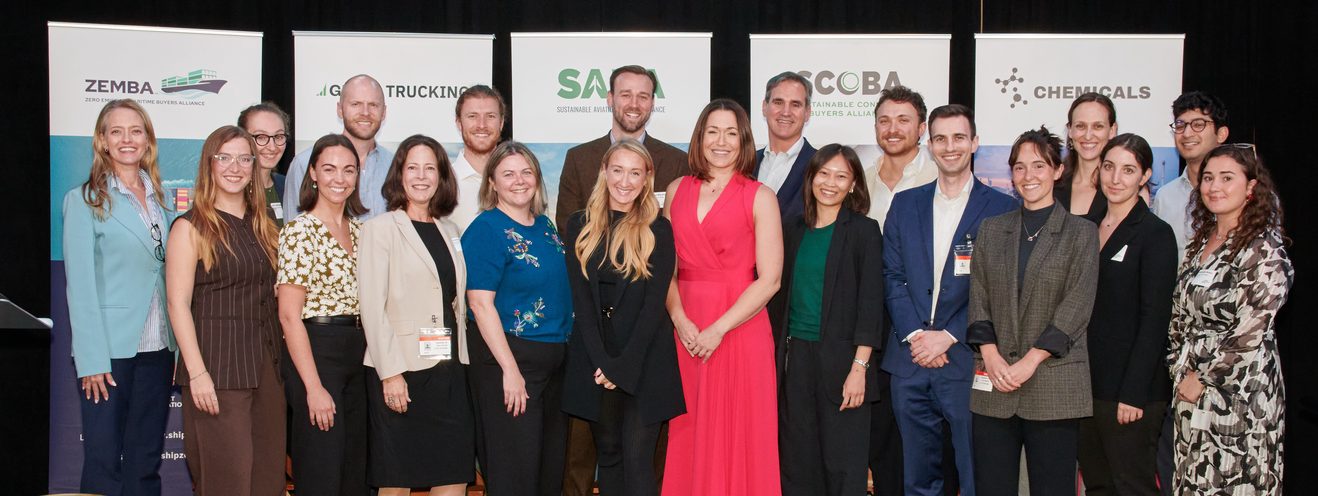
Upcoming Events:
Global Maritime Forum Annual Summit 2026
October 21-22, 2026 | Shanghai, China
Managing Director Ingrid Irigoyen will moderate the panel “Leading by Example” on October 22 at this invitation-only event.
Greenbuild International Conference and Expo
October 20-23, 2026 | New York, NY
GMA Cement & Concrete program staff will be in attendance.
2026 AFCC Global Biobased Economy Conference
November 1-3, 2026 | Washington, DC
Managing Director Andre de Fontaine will be part of the speaking agenda.
SAF North America Conference 2026
November 4-6, 2026 | Houston, TX
Andre de Fontaine, Senior Manager Jackie Brew, Program Associate Alex Coulombe, and Program Associate Megan Wang are all part of the speaking agenda for this SAF-focused event.
Aviation Carbon
November 30 – December 2, 2026 | London, UK
Laura Hutchinson, Senior Manager, System Design, will be part of the speaking agenda at this flagship event for aviation decarbonization. The Sustainable Aviation Buyers Alliance, for which GMA is Secretariat, is a supporting partner of Aviation Carbon 2026.
Connect with us to get started.
Learn more about membership or how to get involved with our programs.
Related News & Resources
09.22.26
Press Release | New Effort to Develop Cross-Sector Registry System Aims to Simplify Supply Chain Decarbonization Across Transport and Heavy Industry
RMI and partners are developing unified book and claim infrastructure, starting with aviation and maritime registries used by more than 150 companies
New York, NY – September 22, 2026 – RMI, the Center for Green Market Activation (GMA), and Mærsk Mc-Kinney Møller Center for Zero Carbon Shipping today announced a joint initiative to develop a unified, not-for-profit book and claim registry system across transport and heavy industry. The effort aims to provide consistent, credible market infrastructure that supports company efforts to address their supply chain emissions across hard-to-decarbonize sectors.
As a first step, more than 150 companies can now access two established not-for-profit registries — the SAFc Registry for aviation and Katalist for maritime shipping — through a common entry point. Katalist is managed by RMI and the Mærsk Mc-Kinney Møller Center for Zero Carbon Shipping (MMMCZCS), while the SAFc Registry is managed by RMI, Environmental Defense Fund, and the Center for Green Market Activation, in collaboration with the Sustainable Aviation Buyers Alliance. The new experience reduces the need to navigate separate tools and provides an initial model for greater consistency across book and claim systems. Alongside this, the parties are releasing a request for information to third-party developers and administrators to inform next steps in creating and consolidating new sector registries into the unified system.
Streamlining tools for impact
Heavy industry and transport — including aviation, shipping, cement and concrete, trucking, aluminum, chemicals, and steel — account for around one-third of global emissions and are among the hardest sectors to decarbonize. They also represent a significant share of corporate supply chain emissions, yet companies often have limited ability to directly source lower-emissions fuels and materials.
Book and claim systems help bridge that gap by allowing companies to support verified emissions reductions when lower-emissions alternatives are not directly available within their supply chains. Registries provide the infrastructure to track the resulting environmental attributes from issuance through retirement, helping prevent double counting and support credible claims. Today, however, registries are typically sector-specific, requiring companies operating across complex supply chains to navigate different systems and processes. This complexity diverts resources from decarbonization actions to managing logistics.
“Companies should not have to navigate a patchwork of systems to take credible action on emissions across their supply chains,” said Thomas Koch Blank, Managing Director at RMI. “By working with the Center for Green Market Activation and Mærsk Mc-Kinney Møller Center for Zero Carbon Shipping to build trusted infrastructure across sectors, we can make participation simpler while maintaining the rigor, transparency, and verification these markets require. Connecting aviation and maritime shipping is an important first step toward that broader vision.”
The new platform will make it easier for companies to address supply chain emissions across hard-to-decarbonize sectors by creating greater consistency in terminology, user experience, registry transactions, and data, reducing friction for companies participating in multiple book and claim markets, all while maintaining the traceability and verification needed for credible environmental claims.
“Integrating SAFc and Katalist is the first concrete step towards a system that works the way companies actually operate,” said Pernille Dahlgaard, Chief Impact Officer at the Mærsk Mc-Kinney Møller Center for Zero Carbon Shipping. “We have spent years building the infrastructure that lets the voluntary market deliver real maritime decarbonization. Working with RMI and GMA to extend that to aviation and across transport and heavy industry gives companies one credible route to accelerating the transition, instead of several partial ones.”
Building an umbrella registry across sectors
The partners plan to build on the aviation and maritime integration to develop registry infrastructure capable of supporting additional transport and heavy industry sectors. With book and claim frameworks already developed for cement and concrete and steel, the registry has a strong foundation as it expands beyond transport. The effort will collaborate closely with the Book and Claim Community, represented by the Roundtable on Sustainable Biomaterials (RSB) and the Smart Freight Centre (SFC), as well as with prevailing target-setting and GHG accounting standards. The collaboration aims to support greater consistency in terminology, data, user journeys and registry transactions, while engaging with existing registries to explore opportunities for consolidation or interoperability over time.
The not-for-profit model is central to the effort. By developing infrastructure around the needs of market participants and positive environmental impact over commercial returns, this effort aims to create a trusted system that can evolve alongside emerging markets while prioritizing integrity, transparency, accessibility, and usability.
“We’re at a pivotal moment. High-integrity book-and-claim systems have been given the green light by SBTi. Companies are coming together to activate green markets through GMA buyers alliances. And, now, RMI is stepping up to provide robust, unified infrastructure for high integrity EACs,” said Kim Carnahan, CEO of the Center for Green Market Activation. “This new registry system is the missing piece of the puzzle we need to credibly scale green markets.”
As part of this effort, RMI, GMA, and MMMCZCS are issuing a Request for Information (RFI) to inform the selection of third-party software developers and administrators to help build and operate the umbrella registry system. The RFI seeks input on a central user interface connecting sector-specific registries, as well as the development and operation of new registries under that umbrella, with the goal of building trust, reducing administrative friction, and providing greater clarity as book and claim markets scale and expand into new sectors. Learn more and respond to the RFI here.
Media inquiries please contact:
Alison Greene, Communications Manager, GMA: alison.greene@gmacenter.org
About RMI
Rocky Mountain Institute (RMI) is an independent, nonpartisan nonprofit founded in 1982 that transforms global energy systems through market-driven solutions to secure a prosperous, resilient, clean energy future for all. In collaboration with businesses, policymakers, funders, communities, and other partners, RMI drives investment to scale clean energy solutions, reduce energy waste, and boost access to affordable clean energy in ways that enhance security, strengthen the economy, and improve people’s livelihoods. RMI is active in over 50 countries.
About GMA
The Center for Green Market Activation (GMA) is a US-based, globally focused non-profit. Through innovative procurement approaches and sector-specific buyers alliances, GMA catalyzes and scales the uptake of low-carbon goods and services within carbon-intensive industries including aviation, maritime, trucking, cement and concrete, and chemicals. With collective decades of experience in environmental markets and alternative fuels and materials, the GMA team works to standardize new, green markets and forges mutually beneficial partnerships between climate-focused companies, suppliers, and mission-aligned non-profit organizations to channel funding to critical climate technologies in pursuit of accelerated sectoral decarbonization. Learn more at gmacenter.org.
About Mærsk Mc-Kinney Møller Center for Zero Carbon Shipping
The Mærsk Mc-Kinney Møller Center for Zero Carbon Shipping is an independent, not-for-profit research and development center established in 2020 with funding from the A.P. Moller Foundation. Our purpose is to guide and accelerate decarbonization of the global maritime industry. This complex challenge requires unprecedented collaboration across sectors, industries, and geographies. Working with our partners, governments, authorities, public sector bodies, scientists, and organizations across the global maritime industry we mature solutions to the most pressing problems across the maritime value chain, from fuels to onboard solutions, regulations, and financing.
Related News & Resources
06.16.26
GMA Newsletter Special Edition | SBTi Corporate Net-Zero Standard V2
If you’d like to have these newsletters delivered directly to your inbox, subscribe to our mailing list through the form at the bottom of our homepage or email pr@gmacenter.org.
This week’s SBTi release of the Corporate Net-Zero Standard V2 is a major milestone for corporate climate action.
Most importantly for GMA programs, the standard explicitly recognizes market-based instruments, including environmental attribute certificates (EACs) from book and claim systems, as legitimate tools companies can use to implement their climate targets. CNZS V2 also acknowledges that many hard-to-abate sectors face real structural barriers to direct decarbonization and creates a pathway for companies to pursue value chain associated interventions, which they refer to as “sector-level actions.” These new approaches towards target implementation can be used by companies that have validated SBTs today; no need to resubmit or wait for the next target cycle.
Taken together, these changes provide welcome clarity and a very strong foundation for companies to invest in the low-emission fuels, materials, and transportation solutions needed to accelerate real-world decarbonization. Given the range of stakeholder views and the complexity of these issues, CNZS V2 is a great outcome and provides critical flexibility to companies making best efforts to implement their ambitious SBTs—especially Scope 3 targets.
Read on for our early takeaways and find us at upcoming events including Trellis Impact and London Climate Action Week to continue the conversation (for details on the sessions we’re a part of, see below). We also plan to host a webinar for GMA program members soon where we’ll take a deeper dive into what this means for corporate decarbonization strategies near term and beyond. Keep an eye out for that invitation if you’re a member of our initiatives!
The Bottom Line: Companies with existing science-based targets can begin using high-integrity market instruments, including EACs generated through book and claim systems, to support target implementation without needing to resubmit their targets.
Top Takeaways as they Apply to GMA Programs:
This is a huge, positive development for GMA programs and members.
CNZS V2 states that companies may use market-based instruments representing value chain associated (which they call “sector-level”) actions as tools to implement their science-based targets. It explicitly references the eligibility of EACs from book and claim systems and lays out a set of requirements these actions must meet in order to be eligible for target implementation. The revised standard creates a strong foundation for companies to invest in solutions that reduce supplier and customer emissions, supporting market transformation in hard-to-decarbonize heavy industry and transport sectors.
GMA programs were tailor-made for this new moment.
The requirements listed for use of sector-based market instruments include providing justification of the constraints faced that prevented direct or activity pool mitigation in a company’s value chain, as well as a set of integrity criteria actions must meet. GMA Programs exist because of the types of constraints SBTi references, and the GMA team will support our members in documenting and reporting those constraints. In addition, the AIM Platform Standard and Guidance, which GMA aligns with, closely tracks (and provides more detail than) the integrity criteria outlined in CNZS V2.
How CNZS V2 integrates with the AIM Standard:
The AIM Standard and Guidance provides companies with a detailed framework for accounting for and reporting investments in decarbonization interventions and is designed to be complementary to other standards. In most cases, the AIM Standard provides much more detail than what is included in SBTi CNZS, which we believe companies will find incredibly valuable as they work to adhere to these latest requirements. The AIM team engaged closely with SBTi staff as CNZS was drafted and is currently developing interoperability guidance alongside SBTi to help organizations understand how AIM and CNZS V2 work together. As SBTi develops its future Recognition Framework, GMA and AIM will take steps toward formal recognition as appropriate. See the AIM Platform website for the latest and stay tuned!
Companies should feel confident taking advantage of these updates today.
SBTi says additional guidance is forthcoming on a few things, including public claims a company can make based on the tools they use to achieve their target. The nuance of public claims is far less important than what CNZS V2 just gave us—clarity on what counts towards target implementation. Further, SBTi target holders do not need to resubmit targets or wait until their next target cycle in order to utilize these new CNZS target implementation pathways. And for those aware that GHG Protocol also has a new standard on “Actions and Market Instruments” (AMI) forthcoming—have no fear. That long-awaited standard is an important piece of the puzzle but the AMI Working Group’s recently released white paper made clear that companies will be able to report any action they take that SBTi now says it will count.
There is still work ahead and we’ll keep you in the know.
GMA will remain engaged with SBTi as they release additional information, guidance, and partnership opportunities. We also remain deeply involved in the development of the GHG Protocol AMI Standard, which has an in-person working group meeting next month in Amsterdam to progress on the draft standard. As these processes continue to roll forward, rest assured we will update you regularly, and you can always reach out with questions.
Connect with us to get started.
The update recognizes EACs as a tool for addressing hard to abate value chain emissions. Watch a short intro to EACs and book and claim in the video linked above.
Continue reading for the latest from GMA and our programs
GMA in the News:
- CleanTechnica covered Greenlane’s expanding EV charging infrastructure in Texas. This success is due in part to Nevoya’s upcoming deployments resulting from GMA Trucking’s pilot procurement.
- SCoBA’s pilot procurement launch was featured in Concrete Products: Alliance RFP spells low-carbon cement capacity, commerce prospects
- SABA and ZEMBA were featured in Argus: Can collective buying solve the e-fuel offtake problem?
- GMA Chemicals announced its pilot procurement: Pilot Procurement Uses Collective Demand to Unlock Investment In Low-Emissions Chemicals
#ICYMI:
- GMA Trucking’s pilot procurement is highlighted in The Electrification Roadmap Series – Electrification Coalition
- The latest from GMA Insights: Harnessing Green Demand to Drive Sustainable Chemicals Production
- Top Q&A for SCoBA’s RFP for Low-Carbon Cement
More from the AIM Standard:
- Catch up with a recording of AIM’s April 21st webinar: Introducing the AIM Platform Standard and Guidance
- Get more AIM insights with this published Q&A from the launch of the AIM Standard.
Upcoming Events:
SAF Congress EU
June 17 | Amsterdam, The Netherlands
GMA’s Jackie Brew will attend SAF Congress EU and speak on the “Book and Claim Outlook” panel. She is also representing SABA during the SAFTA awards, where they are nominated in two categories.
Click here to learn more.
Trellis Impact 2026
June 23-25, 2026 | San Francisco, CA
GMA will be a part of multiple workshops and panels, including:
“Decarbonize Your Supply Chain with Environmental Attribute Certificates”
Tuesday, June 23, 3:30 PM
With GMA speakers: Laura Draucker and Kristen Mertens
“Everything You Need to Know About the SBTi’s Upcoming Corporate Net-Zero Standard V2.0”
Wednesday, June 24, 9:00 AM
With GMA/AIM Platform speaker: Laura Draucker
“Aggregated & Activated: How Buyers’ Alliances Are Accelerating Green Market Transformation”
Wednesday, June 24, 10:30 AM
With GMA speakers: Andre de Fontaine, Kari Pederson, Andrew Alcorta, Clayton Gerber, Joan Gibbons, and Kristen Mertens
Learn more and register for Trellis Impact here.
London Climate Week 2026
June 20-28 | London, UK
GMA will have representatives on the ground, and we look forward to connecting with you.
Reach out at info@gmacenter.com to coordinate.
Climate Week NYC 2026
September 20-27 | New York, NY
GMA will have a robust presence at Climate Week NYC, engaging across multiple venues for the entire event. Planning for the third annual Green Markets Day is currently underway—stay tuned!
Click here to learn more.
Related News & Resources
04.22.26
GMA Newsletter Spring 2026 | Earth Day Edition
If you’d like to have these newsletters delivered directly to your inbox, subscribe to our mailing list through the form at the bottom of our homepage or email pr@gmacenter.org.
Happy Earth Day and happy birthday to us! Fun fact: GMA was incorporated on April 22, 2024, so we get to celebrate both. Not a bad alignment.
We’re so grateful to be doing this work, and our impact continues to grow. Now entering year three as an organization, we’re turning up the dial on implementation with major procurement milestones, new RFPs, fresh book and claim frameworks, and the eagerly awaited release of the AIM Platform’s Standard and Guidance to help unlock the next wave of decarbonization investment. Dive in below for the latest, and if you’re already thinking ahead to New York Climate Week, we’re gearing up for the third annual Green Markets Day on Tuesday, September 22nd — more to come soon.
Watch our latest explainer video, in which GMA’s Joan Gibbons explains why companies often can’t access low-carbon cement and concrete in their region and how book and claim can serve as an unlock and market accelerator.
Program Updates
Aviation
The Sustainable Aviation Buyers Alliance (SABA) has made significant advancements through both procurement and market infrastructure milestones. Infinium’s Project Atlas was selected as the winner of SABA’s next-generation SAF procurement, following a comprehensive, multi-stage review and due diligence process conducted on behalf of SABA’s corporate buyers. In parallel, the SAFc Registry surpassed 500,000 metric tons of CO₂e abated, reinforcing the strength of corporate demand for credible, scalable SAF solutions.
Trucking
The GMA Trucking team’s recently released whitepaper shares detailed findings from its pilot RFP, introduces the challenges GMA Trucking seeks to address, and explores the critical role of demand aggregation and book and claim. GMA Trucking also hosted a webinar on January 15th with speakers from the winning carrier, Nevoya, and corporate buyers Amazon and Etsy. The Trucking team is currently exploring procurement models for its second RFP and planning to integrate physical demand with book and claim for the first time. Get in touch if that sounds as exciting to you as it does to us!
Cement & Concrete
GMA’s cement and concrete program, run in partnership with RMI, finalized a sector-specific Book and Claim Framework in January, following extensive engagement across the value chain. The framework underpins SCoBA’s first RFP, launched in early April and targeting up to 85,000 tCO₂e per year of low emissions cement attributes. We encourage eligible cement producers to submit proposals via the GMA website through June 19, and look forward to seeing this process progress over the coming months.
Fertilizer
GMA Agriculture’s low-emission fertilizer program wrapped up its supplier outreach this spring, drawing responses from producers across a range of decarbonization technologies. The team is now meeting with buyers to define procurement criteria ahead of a formal RFP.
High-Value Chemicals
GMA Chemicals is advancing its pilot procurement for low-carbon ethylene (think plastics!) with an established buyer group and is set to launch its RFP in the coming days — paving the way for the first-ever book and claim offtakes for low-emission chemicals.
Maritime
Late last year, the Zero Emission Maritime Buyers Alliance (ZEMBA) announced that it will facilitate some of the first commercial e-fuel deployments in the maritime sector.
Members are supporting the deployment of both e-methanol and e-ammonia from 2027-2031. Contracting for these landmark deals is currently underway; freight buyers interested in lowering their Scope 3 maritime emissions should reach out through shipZEMBA.org to learn more!
The AIM Platform
The Advanced and Indirect Mitigation (AIM) Platform released V1 of its Standard and Guidance, providing companies with a clear, credible framework for investing in high-integrity emissions reductions across their value chains. The publication follows two pilot processes and public stakeholder consultation periods to ensure the Standard is actionable and applicable across sectors and technologies. A webinar marking the release took place April 21 – a recording is available here.
GMA in the News:
- SABA’s next-gen winner’s announcement was covered by the Sacramento Business Journal and picked up by the Financial Times among other outlets.
- GMA Trucking’s pilot procurement results were covered by Trellis, Commercial Carrier Journal, ACT News, American Journal of Transportation, and others.
- Andrew Alcorta was part of a Q&A article by QCI focused on how EACs can unlock investment in low-carbon fertilizer.
- Bloomberg News highlighted the Sustainable Concrete Buyers Alliance (SCoBA) as part of a January article on data center construction, and SCoBA also earned mentions in Financial Times and others, while the Cement and Concrete Book and Claim Framework was picked up by Concrete Products.
- The AIM Platform’s newly published Standard and Guidance was part of a Trellis article by Jim Giles.
#ICYMI:
- CEO Kim Carnahan spoke with Inder Singh for episode 6 of the Market Shapers Podcast, which will also be incorporated into a class at UC Berkeley on market shaping.
- GMA and partner programs were featured in the International Transport Forum’s recent publication: Claiming the Future: Can Book and Claim Support Low-Emission Transport?
- GMA’s Andrew Alcorta and Akhil Mithal joined RMI’s Patrick Malloy and Tessa Weiss in co-authoring “Cultivating a lower-carbon food supply chain: Unlocking Scope 3 progress through fertilizer emissions reduction.”
- Andre de Fontaine joined the ESG Decoded podcast to discuss how book and claim and demand aggregation can unlock value chain decarbonization.
- Recordings of recent webinars on GMA Trucking, Cement & Concrete, and the AIM Platform are all available here.
Upcoming Events
San Francisco Climate Week
April 18-26, 2026 | San Francisco, CA
GMA is part of multiple events and side-convenings. Reach out to connect!
Click here for more information.
ACT Expo
May 4-7, 2026 | Las Vegas, NV
GMA Trucking will have a number of representatives networking and available for in-person meetings.
Click here for more information.
Home Delivery World
May 20-21, 2026 | Nashville, TN
Clayton Gerber is an invited speaker, including on the keynote panel “Delivering net zero, meeting the sustainability challenge in logistics”
Click here for more information.
Decarb Connect Europe
June 2-3, 2026 | Hamburg, Germany
GMA is an official media partner of Decarb Connect Europe, where Laura Hutchinson is an invited speaker. The conference brings together senior industrials, investors, project developers and buyers who are actively working on capital allocation and deployment decisions in 2026. To receive a special 25% discount on registration, please use the code GMA-25.
Learn more and register here.
Trellis Impact 2026
June 23-25, 2026 | San Francisco, CA
GMA will be a part of multiple workshops and panels, including “Aggregated and Activated: How Buyers Alliances are Accelerating Green Market Transformation” as well as a session focused on environmental attribute certificates.
Learn more and register here.
London Climate Week
June 21-29, 2026 | London, UK
GMA representatives will be circulating at events throughout the week, more details to come.
New York Climate Week
September 21-28 | New York City
GMA will host our third annual Green Markets Day on Tuesday, September 22nd – email pr@gmacenter.org to be added to event-related communications.
Related News & Resources